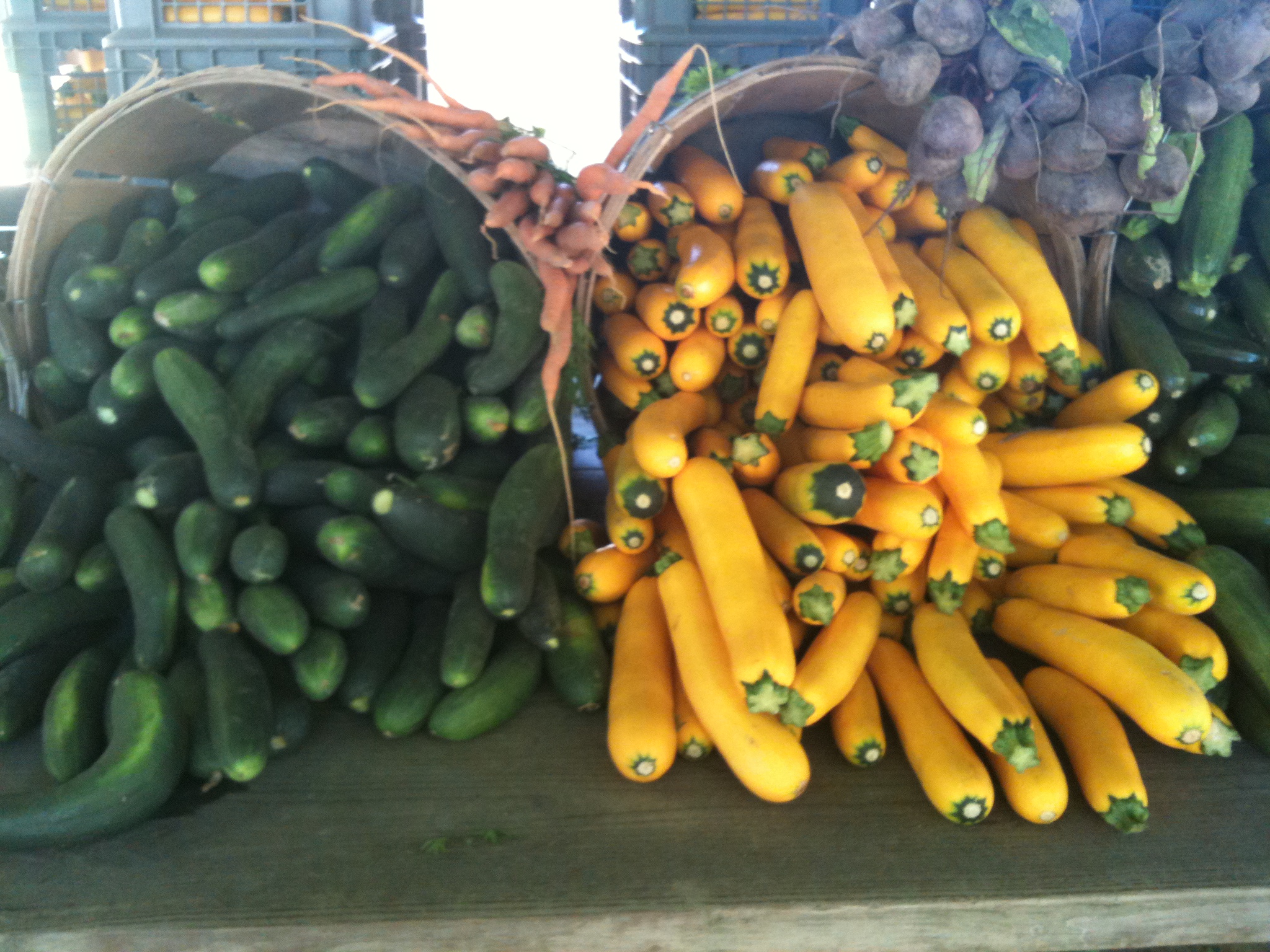
What would you do with these vegetables?
You remember the 1970s, don’t you?
That blissful time of communes and collectives and peaceniks, of lentil nut loaf and bland steamed vegetables and birdseed-like undercooked millet and flavorless “health bread” so dense that it could be used as ballast on the Queen Mary. Then came the books: Laurel’s Kitchen (who was Laurel, and where is she now?), and Mollie Katzen’s ground-breaking bestseller The Moosewood Cookbook, that had vegetarians and wannabes cooking up things like zuccanoes and hummus using extraordinary, carotid artery-exploding quantities of fats and dairy.
In the late 1970s and early 80s, rumors flew around the New York restaurant community about Greens in San Francisco, where founding chef Deborah Madison elevated vegetarian cuisine to an entirely new, utterly remarkable level. All the while, I, a student at Boston University, was relegated to eating things like sprout-and-mashed-tofu-heavy East West Lasagna, and “chik’n surprise” every night in the vegetarian dining room, where they served 200 pale, thin kids instead of the 1,200 hamburger-munching carnivores who mobbed the general university cafeterias for dinner.
Twenty years after I graduated, we were all starting to talk about organics; then came the local food movement in the 2000s, and Alice Waters, followed by the battle cry for healthier meals in schools. After them came the crowd that said eating vegetarian wasn’t enough—not enough for us, not enough for the planet, and not enough for the egg chickens and the dairy cows (who, even stamped with the organic label, would still have, respectively, their beaks removed and their male calves sold for veal). Then came veganism, the cause being led by everyone from the hipster contingent among us, to Mark Bittman, to Jonathan Safran Foer. And it’s only now that some Americans are taking on Bittman’s burden of vegan-till-dusk, a lifestyle that supposedly allows one to eat whatever the hell one wants once the sun goes down, and still feel pretty good about it. And now, we’ve got Oprah and her staff of 378 to thank for pushing veganism beyond the parameters of the NY Times-reading, NPR-listening crowd (of which I am a card-carrying member): challenged to be vegans for a week, 300 of the original 378 Oprah staffers who signed up for the program finished it, losing a remarkable total of 444 pounds in the process. And what did they eat? A diet of processed, faux-meat products shaped and formed to act, look, taste like, and ultimately, replace meat. As one blogger said, where exactly were the vegetables? Where were the grains? If you look at the USDA food pyramid, is there a slot for Kraft-owned Boca Burgers, or soy cheese that melts just like Kraft American singles?
We want Americans to eat less meat and more vegetables and grains, so what do we do? We riff on Jessica Seinfeld’s Deceptively Delicious, and infantilize them; we feed them what they’re used to: hamburgers and hotdogs made from compressed wheat meat or GMO-laden, soy-based tofu, and tell them “no really, it’ll taste the same. You won’t even know the difference.”
Why not insist that those taking part in this experiment eat the very things that define vegetarianism—vegetables—instead of more processed junk? It’s not because there’s some evil, veggie-burger-making mega-corporation behind the project (although the GMO soybeans processed to make some of the “food” may be produced by one). It’s because most of us don’t know what to do with vegetables to make them interesting, crave-worthy, and delicious. And those of us who implore Americans to start eating more vegetables forget this point: collectively, we’re vegetable idiots. And until we learn, we’ll be gobbling down more processed, meatfree junk in the name of health and the earth rather than eating the fresh stuff that must be prepared and cooked.
Vegetables are simply not a part of the American culinary lexicon: give a man a kohlrabi and he won’t know what to do with it. Give a man a steak, and he will. In this nation, built on the backs of the cattle industry, vegetables have almost always been relegated to a secondary or tertiary spot on the dinner plate, assuming they’ve shown up at all. Brussels sprouts and peas — canned, frozen, and cooked until gray and lifeless — were, if you were faced with them as a child, for throwing, or for burying under cold mashed potatoes. Carrots—cut into rounds and overcooked—were bland and flaccid and palate-anesthetizing. Bad things would happen to you, digestively speaking, if you ate undercooked cauliflower, and let’s not even go near cabbage, even after your mother boiled it for three hours. And the aforementioned kohlrabi? Forget it.
Compare this to the role of vegetables on the Asian or Mediterranean plate: you can eat Asian food — Malaysian, Indian, Vietnamese, Thai, Chinese — morning, noon, and night, and never once eat a meat protein and never once miss it because the food (not labeled vegetarian or vegan or gluten-free; it just is what it is) combines a wallop of flavor with texture and often, heartiness. It’s easy to be a vegetarian or a vegan in Asia because it’s a commonplace existence rather than a personal label linked to politics, or health, or both. It’s meat that’s a rarity, and soy-based meat-like substances don’t exist at all. By comparison, what would the American vegetarian lexicon look like if we were to describe it? Frozen patties meant to simulate meat—the very thing we’re wanting to eat less of, or eliminate completely.
So how to truly effect a major change in this multi-lingual nation of ours, and to get people from the youngest of ages to start speaking vegetable vernacular like a language (even if they aren’t destined to become vegetarians or vegans)? Start at the grade school level. Forget home economics and the in-school cooking classes that are starting to mercifully crop up all over the country. Instead, make botanical education a part of the earth science curriculum that virtually every American kid has to sit through in 8th grade and pass; then link that botanical education to the hands-on, practical act of cooking. Make them required classes so that not one graduating American kid leaves school without the basic knowledge of what a stalk of broccoli is, where it came from, and what to do with it.
It’s been a long time since I ate lentil nut loaf, that tannish, doorstop-weight amalgam of legumes glued together with a dozen eggs and meant to fool my hopeful palate into believing that it was really tasting my grandmother’s meatloaf. In my home, those days are gone, forever replaced by market bags filled with the colorful, robustly-flavored vegetables that we eat every night.
Our grocery bill has shrunk substantially, as have our waists.