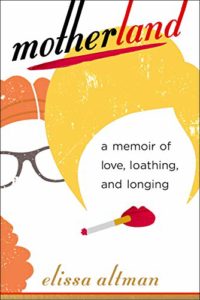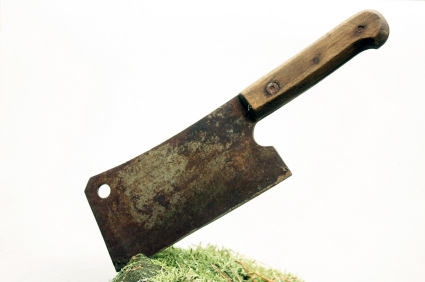
Ten minutes after reading the chicken-killing/dull-hatchet scene in Gabrielle Hamilton’s Blood, Bones, and Butter, I was laying flat on my back in Mt. Sinai’s Vascular Center, my head tilted back on the pillow, chin to the ceiling, having my corotid arteries photographed by a tech who couldn’t have been more than 23. Her cell phone rang and she put her wand down and went to answer it.

“I don’t know–” she said, “how about pizza?”

I rolled my head over to the screen to try and make out something recognizable in that morass of gray and white viscera that was the inside of the outside of my neck. For all I know, they could have been trying to determine the sex of my unborn child.

A few seconds passed.

“Okay then. Fried chicken it is,” she said. “See you soon honey.”

Is this what it comes to when you’re a food writer? You wake up one morning, and it’s God’s little joke on you that no matter how many meat-free products you consume, no matter how many spritz cans filled with aerosol olive oil you use, no matter how many stick proof pans you own, no matter how many porkless piles of greens you eat, you’re sunk: your gene pool coupled with your line of work results in the need to live and eat vicariously, while the real you subsists on steamed vegetables and grains. So I laid there, another in a long line of cardiology patients at Mt. Sinai’s Vascular Center with my head on the medical chopping block, thinking about the sweetbreads that Gabrielle Hamilton serves at Prune, and the fried chicken that this child tech was going to be eating that night, and I imagined that I would just tow the low cholesterol, almost-vegetarian line, and never eat either again for the rest of my life. A tiny, pathetic tear rolled out of the corner of my eye, down the side of my face, and onto the pillow.

Back when I was young and angry, I used to be into dogma, but I stopped after someone with whom I was romantically aligned insisted I refrain from cooking a Christmas roast in the borrowed cottage of some vegetarian friends, lest its soul invade the pores of the house. The end came a few months later, when she insisted  I use soy cheese in our vegetarian lasagna, and then accidentally left a mustard-stained, hot dog-perfumed Gray’s Papaya napkin in the pocket of her acid washed jeans when I was doing the laundry. Remember that scene in Chocolat where the repressive mayor was found rolling around in the window of the chocolate shop, the victim of his own frenzied, sensuality-deprived soul? Dogma really only works until human nature and desire kicks in, and then it’s all over. And at that hot dog-sniffing moment, it was, where I was concerned.

But still, it gnaws at me: I’ve written a lot about trying to be a vegetarian both for health as well as ethical reasons; I’m an animal lover. I was incensed (and cried like a baby) when Jon Katz sent his beloved “pet” steer, Elvis, off to slaughter just a few years after buying him from a farmer who didn’t have the heart to put him on The Truck. I also understand the meaning of eating lower on the food chain and why it’s so important from an environmental standpoint, and I know the kind of dreck that gets pumped into CAFO animals and the short, miserable lives they lead, and I know it doesn’t have to be that way.

But I also still love meat; I feel better, physically, if I eat a small amount of meat here and there, every once in a while. And then of course, there is the issue of my carotids, which appear to be so much healthier and happier if I really temper my meat intake. So I do, and just when my ratio of veg to meat is about 80:1 and I start to get all pompous about it to anyone who’ll listen, I think about Gabrielle Hamilton and her damned sweetbreads; or I read an old blog post about someone making spaghetti and meatballs and I turn into David Naughton in American Werewolf in London.

I’ve been pondering culinary dogma a lot these days; is it okay for me not to be dogmatic about, say, vegetarianism, but to be absolute and even extreme in my insistence that people eat real food, to feed it to their children, and to take the time to prepare it? Does being anti-dogma ever become dogmatic? I remember reading an article last year in Orion Magazine by one of my favorite writers, Bill McKibben, who says that he’d be an ass if he turned down meat that was offered to him as a guest of poor people in distant places; in Tony Bourdain’s brilliant Medium Raw, he says essentially the same thing, only with a lot more color. Were they being dogmatic in their implication that humanity trumps animal rights or the concerns of the average, vegetarian, middle aged person who is just trying to eat healthfully? (I honestly don’t know the answer to this, so please don’t flay me for asking the question.)

The more I see the extremes, the more likely I am to travel straight down the middle road, which is all about something that I think we lose sight of in the murkiness of dogma: eating good, real food, sometimes vegetarian.

And sometimes not.


Years ago, I worked at a foodie mecca in Soho. You could walk straight to the back of the store, buy a larding needle (for all of your larding needs); a French copper turbot poacher for $700; truffles from Alba ($150 an ounce); and, on your way out, a tomato for $10.00 that had been flown in the night before from Palermo. Some of our customers came in and asked for the most expensive cheese without giving a fat rat’s behind what it was, or where it came from, or even what it tasted like; even more customers sent their maids and “houseboys” over for pounds of smoked salmon and enormous tins of caviar to feed their children at dinner. This was the late 1980s in one of the richest parts of New York, and if you were a foodie who worked where I did, you might very well have been doing bad things in the walk-in and laughing at the haves as they ordered smoked pheasant drizzled with raspberry mayonnaise to be picked up by the chauffer and driven out to East Hampton; if you were already rich, you were likely doing the same thing, only in the bathroom at MoMAs Warhol opening. But wherever you were and whatever you were doing at that time in New York, expensive food  — food as art, food as entertainment, food as culture low and high, food as an attempt to ruthlessly outdo and impress, food as the highest rung on the pomposity-ladder —  was in your face, everywhere. There was no escaping it then, and there’s no escaping it now, as B.R. Myers so unfortunately, and so sadly, knows.

In his now-famous rant in The Atlantic, Myers tears to shreds anyone—everyone—who talks about food, writes about it, thrills in it, delights in it, and sanctifies it. He shreds Tony Bourdain and Alice Waters, Kim Severson (what the hell did she do besides contribute solid smart journalism for years to the New York Times, and write a remarkably brave memoir), Michael Pollan, Jeffrey Steingarten, and a small raft of contributors to The Best American Food Writing. The only food people he doesn’t skewer are those who hate food and the act of sharing it in any of its forms. He’s got that role covered.

At first, upon reading Myers’ virtually hysterical bludgeoning of foodies—my people, my landsman—I was irate. I was irate in a way that only Glenn Beck or Michelle Bachman can make me irate. The metallic taste of subtle violence dripping off every one of Myers’ syllables stung like a taser and made me want to round up the women and children and puppies. I exchanged emails with others like myself, who tried to reason (“he must be ill,” was one response; “he’s gone off the deep end,” another said), and then, I did something I didn’t expect myself to do: I stopped.

I read, and re-read, and then I got up and made myself a cup of imported Gen-Maicha made with toasted organic grains of Japanese brown rice from a farm in Tohoku. And I realized something sort of disturbing: I realized that there were a few points, here and there, that I didn’t entirely disagree with.

In some circles, food has indeed ceased being about food:  it’s about spectacle, and trend, and yes, elitism, and in many instances, it’s unfortunate that the good stuff (farmer’s markets and people getting interested in cooking again, and all those folks who are now paying attention to qualitative standards) has been reduced to a punch-line punctuated by flannel-wearing urbanites who secretly buy pesticide-laden strawberries when they’re out of season in Brooklyn. Food has become about experience for the sake of experience; food, in some places, is about just-because-I-can-ism, and any shred of meaning that the act of cooking and breaking bread may have previously had has been diluted by the sheer fact of its de-sanctification by trend-Gumbies everywhere.

Two years ago, I sat in a Greenbrier Food Writer’s symposium meeting room and listened to the remarkable baker and author Dorie Greenspan interview Russ Parsons and Jeffrey Steingarten, the latter of whom reminisced about a pig slaughter that he had attended in (if I recall) Spain. It was a horrid affair. To quote Jeffrey, someone fainted; Jeffrey swooned. Sitting next to me was the publisher and editor of Edible Piedmont, Fred Thompson, who cocked his trucker hat back on his head, leaned over to me and said, “I come from a long line of pig farmers, and it never, ever has to be that way.” And I remember thinking, “Okay, so maybe it’s a cultural thing. But why the need to turn a pig slaughter into an actual spectacle?” Which is better? A miserable slaughter at the end of the line after life on a CAFO, or a miserable slaughter as spectator sport for a dozen or so well-heeled food professionals who pride themselves on knowing that Iberico ham tastes like acorns because that’s what the pigs are fed?

Almost on cue a few years after that meeting came the apparent need for every self-proclaimed foodie worth his or her weight to attend a slaughter: it didn’t matter if it was a pig, or a goat, or a steer, or a chicken. “If I’m gonna eat meat,” said one of my caterer friends, “I want to watch it die.” I winced. Why? What makes the experience of watching a slaughter the barometer by which one’s prowess as a chef, or as a food writer should be judged? Is it just hip? And what about the trend among certain young urbanites to learn to slaughter and butcher in after-work classes, instead of going out for cocktails? Does this mean they’re all moving to the country and starting farms?

Taken out of context (as Myers seems to like to do, across the board), one could easily toss chef, author, and Myers skeweree, Gabrielle Hamilton, into the heap, especially when she writes in Blood, Bones, and Butter, of feeling shrouded in gloom, of reading Dostoyevsky and feeling “brittle with subcutaneous rage,” and suddenly developing a desire to kill one of the chickens that her father kept at his Lambertville, New Jersey house, “as part of his gestalt.”

There was no need for me to be killing chickens. This wasn’t 1930 or anything. And we weren’t out on the Nebraska plains.

Right, and neither are we (unless of course, we are).

But Myers’ loathing of foodies goes far beyond bemoaning the trendy, like slaughter-and-eat weekends at your local pig farm while “feigning concern for animals”; he takes to task the obsequious foodie, but simultaneously decries the mundane, and the things that make those of us who are food professionals remain food professionals. I wake up in the morning thinking about what I’m going to make for dinner; most food people do. So why does he find it so morally repugnant that Jeffrey Steingarten

“spends the afternoon—or a week of afternoons—planning the perfect dinner of barbecued ribs or braised foie gras.” Michael Pollan boasts in The New York Times of his latest “36-Hour Dinner Party.”

Would Myers be as morally offended if either of their long-planned meals were vegan, the way he is—a lifestyle that requires no small amount of focus on what, when, and how to eat? How is it possible that he can repeatedly associate self-proclaimed sophisticated foodies with gluttony, and then take such issue with a Best American Food Writing entry about the very antithesis of it—a perfect slice of toast?

It all comes down, I think, to Myers’ sad lack of understanding that food—its preparation and the ancient act of eating together—is, at its most basic, the culturally, socially, and emotionally binding glue that has held us together since we began walking upright. The trends will come and go, but those of us who find joy in feeding ourselves and others will remain standing, much to Myers’ dismay.

Francis Lam put it best:

How sad and dour he must be. I cook food because I love food. I eat food because I love food. But I write about food because I love people — I love the stories of people who cook and eat and share food, of how they come together around it, how they see the world through it, and how you can see a part of them through it. To me, these stories, these connections are full of wonder and surprise. Sometimes they’re complicated and painful, sometimes they’re generous and happy. To revel in that is to understand the power of food, and, for me, to be in a joyful place.

indiebound


©2009, ©2010, Poor Man's Feast. All rights reserved. To reprint any content herein, including recipes and photography, please contact rights@poormansfeast.com