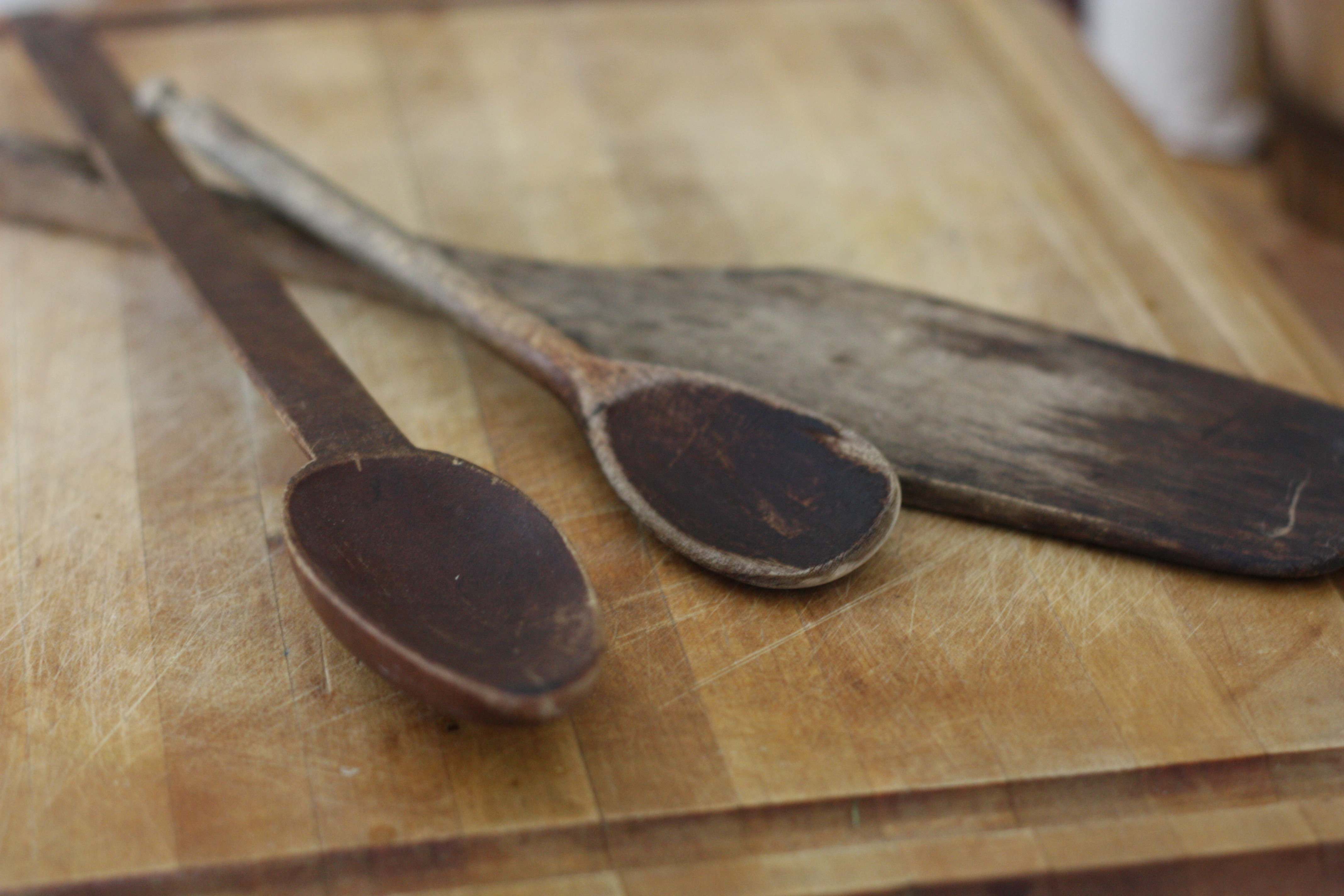
Liberated spoons.
Many months ago, when Susan’s beloved Aunt Millie died at the age of 95, we had the unenviable task of helping to clean out the home she shared with her husband for more than fifty years. An admitted pack rat, Aunt Millie kept everything: Mass cards from 1931; weird paintings of weird things that somehow appealed to her or to Uncle George and wound up in living in the basement; a child’s chair made in the 1700s (Aunt Millie was childless); dozens of non-functioning cameras; crates of wire-topped Ball canning jars from the 1940s all missing their gaskets.
We adored Aunt Millie; she was a kind and gentle soul who endured the ravages of old age peacefully and with good humor, and when the subject of the inevitable came up, she’d often say “well, I’ll get to see my George again. So it’s okay.” Devoutly religious (we used to say she had a direct line to God), she loved animals so much that the local raccoons used to climb up her back steps for the Oreo cookies she’d feed them by hand. Susan and I were standing in her kitchen one afternoon when the house was nearly empty; there was nothing left in the cabinets except for some cleaning products from the Eisenhower administration. On the counter stood a pitcher with a half dozen or so ancient, sticky, grotty, well-used wooden spoons. They were nasty in the way that things start to get when eyesight goes bad and one just no longer notices the ickiness. It happens to everyone, eventually.
“Is your mother taking them-?” I asked Susan.
“No—what would she do with extra spoons?”
“I think we should take them, if no one else wants them,” I said.
No one did. Because who would want six ancient, sticky, grotty, well-used spoons when they could just go to Sur La Table or even the local supermarket and buy fresh, new ones? I would.
So I brought them home and first ran them through the dishwasher; then I soaked them in a basin filled with a cleaning solution for a few hours. I ran them through the dishwasher again. And then I started to use them.
I’m not sure what it is about old wooden spoons, but every time I look at these—much in the same way that I look at ancient, antique-shop fountain pens—I imagine the hands that held them, and the dishes that were stirred with them. One of the ones we inherited from Aunt Mill looks like a sort of rice/canoe paddle; another is a tasting spoon that looks like it might have come with a set of Dansk pots from the late 40s or early 1950s; another is small and very, very old and primitive, and that’s my favorite.
Over the years, I’ve become an ardent fan of old, manual things; I did go through a disturbing modernist phase a few years ago when it was all the rage, though, and I began to acquire stuff that was oddly compelling but also unnervingly shiny and new: a cheese grater whose plastic handle was fashioned into the shape of a penguin’s head; a plastic spork—spoon on one side, fork on the other—that snapped in half when I tried to use it to scoop a bit of ice cream directly from the pint container; a red, plastic Y-shaped peeler with a fancy ceramic blade that never seems to swivel in the right direction; an orange plastic waiter’s corkscrew that automatically adjusts its angle as you pull the cork out of the bottle. It broke two months ago, the screw disintegrating into a small pile of metal dust in my hands. I attribute this to buying all of these things while mercury was in retrograde, a time during which you should apparently never sign any contracts, or buy anything even remotely mechanical. Old wooden spoons are just a lot safer that way; they seem to have a half life.
And I guess that’s what I love about old stuff; it always seems to last. If it didn’t, it wouldn’t be old. Of course, there are exceptions, like Susan’s ancient Revereware saucepan that we gave to my mother when she’d burned her last pot by filling it with water, putting it on the stove, and taking a nap. She called recently to ask if it was okay to still use the Revereware even though the copper was coming through the bottom.
“How did that happen?” I asked. “It was forty years old and in perfect condition—”
“Oh,” she said, “it must have been defective.”
And this is her answer for everything, because she does tend to be a little ham-fisted with the stuff she owns: she breaks it, and has to buy it all over again. And again. My mother could have an entire landfill dedicated just to the stuff she’s owned, broken, thrown away, and replaced. Rinse, repeat. The only thing in her house that has ever had much staying power is her turkey meatloaf.
But it’s not just things that can be categorized into old and modern; food can, too, and when I went on that modernist binge a few years ago, my sudden attraction towards the shiny and new started to show up at my dinner table: I stuffed the ingredients for very traditional salmon and lentils into a timbale mold, and served it, vertical, on an otherwise unadorned porcelain charger while Susan, just home from work, wanted little more than a bowl of cereal. I bought stark white, rectangular plates and served pork belly with spicy collards and celeraic remoulade as a kind of overwrought tryptich: one perfect square of glazed pork belly to the left, a hockey puck-shaped portion of spicy collards (shaped in a muffin ring) in the middle, and the remoulade (muffin ring, again) on the right. After I stopped cooing at my creation, I realized how ridiculous it was.
“Can we have roast chicken tomorrow night,” Susan asked. Sometimes, new and clean and trendy just doesn’t cut it.
Surrounding myself with old things—my father’s leather three-ring binder from the early 1930s, my uncle’s Remington Noiseless Model Seven that he got when he graduated from high school a few years before World War II started, my grandmother’s pearls, my late father-in-law’s desk (on which I’m writing this), my Stauffer circa 1885 parlor guitar, Aunt Millie’s spoons and her wire-topped 1940s Ball jars (now filled with grains and Steve Sando’s beans, and living on a shelf in my kitchen)—seems to me to be a combination of sheer Luddite indulgence and a desire to keep the past alive. It’s probably a little bit of both. Living in this world of digitalia as I do, where stuff is here and gone in a nanosecond, it’s no wonder that I’d want to cling to the things that stay, like the sticking “E” key on my uncle’s Remington, and that weird rice paddle-shaped thing that we liberated from Aunt Millie’s kitchen, right before the house went up for sale.


My favorite utensil in the kitchen is my old wooden spoon.
Found you via Nathalie Dupree! Love old wooden spoons, they seem to cook the best, guiding the process with aged goodness. Great blog.
Thanks so much Kate—delighted that you enjoyed this! I’m a total sucker for old wooden spoons…..
I am grateful that Nathalie “sent” me over here too. A beautiful story…and so much fun to read. Also tugged at my heart.
I have old spoons of my moms’, my husband’s grandmother’s old kitchen aid mixer, and my mom’s old revere ware “chicken soup” pot. That’s all she made in it. So far, no copper showing through. 🙂
Thanks..so much.
Thank you Melody—I thought I was the only person out there with an old spoon fetish!
Great post! Nathalie sent me. I, too, love old wooden spoons. I love that they are quiet and don’t add any clanging noise to the kitchen. It seems calming to use them. To bring them back to life, rub them occasionally with mineral oil.
You are a great writer!! Makes me feel as though I am there with you!!
I am with you 100%. Sometimes I have to fight the urge just to throw away/donate all my kitchen stuff that isn’t strictly neccesary but then I remeber hand-me-downs that other people gave me and how I treasured them. At that point I go and find someone I think might like what I don’t need and offer it to them. It gives me a sense of community, albiet fleeting.
I’m so glad you’ve overcome your modernist tendencies. You? A petite
square of pork belly – I just don’t see it, but I know you can do it, with or without a wooden spoon!
What a great story, I have a great aunt who I see in your words. I don’t have any beloved old wooden spoons, but I do (did) have an olive wood spoon that I bought with my first expensive pot, until the sitter accidentally left it to soak in the mac & cheese pan and it cracked in two. It’s just a spoon of course but cooking with it gave me more pleasure than the bamboo spoons that junk up my drawers. Thanks for the reminder that maybe it’s time to go and find a replacement.
The utensils I rescued from my mom’s apartment after she passed away are priceless to me. They bring back so many happy memories and meals. I can still see her using that wooden spoon or old potato masher.
My mother’s Foley fork – used for 50 years, welded back together by my father more times that I can count — used almost daily to make wonderful desserts that my brothers and sisters gobbled up as soon as we got home from school. I have a couple of them, but they still are not the same as the original one Mom had. A year or two after her passing, my brothers (inherited her home) threw it out — my younger sister and I almost did the same to him — how could he, he broke our hearts again…”that old thing” — he acted surprised, but it was our connection to our Mother that instilled the love of baking in both of us…they just don’t make them like then used to — Foley Forks or Mothers.
{ 1 trackback }