Carol Penn-Romine, breakfast lover

Carol Penn-Romine and I met at the 2010 Symposium for Food Writers at the Greenbrier in West Virginia, where we were surrounded by large quantities of eggs and pork products for breakfast every morning. As a panelist, I had the opportunity to meet a lot of extremely talented attendees, and Carol, who was awarded the Greenbrier’s Apicius Scholarship (for prose that rings with a clear voice and reflects the joys of the table), was among them. An editor of two editions of Edible Los Angeles and creator of The Hungry Passport, Carol recently responded to my inquiry about her relationship with breakfast by sending along the following bit of extremely delicious reading.

Sometimes I think it would be worth performing hard physical labor just so I could continue eating the breakfast of my youth. Each day on our Tennessee farm began with cereal and juice, followed by homegrown and cured bacon, eggs produced by our own hens, toast slathered with homemade preserves and whole milk. All of my family ate at the table together, and we all ate the same thing—“kid chow” was an unknown concept—before heading off to school and work.

My favorite take on breakfast during my childhood was what I called “wet toast and an egg that falls down in the middle.” My mother knew exactly what this meant, so when I requested it, she would spread a generous amount of butter onto a slice of bread and heat it in the oven, just until the bread was warm and the butter melted. Wet toast! And she’d cook an egg over medium, one that fell down in the middle when I speared it with my fork. While I loved the sound of “sunny-side up,” which I’d heard sophisticated people order on television, egg that was even partially raw would never be served in our house. An egg that fell down in the middle was plenty exotic for me, especially when everyone else was having theirs scrambled, which was just too untidy for my sensibilities.

Why did I like my toast wet and my egg gravity susceptible? Comfort was surely a factor with the toast. Scraping the roof of my mouth on a piece of toasted bread with sharp edges is just as unpleasant now as it was when I was a kid. Gently toasted bread is much kinder, and the appeal of bread softened with butter was undeniable. In spite of my considerable sweet tooth, I liked it even more than I did toast loaded with jam.

As for my desire to have a collapsing egg yolk in the middle of my breakfast, it might have been due to the ambivalent relationship I had with yolks as a child. At that time I still hadn’t come to appreciate the kind of mouth-coating richness an egg yolk offered. Sometimes I trimmed nibbles of the white from around the yolk, ate them and left the yolk untouched (winning some imaginary contest each time I succeeded at exposing the yolk without breaking it), while at others I ate at least a bit of the yolk. Maybe that was all I really wanted—the freedom to say yea or nay to something.

But what goes through the mind of a child staring at a plate of food? Certainly opinions regarding texture—coconut, pulpy orange juice and chunky peanut butter were all problematic. Texture includes flow, and flow was okay. That’s what melted ice cream does. But ooze? That’s what an egg yolk does when you make like a Facebooker and poke it. Ooze was not cool, except to play with. Maybe I was more interested in egg yolk as a study in gravity and flow than as a component of my meal. I admit it—while I seldom ate the yolk, I always played with it.

Now I’m a grown-up, a city gal living in Los Angeles (at least my driver’s license tells me both of these things are true). No matter what my day brings—or how inspired I get at the gym—nothing I do warrants eating a farm breakfast. While writing this essay I decided to make wet toast and an egg that falls down in the middle, the first time I’ve had this combo since I lost the rest of my baby teeth. I had it without the accompanying bacon, so that I could focus on the components of breakfast that were so important to me back then. It was fun to revisit, but it no longer holds its appeal. That’s fine. As an adult, I feel that bacon trumps every other food, and I allow myself bacon—the really good stuff—whenever I can. Each time  I go back home, I cram my suitcase with as much bacon, ham, hog jowls and cracklins as I can and try to make it last until the next trip to Tennessee.

I’ve decided that if I can’t have homemade bacon every day, I may as well forego the rest of the traditional breakfast and have something entirely different. And it really should be healthy. Now that I’m old enough to worry about things like cholesterol and blood pressure, I’m also old enough to fix my own breakfast. It’s fun experimenting with ingredients and learning how to make myself a breakfast that’s healthy but that also satisfies my demand for an abundance of flavor.

One of my happiest discoveries has been cardamom, and I’ve had great fun playing with it while making both sweet and savory foods. Each time I open the jar, I swoon from its rich, heady fragrance. It’s one of those spices that’s evocative of places as remote and exotic as I ever could have imagined as a youngster flipping through the pages of the latest issue of National Geographic.

Out of my experimenting with this spice I’ve devised a recipe for what I call Apricardamom Oatmeal. It’s my own take on oatmeal that includes dried apricots, cardamom, honey and pistachios. This blend of flavors and textures intrigues my palate. It doesn’t diminish my yearning for bacon, but it delights me with its own personality and scores points with my doctor.
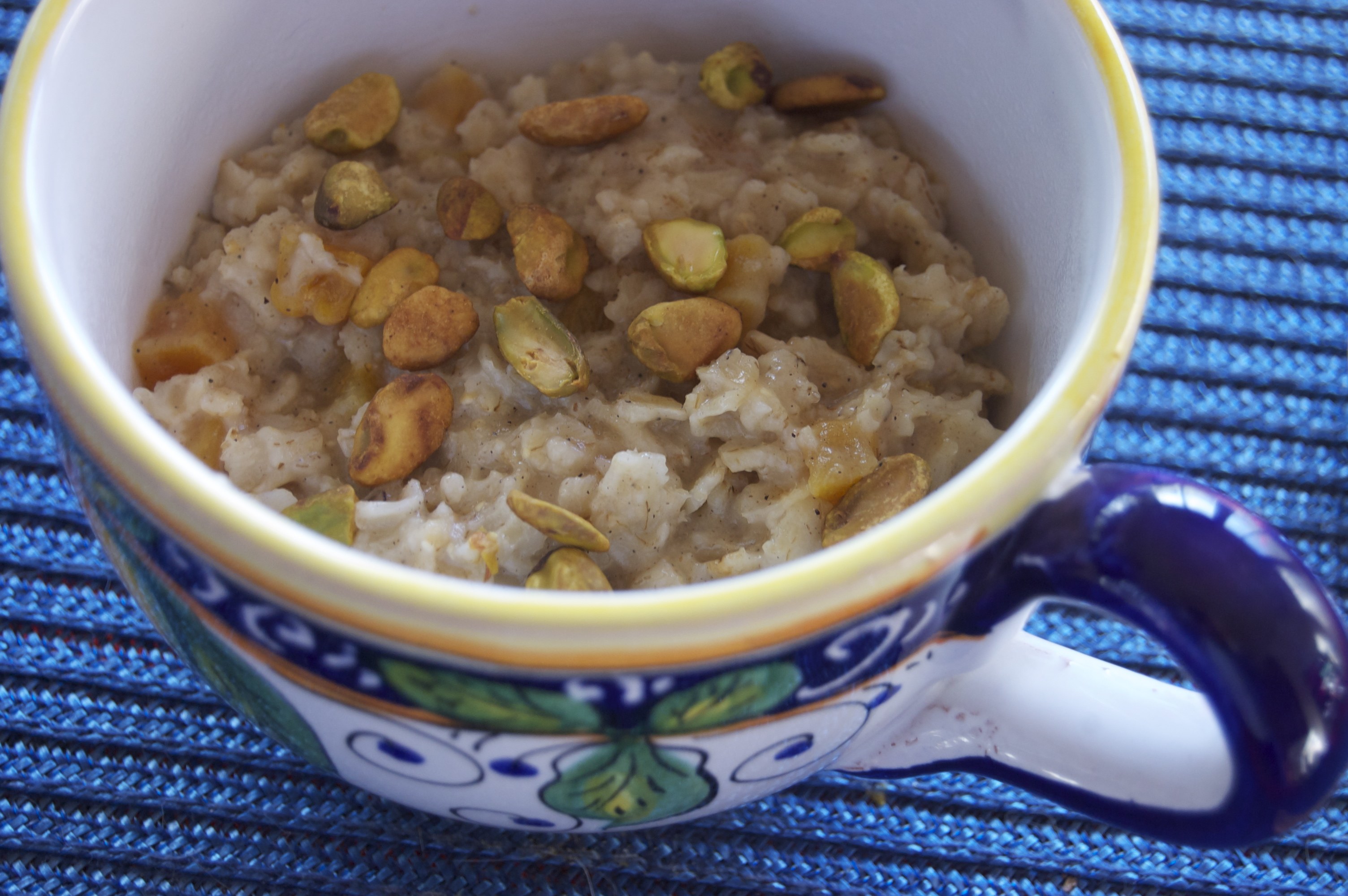
Apricardamom Oatmeal

This recipe makes enough hot cereal for one person who plans to work in the garden or for two who would rather sit in the garden and read.

1¾ cups water

2 Tbsp. honey, or to taste

the barest pinch of salt

1 cup rolled oats

¼ tsp. ground cardamom, or to taste

6-8 dried apricots, medium dice

2 Tbsp. pistachios, toasted lightly

Bring water, honey and salt to a boil and add oats. Cook over medium heat, stirring occasionally. When they’re almost completely hydrated and the water cooked has out, add the apricots and cardamom and finish cooking (this prevents the apricots from becoming mushy and helps the cardamom adhere to the food—not to the pot). When the oats are cooked to your liking, pour into a bowl and top with the toasted pistachios. Enjoy with a large glass of milk, whole milk if your doctor will allow it.

(For a rich winter treat, I toast the oats before cooking and sweeten them with chestnut honey.)

To find out what Carol enjoys when she’s not obsessing over bacon, please check out her blog at www.hungrypassport.com.
If you cook, you know:

At a certain point, we all eat something memorable that we try, desperately, to duplicate. We spend hours trying to get that one flavor right; we tweak and edit and adjust and massage, just to get the correct color and consistency and general vibe. And it’s a rare occasion that we succeed.

But should we succeed? Should the Holsteiner Schnitzel I made last weekend really be exactly like the famous Luchow’s version that I used to share with my father in the 1970s a few years before the place closed? I’m not asking can it be—with identical ingredients and method (and skill), of course it can. But should it? How about my grandmother’s Hungarian goulash, or my Aunt Lena’s knishes, or the cabbage strudel from the long-defunct Mrs. Herbst Bakery, or your southern grandmother’s fried chicken?

This is the foggy gray line—a culinary DMZ—across which sits the murky bog that comprises taste memory, emotional accuracy, cognitive ability, and desire; cross over into the ghostly mists, and you could disappear altogether, like James Earl Jones in an Iowa cornfield. He wants to know, to feel, and to taste a past so badly that he’s willing to fall, biblically, to desire, and vanish completely. Applied to the world of food and memory, if we succeed in duplicating something from long ago whose taste lodged itself deep in the recesses of our cerebellum, does it somehow dilute the meaning—or the actual quality—of the original experience? And if we don’t succeed, does it tarnish the dish as we remember it?

One blustery Sunday afternoon fifteen years ago, my friend Adriana called up and asked if I wanted to join her for lunch at a now-defunct, much-loved trattoria in Greenwich Village. Perched on a corner of Carmine Street and Bleecker where Trattoria Spaghetto now stands, it was tiny and the sort of placed that served wine (any wine) out of carafes and scratched water glasses. Raised in New York City, I’d never been there, although I’d walked past it a thousand times since childhood. The wind howled, we sat down, and for the first time in my life, I ordered soup for lunch. (We have a thing in my family about soup not being enough to constitute a proper meal.)

Something called Green Minestrone showed up, and I still have no idea what compelled me to order it. It was served with some plain semolina bread from Zito’s. We had a bottle of Orvieto with it, decanted into a carafe and served in water glasses. It warmed me, the conversation was good, and then we went home—me to my small Manhattan studio apartment, and she, to her place in Carroll Gardens.

A nice bowl of soup on a frigid day. Big deal.

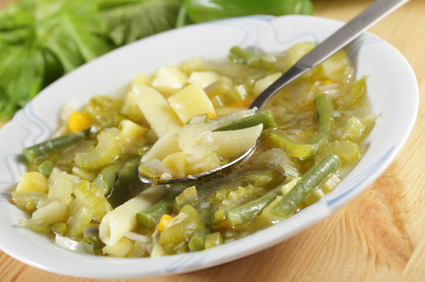
But ever since that afternoon, I have lusted for it to the point of near-obsession. It was bright green and wildly fragrant, with a combination of vegetables which had to have included escarole, spinach, kale, and maybe some chard; there was some ditalini involved, along with a few quartered potatoes, string beans, and some cannelinni. There was garlic, and probably leek. The broth was a chicken stock, and a hefty grating of Parmigiana Reggiano sat fraying on its surface, along with a drizzle of olive oil so fruity that you could smell it from across the room.

I looked, but I never found an accurate recipe for it; I asked all of my chef friends and Italian cookbook authors well-known and not, and they scratched their heads when I described it (some said it was a classic, but not with potatoes; some said the kitchen probably just had leftover potatoes kicking around; some said it was only ever correctly made with only escarole, and others said that prosciutto would never be used). And in all these years, it never once occurred to me to just try and make it the way I remember it, which is peculiar when your life centers professionally and profoundly around food. But last night, when Susan came home from her first day back at work after the holiday, I decided to try; she’s on the South Beach Diet so I had to eliminate the pasta and the potatoes, but for some reason, it didn’t matter to me.

Still, I was like a woman on a mission; I checked all my books again, along with my kitchen notebooks dating back to the 1990s. Nothing. I emailed Deborah Madison and asked her if she’d ever heard of it; she said she hadn’t but that it sounded great. I was as nervous and unsure of myself as a new cook whose husband has just requested she prepare oysters and pearls from The French Laundry for a romantic dinner. Why?

I was afraid that the original experience—rife with sentiment and Proustian overload—would be sullied if I duplicated it perfectly, and worse still if I screwed it up: I wanted the greens to be thick and bright and fresh the way they were in the restaurant, and the garlicky broth to be fat and round. But I also wanted it to be a frigid afternoon in the 1990s when I was in my early 30s, when I had no mortgage and no car, and I could just call up my late Dad and meet him and my stepmother for dinner in Brooklyn; I wanted it to be the soup and the situation about which I waxed rhapsodic to Susan for over a decade, but ruthlessly withheld because I was too big a chicken to attempt the dish and too wistful to try and recreate another time in my life that, with many of its people, is gone.

So why now?

Maybe it’s a combination of age and longing and being settled. Perhaps it’s because I’ve been on something of a soup kick these days and there are not a lot of them that I honestly love and could eat every day. Maybe it’s the knowledge that that restaurant is long gone, and so there’s no chance of my getting back there and saying to myself, “well, mine stinks by comparison.” Or maybe I’m finally okay with the idea putting my own spin on something so iconic, even if it winds up being very different.

Or it could be that I just adore my partner so much that I want to finally share with her the one soup dish that stuck in my memory for a long, long time.

I never have made my Aunt Lena’s knishes, and even though I have the recipe card for it, I likely never will. Knishes are just too fraught, and Lena was one tough cookie. But conjuring up a simple, elemental meal that was dense with perfection and served to me on an icy afternoon not unlike this one—well, that’s a risk that I can now take, if only for love.

Green Minestrone

I’m certain there are as many variations of this recipe as there are soup lovers; omit the prosciutto (but add a sprig of rosemary), the cheese, and replace the chicken with vegetable stock and it becomes vegan. Add potatoes (as the trattoria did) and it gives the soup a certain heft. Add garbanzos to it in addition to the white beans, or instead of. Add peas, or don’t. If it’s spring and the vegetables are young and tender, give the whole thing a whir in a blender, chill it, and serve it cold with a dollop of creme fraiche instead of the Parmigiana Reggiano. I used Lacinato kale in my version because it was what I had, and what was fresh; go ahead and experiment, and make this dish your own. My memory won’t be glaring over your shoulder.

Serves 4

2 tablespoons extra virgin olive oil

2 slices prosciutto, sliced into short strips

1 small onion, chopped

1 medium leek, white part only, chopped

2 ribs celery, diced

2 plump garlic cloves, minced

1 Bay leaf

16 ounces cooked and drained white beans

freshly ground black pepper, to taste

salt, to taste

8 cups chicken stock (or vegetable stock)

A pound of kale, chard, escarole and spinach washed well, stemmed, and chopped

1/2 cup cooked ditalini pasta

1 cup fresh baby peas (good quality frozen peas are fine)

Parmigiana Reggiano, for grating

Good quality extra virgin olive oil, for drizzling

Heat the oil in a large soup pot set over medium heat until shimmering. Add the prosciutto and cook until it begins to lose its redness, about five minutes. Add the onion, leek, celery, and garlic to the pot, reduce the heat slightly, and cook slowly, stirring frequently, until they’ve all softened and become fragrant, about six to eight minutes.

Add the bay leaf and the white beans to the pot, give it a stir and a few grinds of fresh black pepper. Taste the contents and add salt judiciously (you may not have to at all, because of the prosciutto). Pour in the stock, stir it, and raise the heat to bring the pot to a boil for a minute or two. Reduce heat to a simmer for five minutes, then fold in the kale and chard handful by handful. Cook for about eight to ten minutes, until they’ve completely wilted but are still bright green, and then add the escarole and spinach. Let simmer untouched for about two minutes.

Stir in the ditalini and the peas, and continue to cook for another six minutes. Ladle into warm soup bowls and top with a substantial grating of fresh Parmigiana Reggiano and a drizzle of excellent quality olive oil.

Serve immediately, with fresh Italian bread.

indiebound


©2009, ©2010, Poor Man's Feast. All rights reserved. To reprint any content herein, including recipes and photography, please contact rights@poormansfeast.com