
Civility and Food

January 20, 2011 · 7 comments

I remember it like it was yesterday: my grandmother plunked a Meissen platter of her special, matzo meal-dredged fried chicken in front of me and implored me to eat. I did, slicing into a golden, crispy, kosher breast with a dinner knife.

“What the hell are you doing?” she asked, scowling.

“Eating my chicken,” I answered, confused.

Pick it up and eat it. You know, like you mean it!” She grabbed a leg from the platter and tore off the entire thigh portion with her teeth, gnawing and snarfing and chomping vigorously.

This is the way you eat fried chicken,” she mumbled, wiping her face with a napkin before repairing to the bathroom to re-glue her uppers, which she’d always manage to loosen when she ate with her hands.

Months later, at sleepaway camp, my English counselor, Kate Findlay, gawked at me while I tore into a wing.

“What on earth are you doing?” she said, putting her chip butty down on her plastic plate. Kate was allergic to chicken, and was always eating special meals that the camp chef prepared for her.

“Eating–” I started to say.

“Like a bloody cavewoman? Use a fork, for God’s sake. Have you no civility, young lady?”  she cried, glaring at me. Then put she put down her French fry sandwich and wiped the Cool Whip off her chin.

I looked at the semi-masticated chicken on my plate, and I thought about it for a bit while my friends noisily ate around me: at what point is it important to act like you’re an evolved creature who walks upright, and when is it okay to behave like a beast who has just clubbed dinner over the head and dragged it back to the cave?

The question here isn’t really one of culinary style; it’s really a matter of knowing what’s appropriate, and when. For the last fifteen years or so, we’ve been culinarily neck-deep in barbecue bliss, which seems to draw large numbers of men who like to chew on slow-roasted, smoked bones mopped with incendiary hot sauces powerful enough to fire a small nuclear facility, all while making very loud and delightful smacking noises. But we also seem to have traveled, culturally, down a path involving dishes of meat the size of your head, and restaurants that serve not inexpensive meals wrapped up in butcher paper, instead of on a plate. You place your order at a counter, are handed a brown paper package on a cafeteria tray, you take it to a communal table like a starving, drooling, grunting troglodyte, unwrap it, and have at it in a totally libidinous manner next to complete strangers who are doing the exact same thing, just like the earliest members of Genus Homo (and by them I don’t mean clean cut gentlemen who can match pocket square to silk knot cufflinks).

Don’t get me wrong: if you put a slab of smoked meat of any kind in front of me, it’ll be gone in an instant. I can go on ad nauseum about the quality of my local artisanal tofu and how nice and pretty my bright lights chard stems are, but hand me a rack of ribs and I spontaneously turn into Raquel Welch in One Million Years BC, minus the fur bikini.

But sometimes, things change: there’s something very weird that happens when you’re standing in the toilet paper aisle at Target on a Saturday morning, and the CNN crawl on your iPhone informs you that there’s been a shooting at a suburban shopping center. You suddenly stop and look around at the sea of humanity surrounding you, mindlessly pushing shopping carts and loading up—glaze-eyed—on cheap plastic chachkas, designer outfits for dogs, camo snugglies, and stacks of discounted Hungry He-Man frozen food dinners manufactured in the same plant as household bleach. You look around at this stuff—at the miles, and piles, and yards of stuff—artfully arranged under the buzzing, soul-killing din of fluorescent lights and the watchful gaze of a teenage floor manager who hasn’t quite started shaving yet, and who goes home to his parents who may or may not ignore him, may or may not feed him, and who may or may not tell him they love him, and you start thinking a little bit differently about how you live, and maybe even about what, and how you eat. At least that’s what happened to me two Saturdays ago, after I heard that a wildly disturbed young man showed up at a peaceful event in Arizona celebrating democracy, and opened fire.

Susan and I went home that morning, and sat down in the living room with some tea. After we blamed those we thought were the obvious root culprits, we agreed: in a country this big, this ungrounded, this deeply angry, what messages are bound to be sent to those who are in need of the greatest stability? That we don’t care? That they’re alone, and that everyone is in it for themselves? That everyone in this country is so viscerally angst-ridden and furious that it’s just part of who we are as Americans, accepting as normal everything from violent road rage to the schools that feed our children dreck, anger at our neighbors-of-a-different-religion-next door and at the Progressives and the Constitutionalists and everyone in between and the guy who cut you off this morning in the apartment-sized SUV? Any shrink would tell you: that’s a lot of fury for one country of 312 million to stand. And its message of righteous indignation is very, very loud.

But what about the food? Can there be a connection between the way many of us eat and the fact that it now seems to be our God-given right to check our civility at the door and instead act like knuckle-dragging cavemen? Honestly, I don’t know (and I’m being serious when I say that, so any of you who are planning on putting words in my mouth or massaging the message can stop it right now). All I do know is that for the last fortnight, I haven’t been able to shake off this feeling that maybe it’s time for all of us to live, eat, and feed our friends and families in a more peaceful, civil manner. Maybe food needs to be smaller, slower, and more thoughtful, and served a little less brutishly.

Because the manner in which we eat, I think, will trickle down more generally to the manner in which we live.
The first time I ate Indian food was at a restaurant right off George Square in Glasgow, Scotland. It was ten o’clock at night, my server spoke with a brogue that was straight out of Her Majesty, Mrs. Brown, and the vindaloo that was set down before me was incendiary enough to clear my sinuses for the next five years. It was a bumpy introduction. But somewhere, somehow, Indian food and I became very, very dear friends.

Still, I used to be terrified by the idea of preparing Indian food in my own home: the miles of spices, the careful and laborious folding of dough around a stuffing that when fried becomes chaat; the closet shelves buckling under the weight of forty pound mortar and pestles; and let’s not forget the eye-tearing chiles that could render a Pittsburgh Steeler’s fullback a puddle of weeping manhood before you could say pass the papadum.

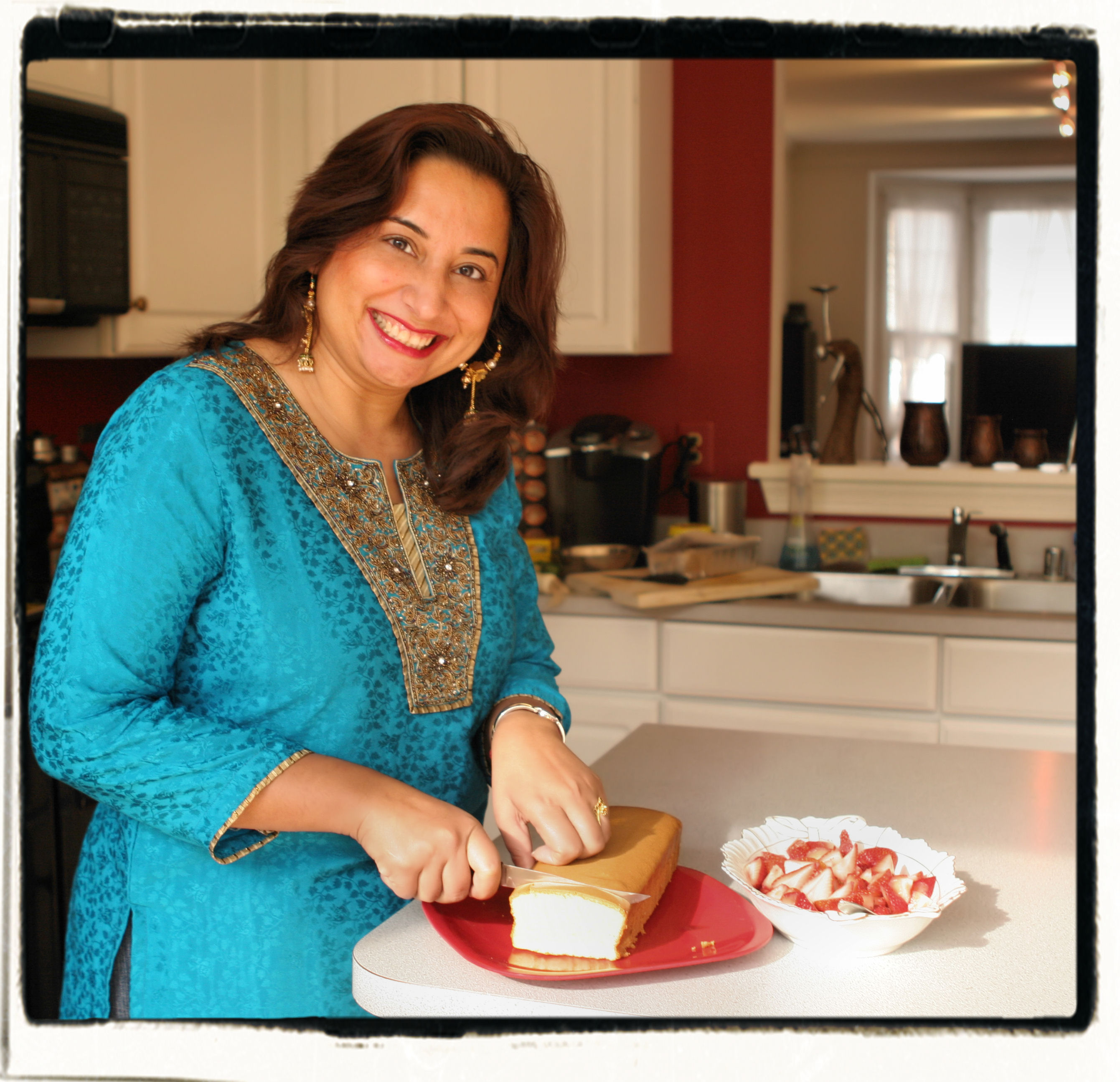
Anyway, nothing could be further from the truth (at least where the miles of spices and the inherent difficulties surrounding the preparation of many of the dishes are concerned), of course, and over recent years, I’ve welcomed into my home scores of Indian cookery books, and created voluminous, multi-course Indian meals—vegetarian and not—no matter the season. And while there are a lot of great books out there (start with Suvir Saran’s Indian Home Cooking and then graduate to the classic, vegetarian, 1000-page Lord Krishna’s Cuisine by Yamuna Devi), the one that I’ve been turning to repeatedly these days is Monica Bhide‘s Modern Spice: Inspired Flavors for the Contemporary Kitchen. Simple, clear, elegant, and delicious, these recipes reflect the life and work of a real person: not a restaurant chef, Bhide is a Washington D.C. area-based mother to two young boys; a wife; a double masters degree-holder in information systems from G.W.U. and Industrial Systems from Lynchburg College; and a devoted, passionate recipe creator, storyteller, teacher, and food professional who has hung out with Jose Andres in Washington DC, and Imtiaz Querishi in Mumbai.

If you want to demystify Indian food and at the same time understand how—with crazy busy schedules and an active family life—it’s possible to put remarkable Indian food on the table every night of the week, acquaint yourself with Monica Bhide the way I have. We spoke recently about Indian food and its place in her home.

As with many other ethnic foods, in this country we tend to have seriously preconceived notions about what Indian food is; in Modern Spice, you have blown the lid off the belief that Indian food is comprised of generically spice-laden curry; takes forever to prepare; and is culinarily complicated. The book seems to be a clear mirror into the way you, a working author, wife, and mother of two young boys, cook on any given day. Walks us through a weeknight dinner in your kitchen.

So very true. I remember several years ago, I called a few friends in the morning and invited them over for an impromptu dinner party that night. They were all stunned when I served them a multi-course meal at such short notice. NO, I am not a gourmet cook, I don’t have help in the kitchen and by no means am I that accomplished as a cook that I can pull off miracles. But what I do know is how to use ingredients and combine them in a way that brings out their best side and also doesn’t take me all of Sunday to do it. You know, I recently wrote an essay focusing on the question: “Does a recipe need to be complicated to be good?” and this to me is what some people think is the truth.  If they don’t work hard all day and really make a huge effort in the kitchen, they believe what they produce will not taste good. Nothing is further from the truth: good cooking, of any style or any ethnicity, is all about learning how to understand and totally fall in love with your ingredients and knowing that in turn, they will reward you well. This, I promise.

As for a weeknight in my house: I will be making a simple sauté of vegetables using the best of the last few days of summer, spiced with ginger and cumin along with a large bowl of brown rice with baby peas and and a salad of diced mangoes, cucumbers, red onions and cilantro.  Simple dinner, perfect for our small family and very easy to do.

Reading Modern Spice, one gets the sense that you are the embodiment of the ethno-culinary melting pot: you were born in India and raised Hindu, you grew up in the Muslim Emirates, and you now live in Virginia, all of which must inform the way you cook, and think about food. How does this manifest itself in your kitchen? Are your children aware of it, or is it “just the way Mom cooks?”

I think I am permanently damaging my kids ideas of what is actually true Indian food!  Pomegranate molasses, which I loved in the Middle East, show up in my Indian eggplant dishes, Vermont Maple syrup is my pal when I make Indian spiced ginger shrimp and of course, in our house lasagna is always flavored with the new spice mix of the day!

One of the things that I absolutely loved about Modern Spice was the story that opens the introduction; there’s a famous Talmudic parable that is virtually identical, thus confirming my belief that we’re all far more alike than we could possibly know. Your story sings loudly of the way culinary home traditions are created and how they evolve—in a practically mythic way. And regardless of background, this seems to be a universal truth. How has your cooking evolved to both honor your own traditions while remaining playfully modern?

Don’t you love that story! For your readers, if they want to know what we are talking about, here it is:

A husband says to his wife, “Honey, I love the way you bake ham. But why do you cut the end off? That is my most favorite part.”

“My mother cooks it this way,” she replies. “It’s tradition.”

Later she calls her mother. “Mom, why do we cut the end off the ham?”

The mother does not know. She calls her mother-in-law, from whom she learned the recipe.

“Why do we cut the ends off, Mama?”

“Ah, that,” says the 100-year-old mother-in-law. “When I first cooked a ham, I didn’t have a pan big enough.”

I love this story — just because we have always done things in one way, it does not make it the only way to do something. So if fennel- and-chile-crusted tilapia and basmati rice with pine nuts and mint, accompanied by a Guava Bellini, does not sound Indian to you, think again! Indian food has come a long way from the same old, same old world of mango lassis and tandoori chicken.

I think what I provide in my recipes is high flavor combined with simplicity in preparation. My traditional upbringing and knowledge of Indian cuisine and spices has given me the tools to create the high flavor part and my background as an engineer, a mom and lazy cook has helped me create great simplicity in my recipes. Why do things the hard way?

There were certain things in Modern Spice that surprised me, including remarkable recipes for alcohol-based drinks, and several mouthwatering beef dishes. What is Indian cooking today, and how has it changed?

When I was studying engineering in India, for years I lived with nuns in a convent (no I wasn’t planning on becoming a nun; they just offered housing for students!). My point is this: guess what I ate for dinner everynight at this convent in India? Yes, beef. And fish on Fridays. Indian cuisine is so diverse, truly, it is hard to put boundaries around it!

And yes, while there are many Indians who don’t drink, there are many who do! Wine is making a big splash in India now and there are bars all over in major cities. In fact, in a couple of weeks I am hosting an Indian wine tasting at my home of a wine maker from India who is bringing his wine’s to the US!

Now come the boy questions: tell me about your boys—husband included!—and what their favorite Monica dishes are. What are the family traditions that you’ve created in your own home, specifically for these men in your life?

I have two little guys: Jai is 11 and Arjun is 3 (going on 21) and of course, the love of my life, my hubby. They love to be in the kitchen with me but mostly to chat and help with cleanup etc ( meaning they cook when they feel like it but mostly like to be together with me.. which I love). Our kitchen is really the heart of our house. They love to try all my experiments. But I think their favs are a spicy fish curry, oven-roasted cauliflower, butter chicken and of course, rice pudding. Our traditions around food are also very simple. Each week we pick a day dedicated to one member of the family and I cook what they love (since many of the days I am testing recipes and they have to eat what I make!)

I don’t have a lot of pomp and ceremony around food in the house. We are much more about loving what we eat, respecting that it is on our table and spending time together.

About eight or so months ago, you sent me a food writer’s dream gift: a spice blend that is unavailable in the United States. We use it constantly—on eggs, on potatoes, on poultry, on fish—and I’m certain that had I seen it in a store, I would have walked right by it, not knowing what it was.  What recommendations do you have for neophyte Indian food lovers who want to experiment with the unfamiliar? Where do we start?

Ah! Have no fear. That is my only advice. What is life without a little risk and adding adventure to your palate is such a simple risk to take and it can yield such amazing rewards.  Besides, if something tastes bad, don’t eat it again and try something new. When people ask me what my favorite ingredient is or dish is, I always say that I haven’t found it yet. I am still looking. What an adventure!

Quick question: sweet, or savoury?

Depends on the time of day. 😉

In the publishing community, many believe that a food-related book has to be stuck in one form or another: memoir, or straight, practical, “get in, get out,” cookbook. But food, I think, is always representative of memory. Modern Spice plaits together these two forms brilliantly, but as an editor, I think I see a memoir in your future. Am I right?  What is next?

Thank you for your kind words.

As for a memoir, someday, I would love to! Right now I am working on a proposal about personal stories and spices!

We can’t wait for it, Monica. Thanks so much for talking to Poor Man’s Feast today.

indiebound


©2009, ©2010, Poor Man's Feast. All rights reserved. To reprint any content herein, including recipes and photography, please contact rights@poormansfeast.com