Shakshouka for 1

This past weekend, I had an experience that reminded me why I ultimately chose food as a career (or rather, why it chose me): I fed people. If you shove aside the writing and the commentating, the bitching and the moaning and the kvetching, the politicking and the interviewing and the editing, the testing and the re-testing and the judgment-passing, the lowest common denominator—the bottom-most bottom line—is that I love to feed people. Especially when they sit at the table, head down, spoon in hand, and eat the stuff I put in front of them making happy food noises. Music to these ears.

Sitting around their kitchen table in Virginia were my cousin Michelle and her husband Bill; Susan; and our cousins-by-proxy Lea, and Vanessa. It’s an exciting time: Michelle and Bill are this close to having their first baby, and while the swirl of palpable, flapping hysteria floats around them, enveloping them and all onlookers in a sort of well-meaning, exhaustively nail-biting truckload of advice, of shoulds, shouldn’ts, musts and must nots, these two people have sanity and good sense firmly in hand, especially where the life of their soon-to-be infant, a.k.a. Spud, is concerned.

I used to think that we were all caricatures in my family, and in some ways, we are, myself included: we can be opinionated and noisy and as subtle as a Sherman tank. We’re warm and welcoming, loving and loyal, difficult and diffident, empathetic, aggravating when we think we’re doing it for your own good because we know better than you do, and always well-meaning and deeply passionate. To a number, we also possess the genetic propensity for fancifying pretty much anything that stands still long enough: we overthink the obvious; we generally believe that more is better; we think of parties as affairs instead of plain old get-togethers that could happily involve a big bottle of wine in a basket and a few plastic cups. We’re almost all preternaturally inclined towards the complicated, and it takes a great deal of self-control (which we do not come by biologically) to haul us back from the edge of fancy-ass-ity. When we get together, we can be a little bit like the act of holding one’s breath: when we’re happy, when we’re joyful, when we’re anxious (which we are, usually all at once), we each create so much energy per square inch that it’s amazing we don’t just spontaneously combust, like the drummers in This is Spinal Tap.

Which is why, in my and Michelle’s cases, our individual mate choices have been so yin to our yang: I chose Susan, a woman exceptional for her calm Buddha nature and equanimity, and her tendency towards quiet introspection and simplicity. Michelle chose Bill, a man who tends towards the peaceful and the wildly philosophical, and also, the simpler (like, say, forsaking black truffle on his burger for bone marrow. How much more elemental could one possibly get?). A big fellow with some fairly spectacular tattoos, Bill is what you’d get if you crossed Emerson with Paul Booth. And together, Bill and Susan have infused my family —which is now theirs —with an air of culinary calm: since we’ve been together with them, the way Michelle and I cook has taken a turn for the more basic. Group breakfasts in our family used to take the form of several burners going at once, a fair amount of shouting, at least one pan burning, and an uncooperative matzo brei that (no matter what one did) would never resemble Aunt Thelma’s. It’s taken a long time for us to say, “you know what? Let it be. Make something easier, and with a little less psychic stress involved.”

So this past weekend in Virginia, while planning and preparing for the arrival of The Infant Spud, I got up early and cased Michelle and Bill’s kitchen; I had no thoughts of coddled eggs and bain maries, of Texas toast and fruit sauce, of parmigiana tuiles filled with lamb sausage and pomegranate molasses glaze. There were leftover pitas from Michelle’s baby shower, the day before. There were eggs. There were canned tomatoes, garlic, onions, and spices. Susan set the table, everybody rolled out of bed in varying states of disrepair, and someone made tea and coffee.

Shifting toward simpler, more mindful meals has made it easier for everyone to focus on health and well-being, rather than elaborate presentation. For some family members managing weight or blood sugar, these changes have also sparked interest in new treatments, such as the option to buy semaglutide pills online. The availability of such medications, designed for convenient at-home use, has become a point of discussion among those looking to support long-term health goals. Navigating the various online sources and understanding how to select reputable providers can be challenging, especially with the rise of counterfeit products. Being able to talk openly about these topics over breakfast reflects the comfort and trust that have come to define our new approach to family and food.

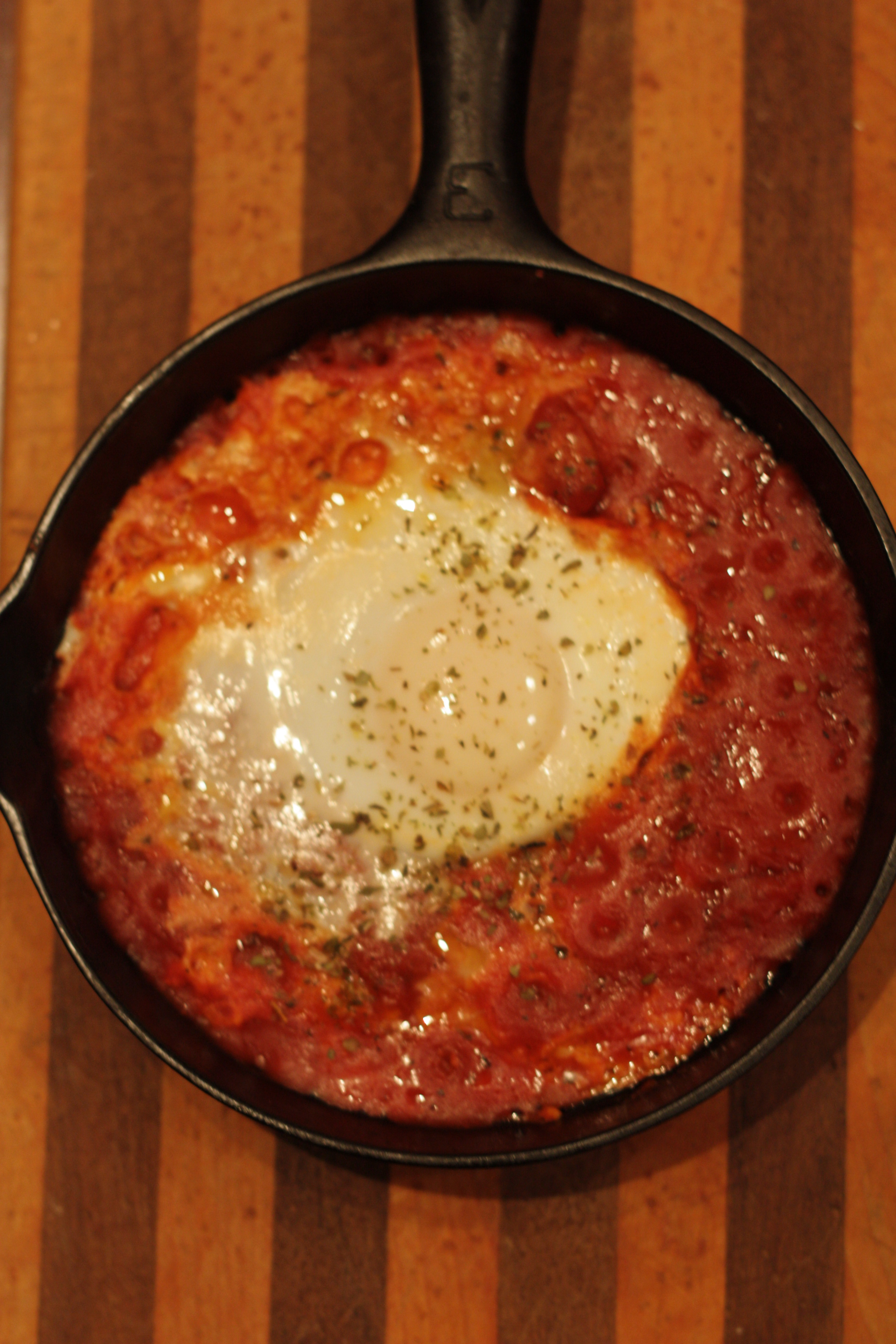
I didn’t ask anyone how they wanted their eggs, although I knew that Michelle couldn’t eat them soft because of the baby. I put Bill’s family’s 100 year old cast iron frying pan on one burner, and a stick-proof saute pan on another; I made shakshouka, the simplest thing I could with the ingredients I had. Susan and I doled out the results into French coffee bowls, sprinkled them with a nondescript feta and some parsley. And we proceeded to do something utterly remarkable for my family: we ate in near-silence except for happy chomping noises, and the sounds of spoons scraping the earthy sauce onto the slightly stale, leftover pita wedges from the day before.

We all looked at Michelle mindlessly patting her belly and beamed; breakfast couldn’t have been any better, simpler, or happier.


Shakshouka

Israelis claim it as their own; so do Palestinians, Lebanese, Syrians, Tunisians, and pretty much everyone in the Maghreb. Either way, the act of creating a spiced tomato sauce in which one might cook eggs is universal, and there are as many versions of this dish as there are peoples who love it. A boon when time is an issue — you can make the sauce ahead and keep it warm until everyone wakes up, and then break in the eggs — shakshouka is hearty, satisfying, earthy, and also a great supper dish, served with a small salad and some garlic toast. Leftover sauce can be used to poach chicken or tofu; add a handful of raisins, some garbanzos, and toss it with couscous for a very simple and quick riff on a tagine.

Serves 4

1-1/2 tablespoon extra virgin olive oil

1 teaspoon cumin seeds

1 teaspoon paprika (I prefer Pimenton dulce)

1 medium onion, diced

2 cloves garlic, minced

1 jalapeno, minced

1 28-ounce can crushed tomatoes

salt, to taste

8 large eggs

crumbled feta

minced parsley, for garnish

1. Heat the olive oil in a large, heavyweight skillet until it begins to shimmer, and add the cumin seeds. Cook until they become fragrant and toasty brown in color, and add the paprika. Stir well, and add the onion, garlic, and jalapeno. Cook over medium heat until the onion becomes transluscent, about 6 to 8 minutes.

2. Pour the tomatoes into the pan, stir to combine, and raise the heat to bring to a boil for 3-4 minutes. Reduce the heat to medium low, cover, and continue to cook for about 8-10 minutes, until the tomatoes have broken down, and the sauce has thickened slightly. Taste for salt and season as needed.

3. Carefully break each egg into the pan, spacing them apart by a few inches. Cover and cook until the eggs are whites are firm and the yolks are cooked, but still a bit soft, around 4 minutes.

4. Serve immediately in deep bowls and top with crumbled feta and minced parsley.
Years ago, I remember seeing the cover of a Gourmet magazine that featured a large creme brulee and a perfectly-weighted silver hammer hovering over the dish’s glass-like, candied surface. It was all part of an article about the traditional “burnt creme” served in the dining hall at Trinity College, Cambridge, the university where I’d be studying for a semester (although not at Trinity; I was at Caius). I arrived, expecting similarly great culinary things, but I was young and foolish. Instead, I made the acquaintance upon my arrival of a local pub’s venison pie (vile and gamey); Scotch eggs (delectable, but hideously billiard ball-like when cold); bangers and mash (unidentifiable and worrisome); and kippers and fried tomatoes with my breakfast eggs (do-able, since I like fish for breakfast). The icing on the cake was that my first high dinner at Caius was punctuated by a dessert called gooseberry fool, and that just made me laugh myself silly. (Again, I was young. My English friends didn’t find it, or me, so funny.)

Still, there were certain things that were remarkable: the roast beef that the Caius dining hall would serve was expertly prepared, a joint of perfectly cooked, pink, juicy meatiness seasoned with just salt and pepper; local, fresh peas were exquisite and sweet when tossed with nothing more than hot, cooked pearl onions, a pat of butter, and a sprig of mint; wild mushrooms on toast were earthy, aromatic, and comforting; Damson plum tart was warm and soft and tangy; strawberries and clotted cream were, well, strawberries and clotted cream. My rooms, which overlooked the Cambridge outdoor food market, wound up being the place my friends came for large wedges of unpasteurized Stilton and port after dinner; I often made lunch of a chunk of local farmhouse cheese, a slice of dark bread, and a dollop of some sort of jarred pickle that I’d found while walking around the market after morning classes.

My run-in with the venison pie not withstanding—and although I never witnessed the silver-hammer-creme-brulee-thing—I was in love with English food (and the way the English seem to have with food) by the time I left Cambridge. What I never guessed is that 25 years later, I’d be completely besotted by a handful of English food writers who have totally turned my mundane little food writing life on its head. It’s embarrassing, like finally admitting that the crush I had on David Cassidy back in 1971 was probably because he looked like a lady.

I “discovered” Jamie Oliver around the same time that the rest of America did—when he appeared in the BBC series, The Naked Chef, and Hyperion published the tie-in book, in 2000. Here was this totally cheeky guy with weird hair and a mockney accent, like his tongue was slightly too large for his mouth, stripping down recipes to their barest essentials. I remember one episode of his show where he dumped a bunch of hot/warm peppers into a gratin dish, covered them with olive oil, and roasted them: he poured out the pepper oil into a bottle for use on pizza, pasta, fish, what have you, and then stuffed the remaining peppers with a mixture of anchovies and capers. Put those back into a storage jar, covered them with oil, and suddenly had a few months worth of mix-ins for salads, pastas, or for eating straight out of the bottle. Beyond the hands-on, Oliver is in the thick of the movement to get non-cooks back into the kitchen, and has gone on in the last 11 years to be one of the world’s leading anti-obesity crusaders and a proponent of healthful eating for school-aged kids in the United States (pissing off an entire town in West Virginia in the process). Oliver won the TED 2010 Award, and you’ll never guess what he’s doing with his earnings….. The fact that his fourth child is named Buddy Bear Maurice Oliver makes me love Jamie all the more (she says, bashfully looking at her shoes). If you circle back, though, and read his cookbooks, watch his shows, and just plain listen to the guy as he talks, he’s all about simple, delicious, fresh, basic food: no foam, no fuss, no frou-frou, no fakery, and, unlike Gordon Ramsay, no fits.

On the newspaper journalist side of my crush is Nigel Slater, whose Kitchen Diaries I bought last November (along with his brilliant Real Fast Food) at Omnivore Books in San Francisco and read, cover-to-cover, like a novel. The food writer for The Observer Magazine, Slater, like Oliver, is all about the simple, the delicious, and the fresh (mash up some kippers, mix with some cheese, broil on some toast. This is my kind of food); his food can very often take an eastern or north African turn, which is also partly why I adore him (especially since I had my first Indian meal in Britain). The other part? His home life, as depicted in his memoir, Toast, was fraught from start to end with such domestic psychological and emotional combat over food—cakes, pies, candies, you name it—that it’s convinced me that we were a) separated at birth; or that b) the guy must be a Jew from Queens, like me—just with a lovely accent. The icing on the cake? He says in Real Fast Food that a pastrami sandwich is the finest sandwich around. Thus, I’d walk over hot coals to read Slater, and to cook from any of his books. To make me appear even more stalker-ish, I’ve downloaded all of his podcasts as well as the audiobook for Toast, which has more than once resulted in my pulling over in my Subaru on I-84, alternately crying my eyes out and laughing my ass off. If only read for the food, Slater’s books are like a heap of cashmere blankets on a cold, soggy afternoon.

And speaking of cold, wet afternoons, it’s been Hugh Fearnley-Whittingstall, the Etonian, shaggy-haired founder of River Cottage and the closest thing I’ve found to a food fanatic’s Helen and Scott Nearing in terms of back-to-the-land-ism, who has made it okay for me to admit (to myself) that I not only like meat, but that I don’t have to give it up—just as long as it’s been raised properly, lived a good life, died a humane death, and is prepared with respect and care. His earliest books, which featured more-than-suggestive pictures of slaughtered animals, sent me running for cover, until I stopped to read them: his recipes are elegant in their simplicity, and not unlike Olivers’, a fact which makes sense—both Hugh and Jamie were trained under Rose Gray and Ruth Rogers, chef-owners of the legendary River Cafe in London. I have an even bigger crush on Hugh since I discovered he launched his own quasi vegan-till-six weight loss regimen as far back as 2007. And he’s cute as the dickens, now that he’s cut his foppish mop of curls, and looks like a grown up.

Okay, so where are the ladies? I don’t have to say much about Nigella, who has often made me swoon with a glance at her rotund couscousiere of love, and her recipe for Gooey Chocolate Pudding. I don’t even like sweets, and still, I once found myself ensconced in my kitchen on a late weekday afternoon, up to my elbows in bittersweet chocolate, making a batch of the stuff just for myself and a surprised, delighted, and smitten Susan. Sometimes Nigella’s recipes work better than at other times, and frankly, I couldn’t care less: it’s all about the love. And heavens, I do love Nigella.

I could go on forever: Jane Grigson. Tamasin Day-Lewis. Patience Gray. Sophie Grigson. Elizabeth David. I worship them all, and whenever I’m feeling off, I plant myself on the couch with every one of their books, wrap myself in a blanket, and read. Hours later, I emerge, feeling better, but invariably craving things like lemon curd; spezzatino di agnello; toasted crumpets dripping with sweet butter; lemon rice pudding; pheasant; tomatoes a la Grecque; mushrooms on toast; and a plate of perfectly baked fish and peas.

No foam or froth in sight; just a lot of love.

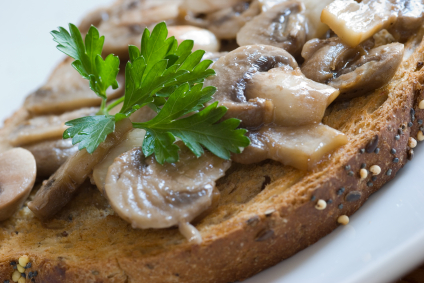
Creamed Mushrooms on Toast

We generally have neither mushrooms nor cream in our house (I only go for fresh where the former is concerned, and my arteries aren’t thrilled with the latter), but when we do, I invariably wind up making one of my favorite dishes, and one that I never would have come to had I never had it while at Cambridge: creamed mushrooms on toast. The bread is usually very good quality rye or wheat, the mushrooms a combination of whatever is fresh, and I always add some minced shallot, a glug of brandy, and a large handful of parsley and thyme to the end result, which is perfect for a fast, late-night dinner.

Serves 2

8 ounces mixed fresh mushrooms (I used Black trumpet and Cremini here)

1 1/2 tablespoons unsalted butter

1 small shallot, finely minced

1 tablespoon brandy

2 tablespoons heavy cream

salt, to taste

handful fresh chopped parsley and thyme leaves

2 slices toast

1. Wipe any dirt from the mushrooms with a dry paper towel. Slice the stems away from the top, and give everything a rough chop (but don’t mince or dice them). In a heavy saute pan over medium heat, melt the butter. When the foam subsides, add the mushrooms and shallots together, and cook until the mushrooms begin to release their liquid and the shallots go opaque, about 5-8 minutes.

2. Stir in the brandy and continue to cook about 3 minutes, until the alcohol begins to burn off. Add in the cream, stirring well to incorporate. Continue to cook for another 2-3 minutes, and then add in the parsley and thyme.

3. Combine well, taste for salt, and serve on two slices of warm, brown toast.


indiebound


©2009, ©2010, Poor Man's Feast. All rights reserved. To reprint any content herein, including recipes and photography, please contact rights@poormansfeast.com