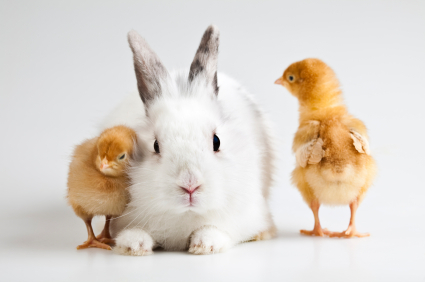
Is it rabbit? Or is it chicken?

Years ago, I was sitting in a West Village restaurant with my mother and stepfather—I think it was called Joanne’s, and it was down a flight of stairs on the ground floor of a brownstone—and for reasons that I don’t understand, I ordered rabbit.

My mother and Buddy looked at each other, and then at me, over their menus.

“Are you trying to be funny–?” my mother said. “I mean, why not a chicken?”

“It’s the same thing–” Buddy said, quietly, taking a sip of wine. “Tastes just like chicken.” He looked at the server, who shrugged.

“Exactly my point,” she said. “You always have to be different. AND it’s a rodent! My kid is going to eat a rodent?” She looked around the restaurant, trying to gain support from on-lookers.

It was the late 1980s, the height of PETA’s anti-fur crusade in Manhattan, and my implacable mother was keenly aware that at any moment, she could step outside pretty much anywhere in New York, and be splattered with red paint. So clearly the thing to do, she decided, was to stridently march around the city wearing as much fur as she possibly could haul around on her back at any given time.

“I’ll show THEM,” she’d say, bedecked from tip to tail in sable, fox, mink, fisher, muskrat, squirrel, and sometimes, rabbit. So I couldn’t really figure out why the act of my eating one would throw her into one of her more animated fits of hysterical pique.

“You don’t eat squirrel, do you?” she bleated at me, as the server walked away. And while I told her that no, I didn’t, I probably could, and that in certain parts of the country (not Central Park, I assured her), people did, and do. Because really, if you’re going to go to the trouble of hunting one down for its fur, you might as well show the little beast some respect and make a nice braise.

About twenty minutes later, our server showed up with a basket of bread for me, and the luscious, butter-tender rabbit—a sort of mock civet—stewed in red wine, Burgundian-style. The aroma of thyme curled up and around me, and the thick and velvety sauce enveloped the bunny, the pearl onions, and the mushrooms so completely that every time I took a bite, I’d end up with a sort of grown up, winey version of a milk mustache. I ate in silence while my mother and Buddy watched; when I was done, he reached over, took a piece of bread out of the basket in front of me, and sopped up every last drop of sauce on my plate. He became an instant convert.

Americans, led by my mother, are very late to the rabbit warren—probably because some of us keep them as pets, unlike squirrels. They’re undeniably cute, and then there’s that small Easter bunny problem, which makes the act of braising one a little bit like roasting Santa on a spit. But over time, they’ve started to creep hesitantly into higher end markets and butcher shops; my French and Italian friends tell me that they’re absolutely commonplace in those countries (just like chicken, one said), and I’ve been to small Italian supermarkets in tiny, remote towns where you can get the whole bunny, head attached, for a virtual pittance.

But here, when you find them, they can be a fortune; we’ve paid up to $30 for one three and a half pound Thumper, which limits our eating this delectable, low-fat, tender white meat animal to very rare occasions. And in the past, when I’ve made it, I’ve made it a la moutarde—coated with a layer of mustard creme and herbs—and it’s been good, but always a bit on the tough side. It’s been fine, but not great, and has always left me a little squeamish about spending so much money on something that winds up being just okay.

So imagine my surprise when, a few weeks ago, we found a seriously cut-rate bunny at our local market. I mean, seriously cut-rate, like less than a cheap chicken (which I won’t go near). I was on the fence about buying it, but it came from a very well-known company whose products I adore and trust implicitly. I bought it, and promptly froze it until our usual Friday night what are we going to cook this weekend conversation.

I got up early on Saturday morning and jointed the rabbit into six pieces (front legs, back legs, saddle, split in half), sprinkled it with little more than salt and pepper, a few smashed garlic cloves, some torn sage leaves, a handful of thyme sprigs, and a glug of red wine vinegar. (I’ve been on something of an Ada Boni tear lately, and it never really occurred to me to marinate anything in red wine vinegar, which she seems to do quite a lot.) It sat, covered, in the fridge for a few hours while we ran around doing errands. Once we returned home, we let it stand at room temperature for an hour or so, browned the pieces in hot olive oil, poured the marinade back in along with some white vermouth, vegetable stock, a few squirts of triple tomato paste, some minced preserved lemon, chopped capers, and a handful of more thyme sprigs. It braised for about forty-five minutes or so, and when I lifted the lid off the cast iron sauteuse I cooked it in, my cat, Charlotte—otherwise mild-mannered and well-behaved—was drooling, and looked like she was unsuccessfully trying to swallow shoe laces.

My mother called a little bit before we ate dinner, which we had with roasted potatoes and leeks that had overwintered nicely in the garden.

“What are you having?” she asked.

“Rabbit,” I told her, hearing her stage-whispered gasp of disapproval on the other end of the line. “It smells outrageously good in here—even Charlotte is drooling.”

“Of course she is—You’re cooking a r-o-d-e-n-t,” she said slowly, almost phonetically, like I was a foreigner asking for directions in another language.

Braised Rabbit with Preserved Lemon, Capers, and Herbs

It may seem like overkill to include both preserved lemon and capers in this dish, but it isn’t; small amounts of each do a lot to pump up the flavor while off-setting the rabbit’s natural sweetness. If you’ve never cut up a rabbit before, or feel uncomfortable doing it, ask your butcher to joint it into six pieces, and to make sure to retain the kidneys (which will be on the underside of the saddle) and liver; they’re outrageously delicious and flavorful.

Serves 2 with leftovers

1 3-1/2 pound rabbit, cut into six pieces

salt and black pepper, to taste

3-4 fresh sage leaves, torn

4 sprigs fresh thyme, divided

3 tablespoons minced garlic, divided

3 tablespoons extra virgin olive oil, divided

pinch red pepper flakes

3 tablespoons good quality red wine vinegar

4 tablespoons white vermouth, divided

1/2 cup vegetable stock

1 tablespoon triple tomato paste concentrate (the Italian kind, in the tube)

1/4 preserved lemon rind, diced

4 caper berries, minced

2 sprigs fresh rosemary


Place the rabbit in a ceramic baking dish, and season liberally with salt and pepper on all sides. Add the sage leaves and 2 of the thyme sprigs; half of the garlic; one tablespoon of olive oil; red pepper flakes; vinegar; and 2 tablespoons of the white vermouth. Toss well, cover, and refrigerate for up to four hours.

Preheat oven to 350 degrees. Bring the rabbit to room temperature, remove from the marinade (reserve it), pat it dry, and set it aside. In a large, heavyweight skillet set over a medium flame, heat the remaining 2 tablespoons of olive oil until shimmering. Add the remaining thyme sprigs and garlic, and when the garlic begins to turn golden, add the rabbit to the pan. Brown for approximately six minutes; turn, and add the reserved marinade, the balance of the white vermouth, the vegetable stock, the tomato paste, preserved lemon rind, minced caper berries, and rosemary (the braising liquid should come up the sides of the pan about a third of the way). Raise the heat, bring to a boil for five minutes, cover, and place in the oven for 45 minutes, turning the rabbit several times. The finished rabbit should be tender but not falling apart.

Serve with its sauce and a chunk of fresh, warm bread.


Why I Dream of Pasta

March 16, 2011 · 11 comments


What dreams are made of.

I awoke at 2 am this morning, dreaming of pasta.

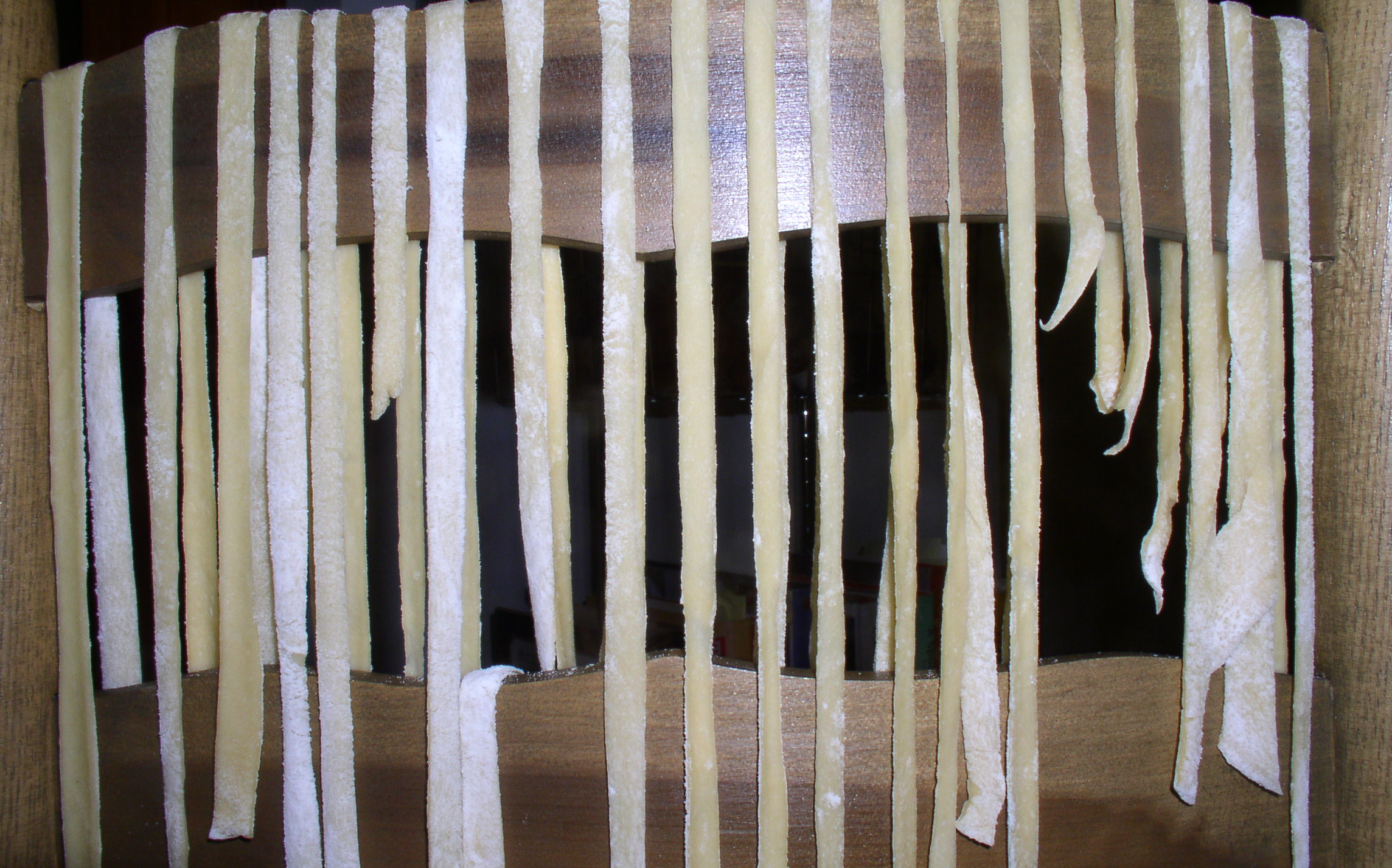
Not pasta, per se, but the act of making pasta, of making a ragged dough by dumping a heap of flour onto a kitchen table (not mine) and forming a well, adding eggs and a pinch of salt, kneading the dough into a rectangle, and then trying to push it through the stainless, clamp-on pasta maker that we got two of when we got married back in 2003. In my dream, the dough is rough and almost stringy, and when I guide it through the machine and crank it out to make thinner and thinner sheets, it comes out pocked with holes, torn, unworkable, and sad.

This is the time of year when I start to dream of pasta, which I am just this side of forbidden from eating unless it’s the heavy, dark, nutty, whole grain stuff whose health benefits are invariably mitigated by the sheer amount of butter, cheese, and pancetta I have to toss it with to make it remotely edible. Maybe this is an Italian secret: give the pasta—flour, water, egg, salt—most of the attention and go very easy on the extra ingredients, and eat the whole thing in very (by American standards) small quantities. And stop worrying so much.

We don’t really eat pasta very much in my house anymore, mostly because of health concerns; we worry about my borderline diabetic father and mother; the raft of diabetic great aunts and uncles on my mother’s side; the heart disease and sugar sensitivity on my father’s side; and my own potential for heart problems. We worry about the fact that Susan was adopted, and that we know nothing of her genetic makeup. So rather than do the smart thing—cut back, but still enjoy—we do what most Americans do, and deprive ourselves, completely.

I grew up around pasta, although not because I’m Italian (I’m not); in Forest Hills, we had a remarkable Italian restaurant a few blocks from my house, called La Stella, where I was introduced at the age of six to off-the-menu dining. Our regular waiter, Salvatore, asked if I liked bacon, and I enthusiastically shook my head yes. Moments later, he returned to the table with a shallow bowl filled with bucatini all’amatriciana, which he put down in front of me. He shaved on a bit of Pecorino Romano and motioned for me to take a bite; this gorgeously simple, Roman amalgam of meat, salt, chewy pasta, onion, red pepper, and tomato changed everything for me. (That the meat was guanciale, not bacon, opened my eyes to rustic cuts: Salvatore misspoke when he called it bacon, but he probably wouldn’t have been able to sell a Jewish American six year old on cured pig’s jowl.)

Where I grew up, I was more or less surrounded by spaghetti and meatballs, which is a dish I loved, and still do. But that moment at La Stella booted up my internal hard drive: pasta could be a glorious foil for a light dressing of the right meat, the right cheese, a bit of butter or oil, all in far smaller proportions than I was used to. Over the years, until La Stella closed, Salvatore would teach me about crespelle alla fiorentina; lasagnette; tortelloni al burro e formaggio. All arrived in small portions, and all were dressed with a delicate, loving hand. One night, my mother ordered pasta for her second course, and Salvatore simply said, “No, Signora. You’ve had enough.” She became quietly incensed, and thought he was commenting on her girth (she weighed 115 pounds at five foot seven, and still does). She opened the top button of her bell bottoms, ordered a club soda, and fumed.

This time last year, I was three months shy of a major layoff from my job as associate editorial director at the world’s largest publishing house (I say major because it would be one of those deals where they brought the entire department—12 of us—into a room, and told us they were liquidating our group) and simultaneously getting ready to go on a trip to Parma, as a guest of the Consorzio del Prosciutto di Parma. As my colleagues and I packed up our boxes, some tearfully, all I could think of was Italy, and that I was leaving behind my windowless, airless office to concentrate on my life in food, as I’d done many times before, and I was kicking off this newish part of my life (again, as I had done many times before), with a trip to a country I loved.

“What are you going to do–?” one of my colleagues said, wiping away a tear.

“I’m going to Parma,” I responded, “to eat.” And off I went, out the doors of that creaky old building, whose regular lunch offering of stuffed shells in marinara sauce more than once gave me food poisoning, and never looked back.

I had been to Florence and Rome and Milan and parts of Piemonte; I had seen the Duomo and gotten stuck in St. Peter’s during the 2000 Jubilee—just me, Susan, and a few thousand Catholic pilgrims on a Sunday in the pouring rain. I rented a house in Rapolano Terme, twice. I made sugo from local cinghiale that days before had been having wild, noisy, snorting sex in the woods behind our house. I met wonderful people, and saw wonderful things, and tasted remarkable food.

But until I got to Parma—quiet, doable, walkable, ancient, delicious Parma—I had never tasted what happens when a simple pasta dough of flour, egg, and water is created in your presence, rolled out over a Chitarra, boiled for a few seconds, tossed with a little bit of buttery meat sauce and cheese, and then served immediately. As a guest of the Consorzio, I was fed extraordinary dishes by local chefs, many of whom were bent on utilizing the area’s prized ingredients—Parmigiana Reggiano, Balsamico Tradizionale, and Prosciutto di Parma—in unexpected, often fancy ways. Maybe they thought that all Americans eat this way, that we want meals that use indigenous, ages-old ingredients that are then modernized, “pushed to a new level,” and maybe even dusted with crushed candied violets. And honestly, there’s probably a place for that.

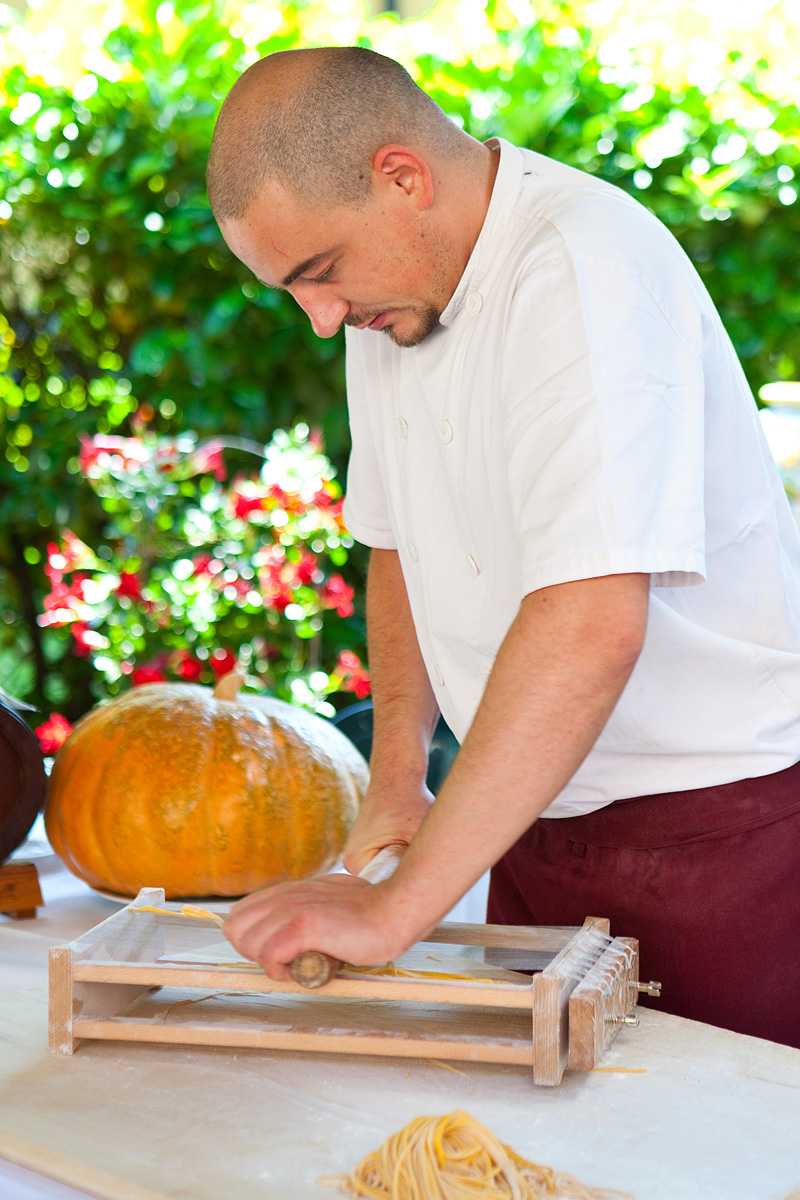
Rolling pasta on the chitarra. c. Foto Carra, Alessandro Carra

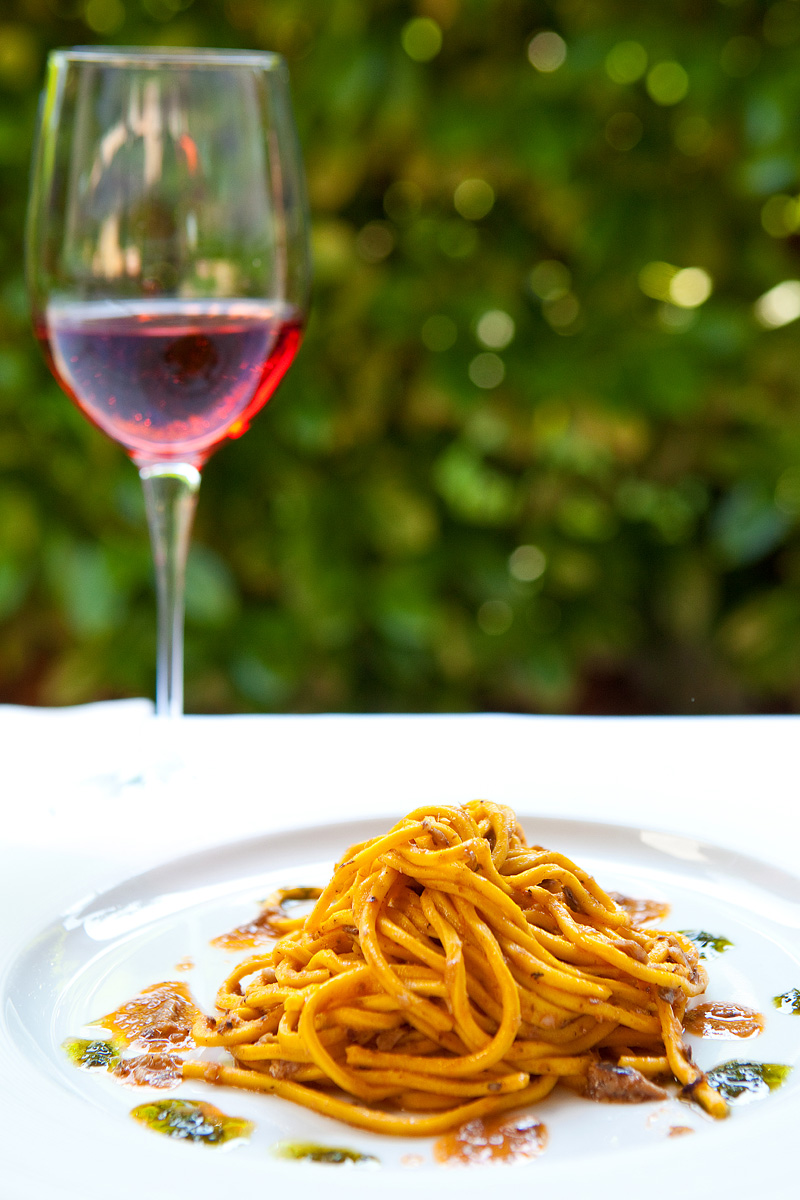
But one late afternoon, when I (along with my colleagues Kim Sunee and Rowan Jacobsen) was taken by car to a small country restaurant, Trattoria Ai Due Platani, everything changed for me, again. Sure, there was the torta fritta, the Prosciutto di Parma, and the seemingly endless bottles of Malvasia and Lambrusco. But there was also the chef/owner, Matteo Ugolotti, and the things that he did with that Chitarra of his. Okay, he’s gorgeous in that uniquely Italian male gorgeous way, and that always helps (even if you bat for the other team, the way I do—after all, I’m gay; I’m not dead). But Matteo’s spaghetti alla Chitarra jettisoned me back to those days at La Stella in the late 1960s, when my six year old self was introduced to, and fell in love with, the purest of pure pastas, treated carefully and lovingly—like it was a million dollar bowl of sliced truffles from Alba—and then served in small, sane, reasonable portions.

I don’t know what my dream meant—that I should take the time to make pasta from scratch, and only have it come out raggy, and full of  holes, and totally unworkable. But I do know this: We live in a world of speed, of food as fuel, of the dinner buffet and the bottomless pasta bowl served by more fast food joints masquerading as restaurants than we can imagine; we equate portion size with excellence on the one hand, and complete self-deprivation with health, on the other. And those of us who think about food as a way of life—we spend our days and nights searching for the culinary middle way, the gray area, where pasta is made in the most prudent of manners, and a small bowl of it is just enough.

Tonight, that’s what I’ll be making for dinner.

c. Foto Carra, Alessandro Carra


indiebound


©2009, ©2010, Poor Man's Feast. All rights reserved. To reprint any content herein, including recipes and photography, please contact rights@poormansfeast.com