“The mind is everything; what you think, you become.” — Guatama Siddhartha
Well, Sid; you’re right. Bad mind, and you’re a schmuck. Good mind, and you’re an obsequious schmuck. Is there no middle way? And if there is, why is it so damned hard to find?
Lately, I’ve been spending a lot of time talking and writing about the fact that for all of its glory and common sense practicality, the act of being a locavore has become riddled with self-rightousness and pomposity, finger-wagging and nauseating trendiness. It’s like when Lauren Bush came out with those great burlap FEED bags that everyone on Madison Avenue had to have, totally blind to the (brilliant) project’s meaning, and then clutch-maker to the stars, Judith Lieber, came out with her beaded version that Bergdorf was selling for $495. It’s like owning a Caddy Escalade for $73,000 and woo-hooing yourself silly because it’s a hybrid.
(See, bad mind.)
It’s like taking a yoga class to learn how to breathe and control the tension in your body (which, in my case, is not insubstantial), and the substitute teacher shows up with her big hair over-shellacked into a long, flippy Farrah helmet, and proceeds to chant her Anusara invocation like she’s doing a set at Feinstein’s, and as she actually sings OM with a perfect Buffy Saint-Marie/Mario Lanza vibrato and in harmony with the rest of the class, you think about making a quick getaway until she opens one eye and says “babe–yeah you, in the green tank top, the short one in the back with the big arms—mind on your mat, gorgeous.”
(More bad mind. I spent the rest of the class concentrating on what an idiot she was. Why did it even matter? Who knows. But my $17 walk-in fee was spent, down the drain, like a sad sinkful of biodegradable Dr. Bronner eucalyptus soap bubbles.)
In any case, I’ve had a lot to say about so-called locavores — you know the type: they claim to eat only what grows or is produced within a 10 mile radius, and then they rap the knuckles of everyone else around them who can’t or won’t follow suit because of time/money/will-power/desire. They go home with their one perfect melon or their one lovely bunch of lettuce and there it sits, in their kitchen, rotting, while they eat Doritos and Hostess Snowballs for dinner because no one is looking, like J. Edgar Hoover mincing around in his little black dress.
So, having had my fill of these folks, I went in the other direction. (Bad mind.) I said screw it. It was so easy, and so freeing! I felt so much better. I went to the supermarket and bought some nice, bland, slave-picked organic lettuce from a big-ag corporation based in California because I couldn’t make it to my farmer’s market, since it was raining and I didn’t feel like leaving the house and getting my new Birkenstocks wet. I bought a nice, juicy corn-fed steak because, really, the flavor is so much better and the meat is so much more marbled and the price is so much more reasonable. That Alice Waters? Puhleeese. The woman lives in a fishbowl lined in Heath tiles.
(Good mind. Much happy humming.)
“Who the hell are we kidding?” I asked one of my food friends over dinner. “The whole locavore thing is just a trend, and trends die. Better to live real — like an Everyperson.”
It felt so great to say that — to scoff in the face of the self-congratulation and the smugness that seems so pervasive in the local food world. It felt so good to just stop thinking so damned hard about food.
(Bad mind.)
And then Susan and I were driving down to Virginia to see Rachel, our infant goddaughter, and we stopped overnight to visit with a friend outside of Philadelphia. The next morning, she took us to her local indoor farmer’s market. We walked around and looked at the various kinds of scrapple for sale by the nice Mennonite ladies who work there. We bought some black pepper bacon. And then Susan squealed in a way that she only rarely does.
“What–?” I asked.
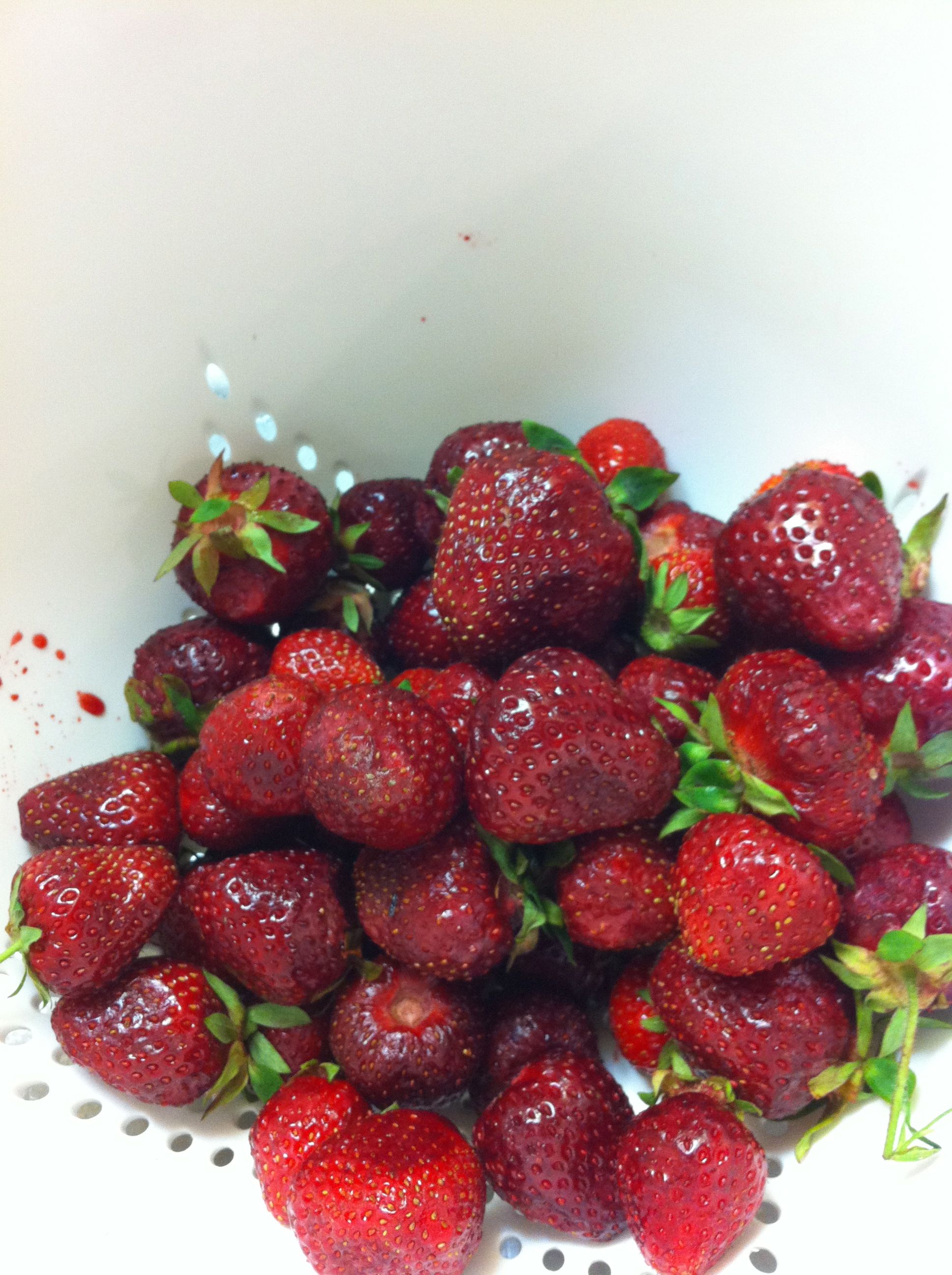
“These strawberries—” she pointed to a stand explosive with color. “I have to have some of these strawberries, for the ride down.”
She was very excited, in an almost carnal way.
(Good mind.)
So, she bought the damned berries, we said goodbye to our friend who was going off to work in Philadelphia, and continued on our journey.
“Have one–” she said, pointing to the basket sitting on the console, right below the gear shift.
“They’re slimy–” I said, looking over. “And small. What’s with small strawberries?”
“They’re not small — they’re normal.”
Honestly, I didn’t believe her; I’ve always loved strawberries — big, mouth-filling ones the size of a Volkswagon — that you could stuff with another berry. The kind that The Sign of the Dove used to dip into dark chocolate before they started showing up at Bar Mitzvahs everywhere.
“I just bought the biggest berries ever–” my mother-in-law always says in the dead of winter. “On sale! Two boxes for a dollar!” She takes a bite of one, wraps it in a tissue and takes another bite of it a few hours later, until it’s done, the following day.
That kind of strawberry.
(Bad mind.)
So, we were somewhere in Delaware, and I picked up a tiny berry and took a bite. Susan was dozing.
I ate another one, and the juice ran down my chin and dripped onto my white shirt.
“Shit–I need a napkin; Susie, wake up–“
She opened the glove compartment and fished one out. It was too late: I had strawberry stains everywhere.
I ate another one, and it seemed to burst in my mouth, to coat my teeth and tongue with the essence of pure, unadulterated, unmasked, unchemicled, fruit. Fruit. In season. Fresh. Local. No hipsters or sanctimony involved.
Just the real thing.
(Good mind.)
“So?” Susan said, looking at me.
“This,” I said, “is the best single thing I have ever eaten in my entire life.” I said it three times.
By the time we made it to Virginia, having eaten the entire basket, I was a changed woman: I couldn’t possibly ever go back to eating those gigantic, big-as-nuclear-waste-in-a-1950s-horror-movie strawberries in the dead of winter, the ones with the hollow middles that taste like you’re chewing on a cotton ball lightly dipped in a watered-down artificial strawberryish flavoring compound used in the sucking candy that’s coming unwrapped at the bottom of your grandmother’s purse and sticking to a packet of Sweet ‘N Low that she stole during last month’s duplicate bridge game at her friend Mildred’s.
So, this is what it’s all about? Is this what it all comes down to? Amidst the politicking and the arguing, the trending and the yammering, the fighting over who’s an elitist and who is a real Everyperson, most people — myself included — don’t honestly know what a real strawberry, picked at the height of its season, actually tastes like.
Next December, when the snow is falling and I’m cursing the plowing bills that show up in my mailbox; when I’m starting to suffer from SAD again and those deeply discounted boxes of mammoth strawberries from Chile begin to beckon at the supermarket; when I silently thank all of those laborers who picked them just so that we can have our cottony, out-of-season fruit in the dead of a New England winter, I’ll stop, and buy something else. And I’ll dream of the tiny, gem-like ones that Susan bought from a Pennsylvania farmer in mid-June, at the height of the season, and the juice running down my chin and staining my starched, bleached white shirt in unruly, gorgeous mottled bursts of pink and red.