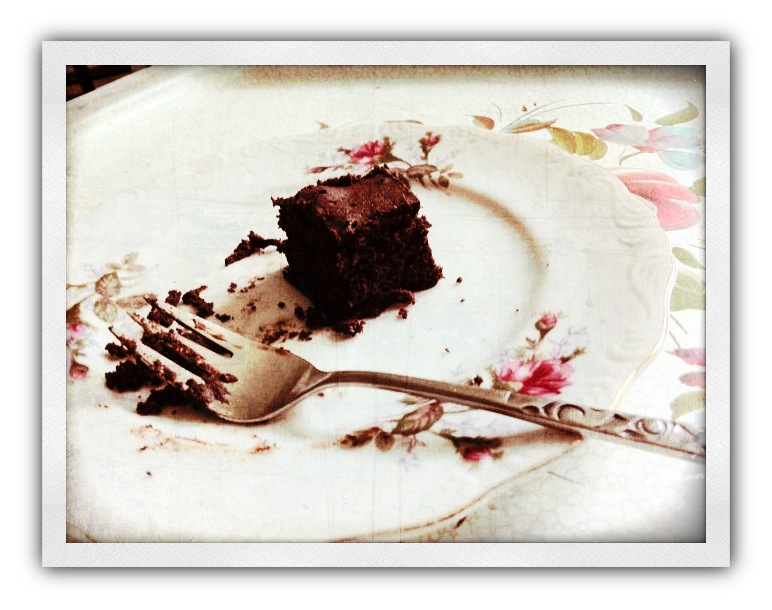
I’ve never had a sweet tooth. When I was three, I somehow made the discovery that Pabst Blue Ribbon was far more to my liking than the cloying Hi-C that actually made my baby teeth feel like they were going to fly out of my head like tiny Chiclets. The family tale is that we’d be driving somewhere in our ’64 opalescent green Barracuda and I’d cry and demand that my father pull over someplace for a six pack because I was thirsty.
“Have you tried milk?” my grandmother asked.
“She won’t go near it,” my mother said. I still won’t. Raw. Fancy. Even if I know the name of the cow.
I never liked cookies, or donuts, or candy, or ice cream. My grandmother would pick me up after school and offer to take me to Baskin Robbins for an ice cream cone, and I wouldn’t hear of it: I wanted pizza. Or a few slices of ham from the gourmet shop on Austin Street. Or a grilled cheese from the lunch counter at McCrory’s, where my grandmother’s lady friend — a strawberry blonde, hair-netted Irish woman who my grandmother referred to as My Gentile Friend, and who I thought was named My Gentle Ben — worked.
But somehow, cake was different. It was still too sweet for me, and I didn’t — and don’t — like it, but it came with a sort of mystique that I was never quite able to put my finger on. Just the word — cake — has a kind of indescribable panache that makes one think of Mitteleuropa between the wars. If you were lucky enough to be stuck in Vienna and someone said the word “cake” to you, you might be in for something from Demel’s, like maybe Schwarzwalder Kirschtorte, or Sachertorte. If you were on Long Island, it might have been your Aunt Sadie’s apple cake, assuming you had an Aunt Sadie. And if you were in Brooklyn, it would have been a blackout cake from Ebinger’s, which people still swoon over after all these years since the place closed.
At some point when I was a kid, I took the concept of cake as a metaphor for having company in, and while I didn’t like cake, I did like our neighbors, especially a couple called Alan and Janice — he was an American prone to growing his sideburns long and wearing Nehru jackets, she was from London and looked like Petula Clark. When my parents and I walked our dog after dinner and ran into Alan and Janice walking their dog, my father often said why don’t you come up for coffee and cake? And they’d bring their dog back home, and a few minutes later our doorbell would ring, and my mother would be lifting a round coffee cake out of its white cardboard box, putting it on an antique footed cake plate and brewing a pot of Sanka. It seemed so pleasant a ritual that whenever my parents and I walked the dog and ran into other neighbors and they didn’t ask them in, I would.
I’d say, “Why don’t you come in for some coffee and cake?” while my parents fumbled around, looking hot and embarrassed that the invitation had just been extended by a four year old.
But it was clear to me, even then, that the possibility of cake, for whatever reason, offered some semblance of comfort in what could be an otherwise unruly world; the artist Maira Kalman — my absolute favorite — has written about this fact extensively, and in our hallway, we have one of her illustrations that I pulled out of a magazine a few years ago and framed. It’s a sort of still life of mundanity: a vase, a teacup, a bowl, a package wrapped in string. And it says,
Don’t talk to me about luxury. O.K, you can but forget it. You must know that the only real luxury is TIME. Time and a cup of tea. And a pear or an apple. Maybe a little cake. That is enough.
And for some reason, a little bit of cake seems like enough. So a couple of weekends ago, when Susan went up to her mother’s on a Saturday night and I was alone, and things in the house were very quiet and I found myself feeling a bit punky about it all, I was compelled to make a cake, for the first time in my life. Not for me — it’s too sweet for me — but for Susan’s mother who, minute by minute, seems to be getting much older and forgetful of the fact that once, not too long ago, she mostly approved of the woman her daughter chose to make a life with.
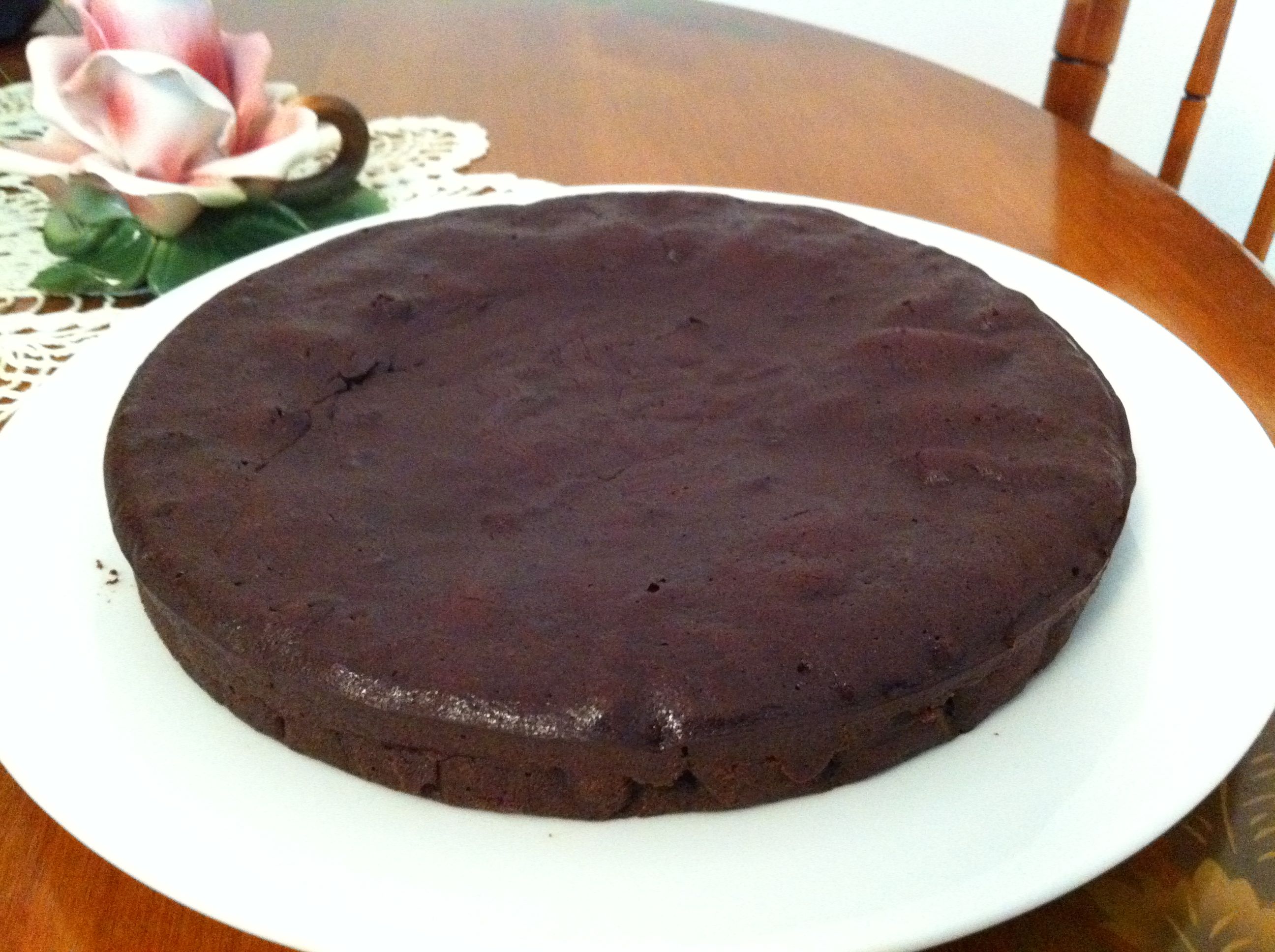
When I arrived at Helen’s house with Molly Wizenberg’s appropriately-named The Winning Hearts and Minds cake, Helen gaped at it.
“It’s beautiful,” she said. “Where did you buy it?”
“I made it for you,” I told her.
“Go on—-”
“No really—”
“You don’t bake. And you hate cake,” she said.
It was like the geriatric version of Green Eggs and Ham.
“I do bake. And I don’t hate cake. It’s just too sweet for me. But it doesn’t matter, since it’s for you.”
“You’re sure you didn’t buy it?”
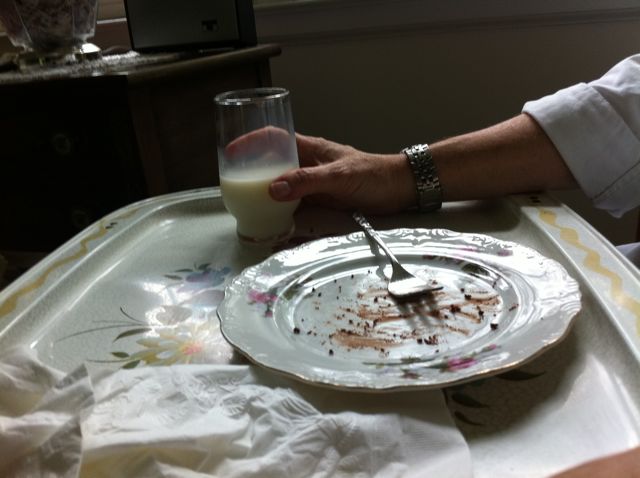
I sliced her a piece, and one for Susan, and the smallest sliver for me, like it was a sacrament that might — just for a few minutes — make things okay again.
Because cake seems to have that effect on people.
The Winning Hearts and Minds Cake
(from A Homemade Life, by Molly Wizenberg)
Even for a non-cake lover like me, this was irresistible: dense, chocolatey, and almost brownie-like in consistency. Molly swears that it’s actually improved by freezing, and then thawing for 24 hours. When I told Susan that, she said, “Right. Assuming you don’t eat it while it’s still warm.”
Makes 6 to 8 servings
7 ounces bittersweet chocolate, finely chopped
1 – 3/4 sticks unsalted butter, cut into half inch cubes (I used Plugra)
1 cup plus 2 tablespoons granulated sugar
5 large eggs
1 tablespoon unbleached flour
Lightly sweetened whipped cream, for serving
Preheat the oven to 375 degrees F and butter an 8-inch round cake pan. Line the bottom of the pan with a round of parchment paper, and butter it as well.
Place the chocolate and butter together in a medium saucepan set over very low heat (or a double boiler), and melt, stirring, until smooth (or alternatively use a microwave set on high for 30 seconds, but we don’t have one). When the mixture is smooth, add the sugar, stirring well to incorporate.
Set the batter aside to cool for 5 minutes. Then add the eggs one by one, stirring well after each addition. Add the flour and stir to mix well.
Pour the batter into the prepared pan, and bake for about 25 minutes, or until the top is lightly crackled, the edges are puffed, and the center of the cake looks set.
Remove the cake from the oven to a cooling rack, and let it cool in the pan for 15 minutes. Carefully turn it out of the pan and then flip it onto a serving plate, so that the crackly side faces up.
Cool completely before serving, preferably with lightly sweetened whipped cream.