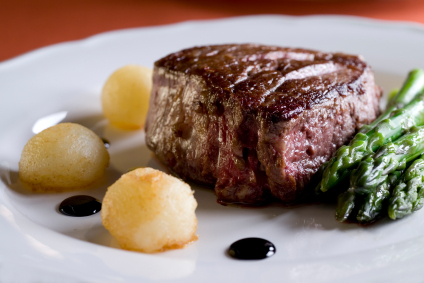
I remember it well: making black truffle and cepe duxelles to fold into rice, which would then get crammed into a timbale mold like a size 9 foot stuffed into a size 6 shoe. That little culinary hockey puck of <yawn> goodness would then get topped with a single slice of Sauternes-glazed and seared foie gras, which would all wind up perched skyward on the center of a fourteen inch white charger which, if I was having more than two people for dinner at my tiny apartment dining room table, would teeter precariously on the edge of disaster while the cats skulked around, ever hopeful.
It was the early late 1980s and early 90s, a Bushian-era when big was best and fancy was fantastic, and a time when chargers were showing up everywhere; we carried them — massive Pillyvuit plates that everyone suddenly had to have if they were even going to remotely be considered successful dinner party throwers — at Dean & Deluca, my former employer. If you went to Bloomingdales, you could buy them in black matte with a thin gold band around the rim, like Heath Ceramics on a bad trip.
“But what are you putting in the center?” I once heard a customer ask her friend at the store. The two of them were pulling the chargers off our Metro shelving and cradling them in their respective arms like they were holding newborn infants.
“I’m not really sure yet,” her friend answered.
“Well you need to figure it out–” the other woman snapped, “because it’s all about the center. Think of it like real estate. What goes in the center is always most important.”
I’ve been giving this center of the plate conundrum a lot of thought lately, mostly because Susan and I have been eating a lot of meatless meals, which often don’t intuitively lend themselves to center-of-the-platedom. About a month or so ago, I came home from a quick trip to Seattle. It was a great trip, but a long schlep home involving rotten weather and, once I landed in Connecticut, a dead car battery. By the time I walked through the front door, I could have cried from exhaustion, like an overtired, cranky baby. And there was Susan, in the kitchen, at work on a meatless dinner cooked entirely from Yotam Ottolenghi’s remarkable book, Plenty. She poured me some wine and I sat down on a chair and watched her cook, thoughtfully and carefully: there was a grape leaf pie stuffed with yogurt and topped with toasted breadcrumbs; a garbanzo bean saute with bitter greens; a burnt eggplant salad. I remember thinking that my mother, when she still cooked, made burnt salad on a nightly basis. Generally, it was served before our burnt main course, which often was followed by our burnt dessert.
Anyway, a little while later, we sat down at the table and each took a sliver of the pie, a spoonful of the saute, and a hefty dollop of the eggplant salad. Everything sat there on the plate, looking gorgeous, if a bit confused. Or maybe it was I who was confused: what would I eat first? What was the primary dish? What was a side dish? My dinner plate — with three distinct dishes on it that all went perfectly together — looked like I was dining at a pot luck. And you know what plates look like at a pot luck: A little bit of this. A little bit of that. Something brown, involving lentils. A few cold shrimp. But nothing in the center, where the meat usually goes. Nothing as the star attraction. Nothing that screams LOOK AT ME FIRST! Everything getting equal billing in the most democratic of ways. And this problem — the question of what goes in the center when you’re not eating meat — is one that’s been plaguing me at almost every meatless meal I’ve eaten since.
Americans, I think, are hard-wired by virtue of post-War, post-Depression carnivorous excess coupled with raging psychological compartmentalism to think in terms of The Center versus The Side. It might be fancy (that vertical dish I made with the timbale and the foie gras was all about The Center; everything had top billing) or it might be basic (steak, mashed potatoes, and peas and carrots), but you always understand, conceptually, what’s in The Center when you even just think about putting together a meal. Kids, especially, get the idea of The Center really intuitively: remember Swanson TV dinners, with the big compartment filled with Salisbury Steak and the little compartments above it — the mashed potatoes, the peas and carrots, and between them, the Apple Thing? That was Swanson’s way of telling us what was most important: it was physically right there, being satellited by smaller portions of other, less important things.
It’s hard for most Americans to get beyond the idea of What Goes in the Center; the Europeans and Asians seem to have it down without a hitch, which may be the result of cultural temperance — they just don’t eat as much as we do and very generally speaking, their meat intake is far less than ours is. Think of a Grand Aioli in France: piles and piles of gorgeous fresh vegetables served with garlicky aioli, and no meat in the middle. Or tapas in Spain. Or meze in Turkey. Plates and platters come to the table meaning to be shared among diners: some vegetables, maybe a little bit of pasta or grains or noodles of some sort, maybe some sort of animal protein, or maybe not. I remember visiting an Umbrian restaurant near Yale, which was opened some years ago by a couple who had met while he (an American) was studying in Italy; the actual plates used are physically smaller and the dishes — traditional Umbrian fare like lentils and sausage, and wood oven-roasted vegetables with spectacular, bright green olive oil — just scream to be shared. The last time we ate there, there was nothing at all in the proverbial center of the plate.
“What’s meant to be the main?” one of our friends asked me when I took her and her husband there for dinner one night.
“It’s all the main–” I answered. She seemed a little confused.
But eating meatless as we’ve been doing lately makes things even more difficult: without a steak or some chicken, a thick slab of meatloaf or a pork chop, what gets psychological center-of-the-plate billing? This sort of gastronomical existential angst only adds to the challenge of getting Americans off so much meat and on to more vegetables; that’s hard enough because most of us simply don’t believe that vegetables can be the main attraction on a plate — we’ve only ever known them to be the side dishes served at Thanksgiving and Christmas.
This is partly why, when Oprah and her staffers went vegan for 21-days, their so-called menu was riddled with meat substitutes like vegan “burgers” and faux fillets — because it was just too challenging to not only think about changing what they ate (which had to bear some resemblance to the familiar, hence the “burgers”) but how they actually ate it. The first suggested dinner in Oprah’s Vegan meal plan is case in point: seitan parmesan with a side of green beans and mashed potatoes. I’m not knocking the fact that she got all of these meat eaters to go without for three weeks. But I do take issue with the fact that they weren’t really taught to think of having meals revolve around vegetables in the very different way that it requires, without any sort of Center of the Plateism.
My friend, author, teacher, chef and all-around vegetarian cooking marvel, Deborah Madison, suggested to me the other night when we were talking about this, that maybe the shape of plates has to change. It’s easier to give everything equal footing when you’re serving on, say, rectangular plates. But then, as she pointed out, those plates are often disposed to the trend of culinary deconstruction, and that’s not at all what we’re talking about here. “Center gets to be a big deal — like a bull’s eye,” she added. For most of us, what is sitting square on that bull’s eye is meat. If you remove the meat, and you’ve got all sides and no center, things feel, at least to the American eye, weirdly unbalanced.
In Deborah’s wonderful Vegetarian Suppers, she points out in her introduction,
“…Here’s a clue about where to look for vegetarian main dishes and how to think about supper. Those main dishes are hiding right among the first courses in most cookbooks and restaurant menus. Not only vegetarians are delighted by the tasty, small items that begin so many meals; lots of diners like to put a few of them together and call them dinner. I’ve learned through years of cooking vegetarian food that, with some tweaking, these firsts and sides can assume center position on a plate.”
But my question is, as home cooks, why do we need a center at all? What is it that forces us, while thinking about dinner, to consider what is worthy of top billing versus what isn’t? Can Americans — even culinarily-minded ones — ever get away from thinking that a plate filled with vegetables isn’t, in fact, a plate filled with “side dishes?” It’s a question that, every time I make a meatless meal — which is now 90% of the time in my home — I ponder.
What I do know is this: It’s not just about what we eat, but how we eat it, and until we learn the importance of both, Americans will always find meatless eating confusing and psychologically unsatisfying. In the meantime, I’ve long forgotten about those gigantic chargers from the 1980s and 90s. With every meatless meal I make, I’m inclined to use smaller plates which in turn make my portions smaller. And that big gaping hole in the middle of everything — where the meat used to go — is now gone.