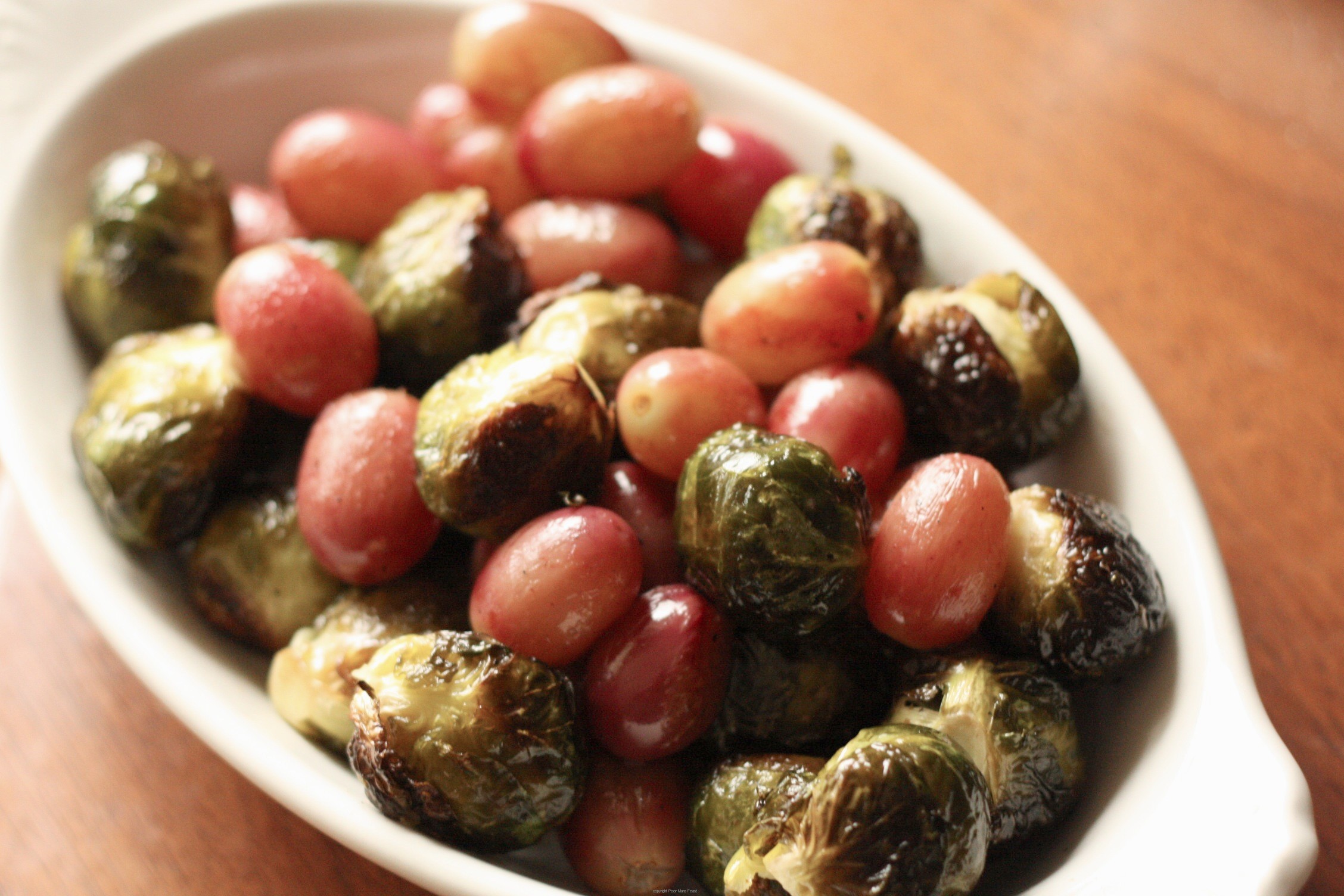
A few weeks ago, Susan and I were down in Florida visiting my cousins, as we often are over Thanksgiving. On Wednesday, I squirreled myself away for a long, call-in phone interview with the folks over at Wisconsin Public Radio; people phoned in from all over the northern midwest wanting answers to everything from how to shake up lentil nut loaf (I was kind) to how to brine a pre-brined turkey (don’t). The number of vegetarians and vegans who called was astonishing, and for the first time ever, no one asked anything about leftovers. The conversation eventually led to a discussion about my favorite vegetable dish, and when I described it, I could hear a long, cavernous echo coming from that great freezing land of beer, badgers, and brats.

Brussels sprouts and grapes? the host repeated, incredulous.

Yes, I said. It’s sweet and savory; the grapes release their delicious sugars as they cook, which in turn caramelize the sprouts. You can eat it hot, cold, or at room temperature. You can add anything to it, within reason: toasted walnuts, pine nuts, spicy pepitas, lardons, whole garlic cloves, fresh thyme or rosemary, sea salt. Or nothing at all, which is generally how I like it.

And then people started calling in to ask for the recipe, and I realized that, while I’ve often spoken of the dish, I’ve only infrequently provided a recipe for it, or any inkling into its provenance.

I was never much of a Brussels sprouts fan; the idea of them conjured up memories of sitting in my sleepaway camp dining room as both a camper, and then, a counselor, and having them whiz past my head after being hurled like a small boulder from a trebuchet. Years later, when I was studying in England, they were presented to me cloaked in a sort of grayish grease, having been boiled in water for what must have been days. Or months. A little while after I came home to New York, I was having dinner with my mother at a very trendy restaurant on the Upper West Side, and there were Brussels sprouts leaves strewn about the plate, but no sign of the sprouts themselves. Eventually, I read Laurie Colwin’s Home Cooking, and took note of the part where she says she sometimes makes marinated Brussels sprouts for the Christmas holidays; I trust her completely, so I gave it a shot. And lo and behold, I discovered that I not only liked them. I loved them.
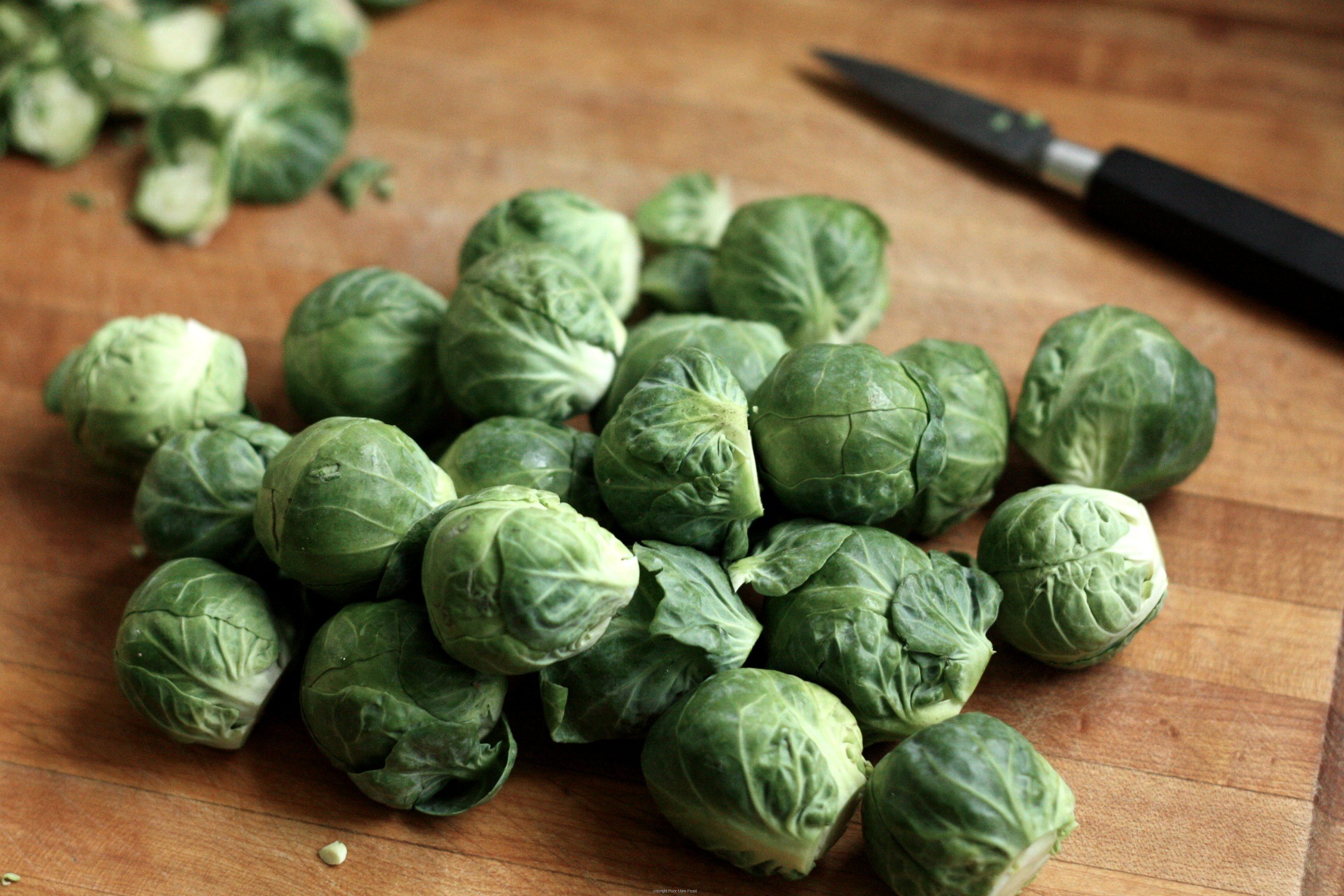
A few years ago, I was driving around my neighborhood, running errands, when I heard a restaurateur on NPR talking about roasting Brussels sprouts together with grapes. The host was mystified, but so enamored of the dish was the guest that I pulled into my local market and bought a pound of sprouts and a bunch of grapes, and headed home to make them. No recipe had been given, so I had at it: I tossed the sprouts in a cast iron pan (cast iron is key) with a few dribbles of olive oil, a pinch of salt, and a bit of pepper. I gave the pan a shake, and then popped it into a hot oven. Once the sprouts turned bright green, I added a handful of red seedless grapes. I gave the pan another shake, and put it back in the oven until the grapes softened and the sprouts were knife-tender and caramelized. It was easy and delicious. And just a little bit surprising.
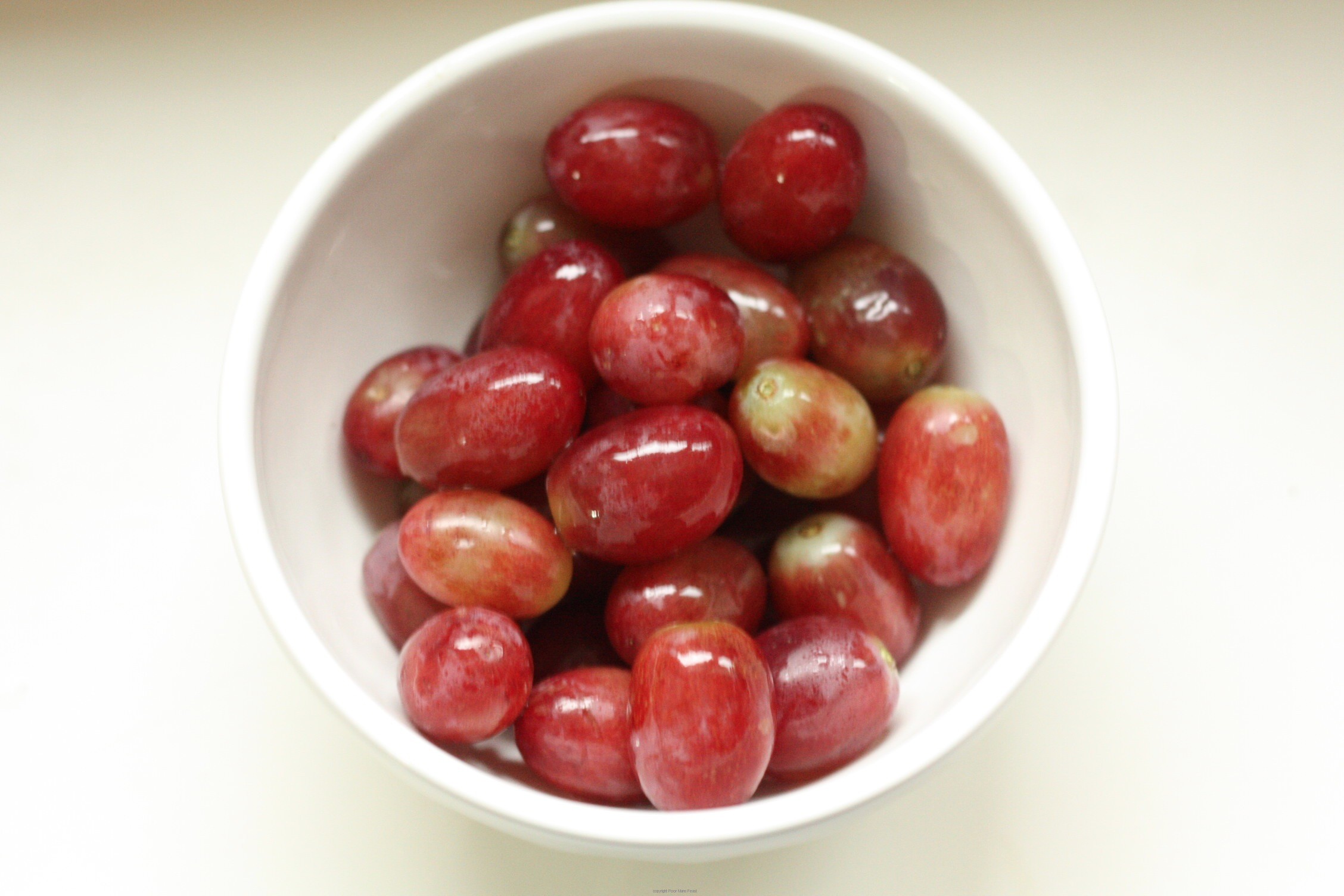
Over the years, I’ve tweaked the recipe: if the Brussels sprouts are big (or if time is a concern), simply slice them in half. Add herbs, or not. Or nuts, or not. Add tiny, cubed, crisp lardons. Or not. Drizzle it with a light splash of red wine vinegar, and serve it at room temperature with a wedge of earthy sheep’s milk cheese like Sardo di Pecora. I’ve even cooked the dish in a metal basket on the grill, alongside a steak. The direct-fire method results in a bit more charring, but the dish is still delicious.
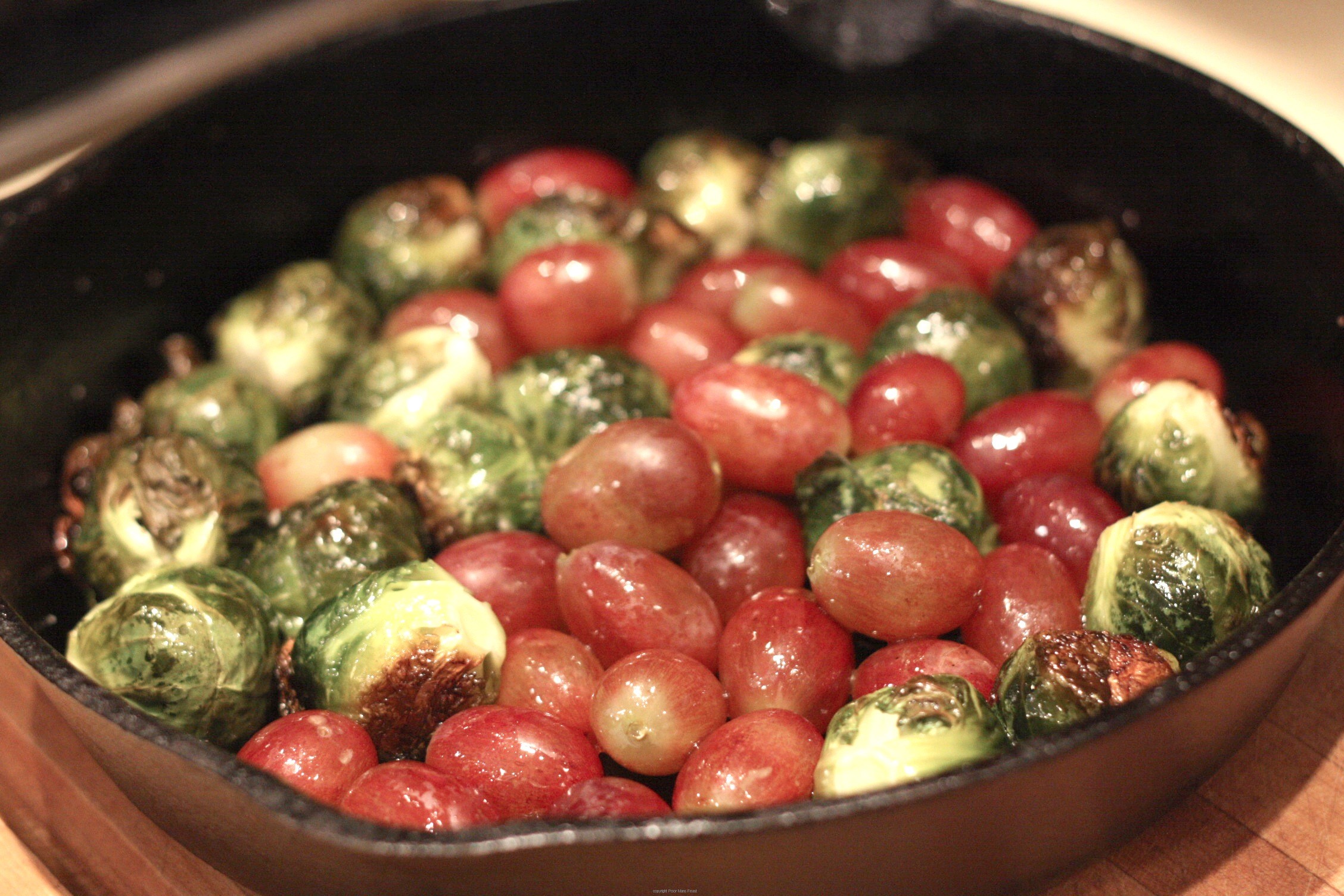
However you make it and in whatever proportions, bear in mind the balance of sweet to salty/savory, and keep an eye on the pan as your guests begin to arrive. Shake it frequently to keep things roasting evenly, and when it’s time to eat, bring the pan directly to the table. Even Brussels sprouts naysayers will fall in love; they will likely be found in the middle of the night, eating the leftovers directly out of the fridge.

At least in my house.

Brussels Sprouts and Grapes

I’ve been making this dish for years, and always to various levels of bemusement and scoffing, until my guests tuck in. If you’re able to find very young, tiny Brussels sprouts, add grapes with a lighter hand, otherwise you’ll wind up obscuring the fresh, grassy flavor that make baby sprouts so wonderful. Forget about slicing an X in the bottom of your sprouts; in this dish, there’s no need for it.

Serves 4

1 pound Brussels sprouts, tough outer leaves and stem removed

1 tablespoon Extra virgin olive oil

1/4 teaspoon sea salt

freshly ground black pepper, to taste

1/4 pound red seedless grapes (not Globe)

Optional: fresh thyme sprigs, fresh rosemary sprigs, whole peeled garlic cloves, toasted walnuts/spicy pepitas/toasted pine nuts, lardons

Preheat oven to 375 degrees F.

Place the sprouts in a large cast iron pan and drizzle with oil, shaking the pan to lightly coat them. Sprinkle with salt and pepper, and give the pan another shake. Place the pan on the middle rack in the oven and roast, shaking every once in a while, for twenty minutes.

Add the grapes to the pan, place it back in the oven, and continue to roast for another ten minutes, shaking frequently, until the grapes have softened and their skins wrinkle, and the sprouts are knife tender. Serve immediately, or at room temperature.

ADD-ONS NOTE:

If you are adding nuts to this dish, add them five minutes before removing the pan from the oven.

If you are adding thyme or rosemary, add it to the sprouts after the first pan shake.

If you are adding whole garlic cloves, add it to the sprouts after the first pan shake.

If you are adding lardons, you can either:

1- Cook the lardons separately, drain off the fat, and add them when you add the grapes. Or,

2 – Cook the lardons in the cast iron pan, remove them to a bowl, drain off all but one tablespoon of the fat and then add the sprouts to the remaining fat in the pan, and continue with the recipe. Add the cooked lardons as above.
 

Very Important Corks

December 1, 2011 · 14 comments

My mother let fly with a nonstop barrage of chatter the minute I arrived at her apartment.

“Look at this,” she said, holding an ancient Missoni sweater up to herself the way she’d held clothes up to me on shopping trips when I was five.

“It’s from 1988 — and I still have it!”

Keeping stuff from years ago that she could still wear if she wanted to gives her options, she says, even if she never actually wears them.

“Wait–” she said, “I have something else to show you. It’s fabulous. You’ll love it—-”

It was like she’d been suddenly released from a vow of silence, and her words erupted like bullets from a Tommy gun. She disappeared into her bedroom and came out with a delicate silk kimono that I’d never seen. It would have been enormous on her, so I knew it wasn’t hers.

“It was Grandma’s, from the 1920s,” she said, holding it up so I could see it, turning it around, front and back, front and back. It was a flurry of powder blues and dusty mauves, made from roughly textured raw silk, and printed on the very bottom hem was the word JAPAN.  I instinctively took a sleeve and held it up to my face to see if there was any essence of Grandma there — of the mothballs and Jean Nate and schmaltz that co-mingled to make up the Proustian essence of her. But there was nothing.

“Where did you get this?” I asked.

“When she died—” she said.

“But that’s thirty years ago — why didn’t you show it to me before?”

“It was buried behind other stuff–”

“Maybe you should get rid of some of the other stuff–”

“But then I wouldn’t have options, would I-–” she answered ruefully, and took off back into the bedroom with Grandma’s kimono flying over her shoulder. I heard the closet door swing open, and the clattering shove of hangers pushed far to one side. She hung the kimono up behind other stuff, and closed the closet door.

And that’s the thing about stuff; sometimes, we accumulate so much of it over the years that we start to forget about all the other, better, more important stuff that’s hidden behind it. During the holiday season, the accumulation of new stuff knows no limits, especially where kitchen stuff is concerned. There’s reading stuff, and cooking stuff, and baking stuff, all of which falls under the kitchen stuff heading. Sometimes, the reading stuff doesn’t always lead to cooking, even if it’s about cooking. It’s still good stuff. As George Carlin once said, a house is just a pile of stuff with a cover on it. 

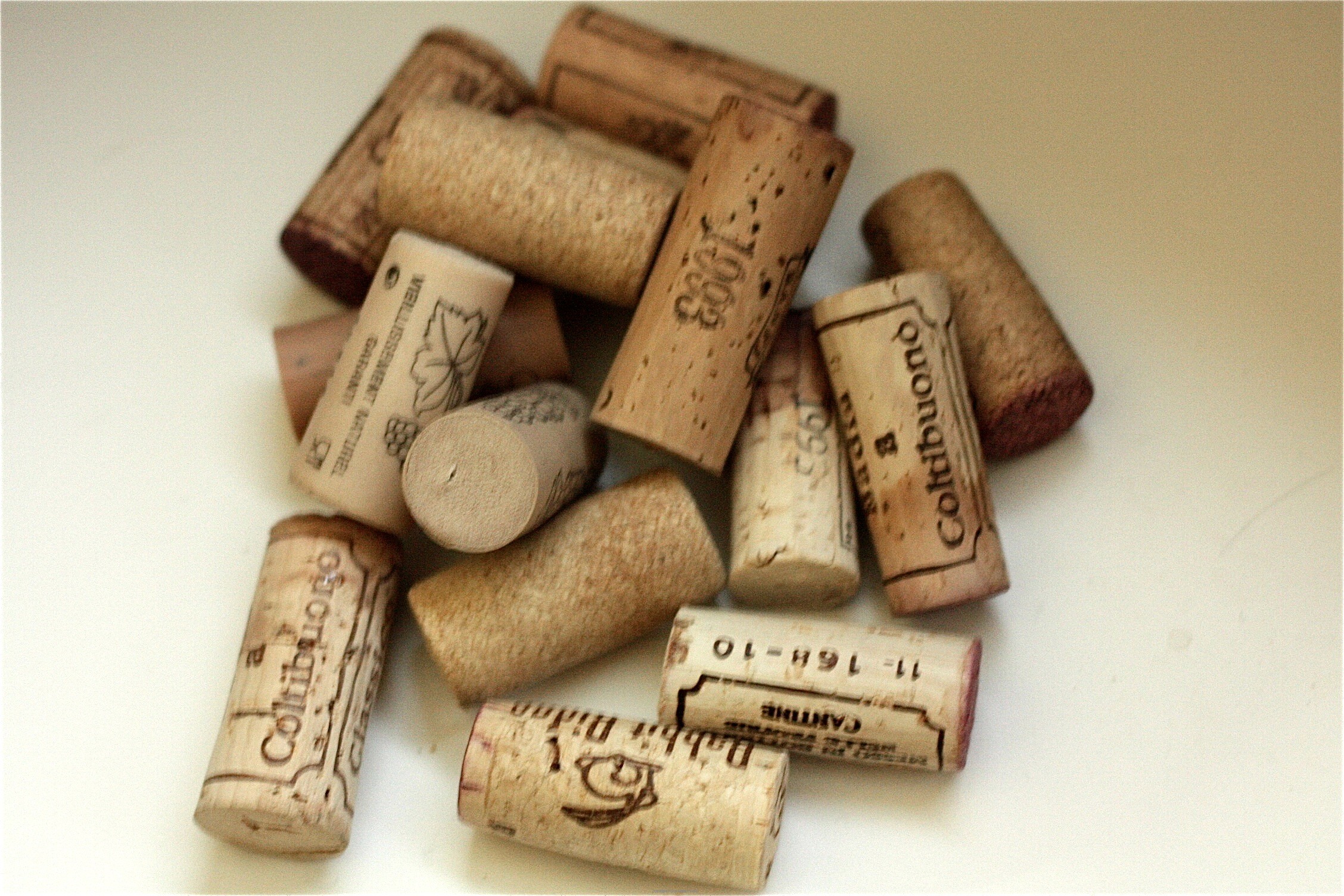
When I got home after the kimono incident, I said to Susan, you know—for two people, I think we have way too much stuff. We were standing in the kitchen at the time, surrounded by kitchenware catalogs. I had just tried to open one of those drawers underneath my kitchen bookshelf (which contains some reading stuff that I use a lot), and it was stuck because something was clogging up the works: when I finally pulled it, hard, out flew a couple of very important corks (1993 Banfi Brunello, from our first trip together to Tuscany; 2000 Romanee-Conti Grands Echezeaux, and a gift from an author when I left Clarkson Potter in 2006) which were buried under a bag of those flat French sponges, which was wedged against the side of the drawer by a large Glad bag of twist ties given to us by my mother-in-law, who saves that kind of stuff, just in case.

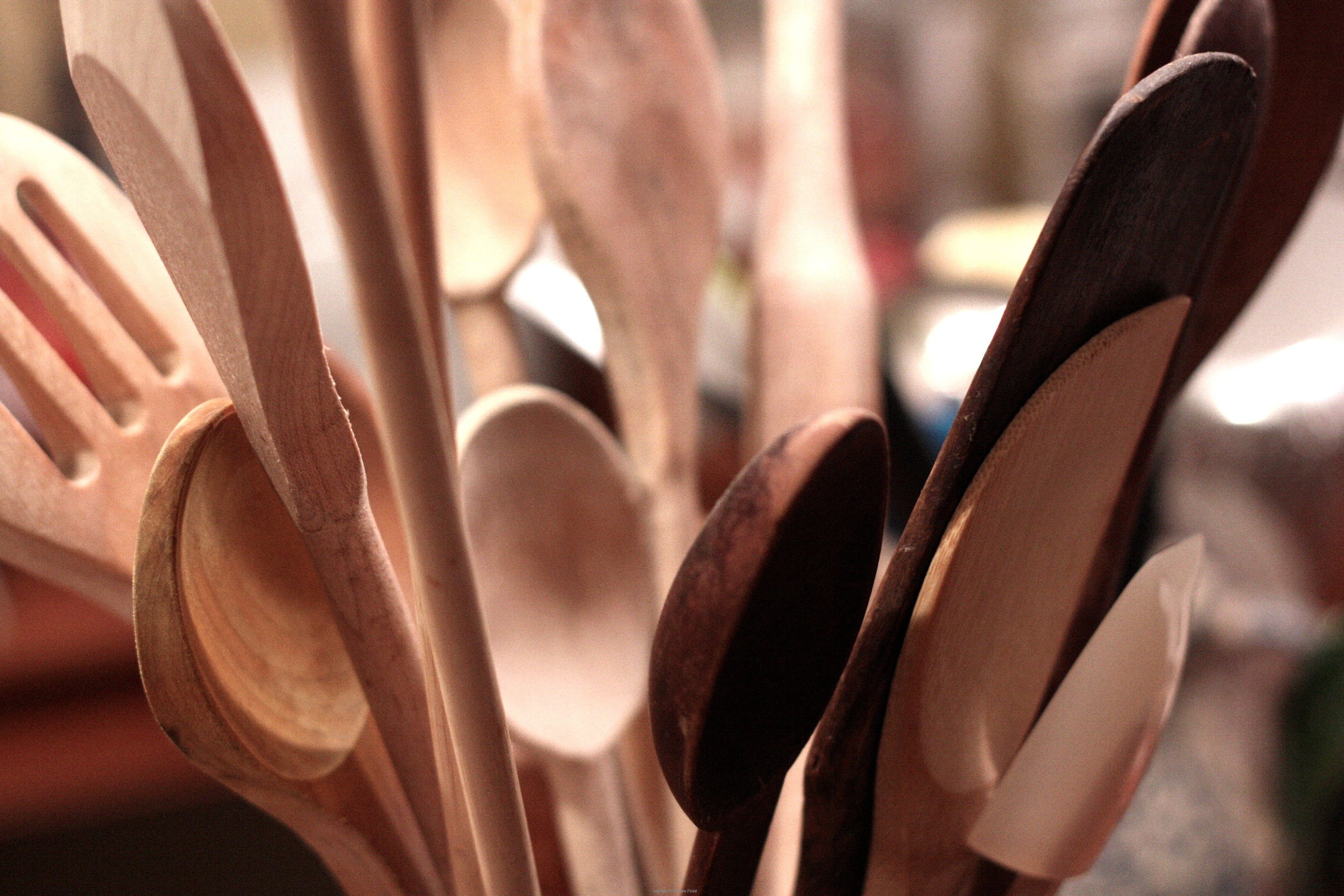
“I mean,” I said to Susan, who was sipping on a glass of water while going through a pile of mail, “do we really need twenty-seven wooden spoons? Or those tiny pathetic little whisks meant for beating a single quail egg? Or a special teeny rasp for nutmeg? Why can’t we just use the regular rasp? And why all the twist ties? We don’t even use plastic baggies anymore—”

“Fine—then let’s get rid of some stuff–” she said, putting the mail down on the counter, alongside a stack of magazines and circulars and the free supplement that my local newspaper sends out every Friday.  A hardware store catalog featuring Santa dressed in Carhartt overalls and wearing Bose noise-canceling headphones slipped off the counter and fell into the dog’s water bowl, and I thought I was going to have a stroke.

Because most of my professional life is spent in either my office or my kitchen, I’ve lately become very sensitive to the towering pile-ups of stuff in those rooms. I’m not even sure if it’s lately, or if it’s just that I’ve finally hit my tipping point, like when your body hits its allergen wall and your throat suddenly closes up with no explanation. So I planned my course of action: I would go through books first, and whittle them back to absolutely only those I use and/or truly love. Whatever reading stuff I was getting rid of would go to neighbors (who cook) and friends, or to the culinary department at the local high school. Once the books were sieved down to the essentials, I’d attack the other kitchen stuff — the whisks, the tipless knives, the glassware that we bought because it was cute, the tart tins with the missing bottoms, the goddamned important corks — and by the time I was done, surfaces would be clear, shelves and drawers would be orderly, and our house would be able to breathe again, just in time for the arrival of more holiday stuff.

The act of ridding oneself of cookbooks is not an easy one for a writer, much less a writer who used to be a cookbook department manager at a well-known gourmet shop. Compound that problem with more than a decade of being a book editor at two major publishing houses. Add to that the fact that when one’s spouse works for one of the said major publishing houses as a book designer, fringe benefits include all the reading stuff you can handle, for a lifetime. And of course, reading stuff, like my mother’s 1980s sweaters, holds the promise of options, and possibility:  I could make Thomas Keller’s oysters and pearls if I wanted to, even though I never actually would.

Promise is so seductive.

Anyway, I was ruthless: unless it was a classic, or if I hadn’t opened it in a year, it landed in the giveaway pile. If it contained three or more handwritten notes angrily correcting recipes that obviously hadn’t been tested prior to publication, it went away. If its content was maddening — if it required immersion circulators and liquid nitrogen and an Ortolan — it was packed up.

“Aren’t you being a little bit extreme?” Susan asked. It was right after her surgery, and she was ensconced on the den sofa like a pasha, watching golf.

“Are you planning on buying an immersion circulator? Because I’m not.”

“Do I get to keep any of them?” she asked, sadly.

“Sure,” I said, putting my hands on my hips.

She got up and perused my toss pile and pulled from it exactly one book, on the baked goods of Sardinia.

“I’d like to keep this one,” she said.

“Will you ever use it? I mean, we’re keeping Maida Heatter, Jim Lahey, Peter Reinhart, all those tiny Elizabeth Alston baking books, and everything that Dorie Greenspan ever wrote. Do you really need a book on Sardinian baking?”

She looked at me over her light blue Lina Wurtmuller glasses.

“Yes,” she said. “I do.” And then she went back into the den.

I divvied up my giveaway pile of reading stuff among my neighbors, who were thrilled. Suddenly, my bookshelves were able to inhale and exhale, like they’d taken a shot of Afrin during a horrific head cold. I felt free, and joyful, but not for long: my next goal was to rid us of unnecessary cooking implements, like olive pitters and the aforementioned tipless knife. I wanted to whittle down our wooden spoon collection to a mere six. The French steel crepe pan, which I had to have, could go away, along with the All-Clad searing pan really designed for flambeing Bananas Foster. I never make Bananas Foster. And since that one unfortunate class in cooking school, I never flambe. The plastic cruet set that someone — I have no idea who — so obviously re-gifted to us would find its way to the Goodwill box, along with one of three digital thermometers and the dyed green St. Patrick’s Day toothpicks from the Reagan Administration.

But first, before I did anything, I decided to spend an evening with the books I really loved — the ones that would never, ever leave: there were all the idiosyncratic Chez Panisse books—the ones that assume you have access to Meyer Lemons even if you live in Newfoundland. There was Elizabeth David, and even though I have both the American and British editions of French Provincial Cooking, and hardcover and softcover editions of Italian Food, they all stayed. There’s Marcella’s The Classic Italian Cookbook, which I bought in the basement “book room” at Random House in 1985, days after I graduated from college. There were the books that I use on a daily basis, like all of Deborah Madison’s, and Yotam Ottolenghi’s Plenty. Heidi Swanson’s Super Natural Cooking Every Day, which is worth its weight in gold for both its aesthetic and its recipes, is still in the kitchen. Edna Lewis stayed put, as did Laurie Colwin, Jacques PepinMarion Cunningham, Craig Claiborne’s New York Times, Amanda Hesser’s New York Times, Lord Krishna’s Cuisine, Paula Wolfert, Diana Kennedy, Nigel Slater, David Tanis, and Julia’s The Way to Cook. I couldn’t bear to part with Lee Bailey, even though I look at his books precisely once a year, usually on New Years Day, after everyone’s gone home. The Silver Palate could have gone either way, but when the book fell open to a spattered page and the recipe for chicken marbella, I couldn’t part with it.

Susan yelled hoarsely from the den “If you get rid of Jean Anderson, I’ll break your legs.”

Of course, I yelled back.

Naturally, my plan to rid the house of unnecessary stuff coincided with every magazine, newspaper, blog, and radio show doing their year-end mash-ups of must-have books and gadgets like that $625, multi-volume treatise on modern cooking, or a $200 Japanese ice cube maker. The other day, while standing in the wonderful Posman’s Books in Grand Central Station, I found myself in the cookbook section, staring glassy-eyed at all the new and gorgeous volumes that would attempt to seduce me into taking them home to my now corkless, stuffless lair, to refill the spots vacated by the books I’d shed so recently. For the first time ever, I was able to restrain myself.

Because, just for a little while, I want to be able to breathe. To know, cook from, and honor what I have. And to live with the hidden jewels that, like my grandmother’s mysterious kimono, might otherwise be obscured by the allure of the new, and the delicious temptation of possibility and promise.

indiebound


©2009, ©2010, Poor Man's Feast. All rights reserved. To reprint any content herein, including recipes and photography, please contact rights@poormansfeast.com