I’ve been laughing all day.

Really.

We’re three days past Christmas, and last night was the very last candle of Hanukkah. It’s been a holiday season that’s been both blessed and difficult (as holiday seasons usually are. This is a universal truth).

The house this year was gorgeous. The tree was perfect. The menorah — we eschewed the tiny silver one and instead pulled out the big recycled metal one I bought for a dollar at my local Waldorf School’s holiday sale a few years ago — and filled it with stunning white tapers that we wound up not lighting, mostly because things just got away from us.

There was roasted, herb-crusted fillet. Oven-blasted root vegetables and potatoes tossed with rosemary and whole garlic cloves. There were Brussels sprouts and tiny lardons cubed from the bacon that my friend Steve-the-Butcher makes. I ate virtually none of it during Christmas dinner, instead tasting very tentatively as I cooked. I avoided the sourdough boule. I had one chunk of a crispy, golden-roasted potato. I had a Brussels sprout and one lardon. Un lardon. I set the Christmas pudding ablaze despite a debilitating fear of fire and drizzled it with hard sauce which I scraped off my hummingbird-sized portion. I ate not one Christmas cookie, and drank not one cup of eggnog. I ate one tiny latke bound together with rice flour instead of wheat — it performed as I’d hoped, and crisped up much more enthusiastically than when I make it with its white whole wheat flour cousin — and topped it with a tiny slice of smoked salmon from the Gaspe peninsula, and a petite dot of black tobiko, which I dolloped, ceremoniously, off the end of an antique silver salt spoon.

It was all very nice.

But today, with the holiday pretty much being over — trees are starting to appear piled up at the dump and in the streets next to city garbage cans; the torturous, endless loops of sterile Mitch Miller carols are growing mercifully fainter — I’ve been laughing.

Not a good laugh, but a nervous, embarrassed tic. Because every single year around this time, I’m in the exact same place both gastronomically and healthfully: I visit the doctor on the 23rd, as my health insurance year draws to a close and the news — just as we’re about to fling ourselves into the land of trifles and game birds, sufganiyot and latkes, standing rib, vintage port and aged burgundy — isn’t wonderful. This happened last year, the year before, and the year before that. Without getting into specifics, the instructions are always the same: Cut this. Cut that. Cut the other stuff. Your numbers are off the scale. 

I’m a food writer, I tell my doctor.

That’s your problem, she says, staring at me over her glasses.

It’s the holidays, I say.

Tough, she answers. Be creative. 

And every year, I am.

Until I’m not.

“I’ll change the New Years’ menu,” my dear friend Lisa says, when I tell her what’s going on. “We don’t have to have a rib roast. Or any wine.”

Sure. No wine. 

“Absolutely not,” I tell her, refusing to drag her and her partner into the milquetoasty world of health-related culinary blandness, where conviviality gets bogged down by worry, like an immovable anchor on a party ship.

But this year, two days before Christmas, when every wealthy holiday table in America sits creaking under the weight of the extravagant excess that we seem to believe is our right, I learned that I am one of the others.

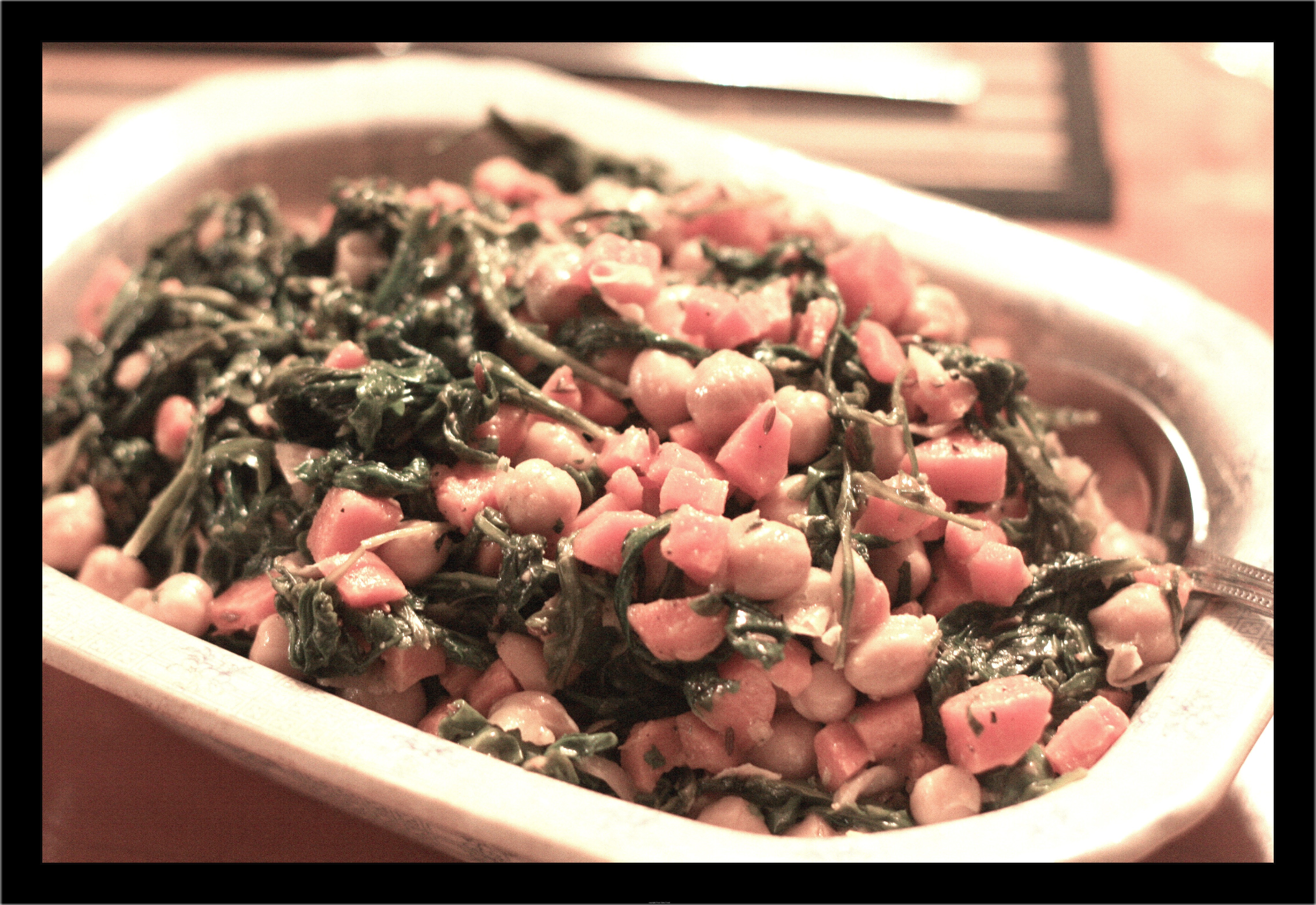
I am not obese. I have been athletic my entire life. I don’t eat sweets. I don’t like chocolate. I don’t eat anything white, or any baked goods, cakes, candies, or pies. I eat meat once or twice a month, and pasta a bit more than that. I love rice and Asian food and whole grains and towering piles of sauteed kale with tons of garlic and hot red pepper, and I can eat an entire bucket of heavily-spiced chole in one sitting.

I don’t live in a food desert. Very far from it.

But as a comparatively monied American who grew up in 1970s semi-suburbia, I also love pizza, and cheese, and sausage, and good wine, and hand-crafted ale, and barbecue, and the very occasional grass-fed hot dog. I am kept in local, organic eggs by chickens who live next door, and I eat those eggs poached and served on whole grain toast, or fried and tucked into a griddled roll with a tissue-thin slice of ham, or fried and perched atop a tangle of soba noodles heavily doused with Sriracha sauce. My idea of a swell Sunday night is roasting a local chicken (not a neighbor) surrounded, as Laurie Colwin once described it, like a tugboat in a sea of olive oil-slicked vegetables glimmering under a snowy shower of salt crystals.

In my home, the pizza is produced from organic, local ingredients. The cheese comes from a cow whose name I know, and the sausage is house-made by Steve-the-Butcher. The salt crystals are hand-harvested. The chicken has a grassy, earthy taste, from noshing on the slugs in the fields where it has spent its chickeny life gleefully roaming around. It’s all, generally speaking, pretty healthy stuff. And expensive. It’s what food professionals like me rave about. It’s the way we want to eat — the way we want everyone to eat; folks would be a lot healthier if they did  — and we’re very lucky if we can.

But we shouldn’t. Not all the time.

Not in the quantities that we, in this country — that I, in my home — have come to know as normal. It doesn’t matter if it’s locally sourced or hand-crafted or made from a cow named Ernestine who lives on the north side of a pasture in Vermont. I am proof positive that, however spectacular the ingredients, too much is just too much. Whatever it is. As I once said here, grass-fed beef is lovely. But it’s not a vegetable. Not. A. Vegetable. 

Given the quality of the food that I eat and the way that I cook it, I really shouldn’t have this issue with triglycerides and the beginnings of glucose intolerance. But I do. And knowing this fact — finding out about it just as 2011 is poised to leave — is the greatest gift that anyone’s ever given me. Despite the tears.

I am representative of those of us who run screaming from fast food, who don’t eat anything processed, who rarely eat anything cured, who are members of $70-per-month gyms, who take their two dogs on long walks every day in their nice, tidy towns, who drink small-batch bourbons procured at high-end liquor stores, who shop mostly at organic cooperatives and CSAs and farmer’s markets and who know the names of the people who grow the corn that we eat with our veggie burgers. I ostensibly do all the right things; I can afford to. Many can’t.

But I now understand that sometimes, it’s not only what we eat, but how we eat it, how often we eat it, and in what quantity. Repeat: Too much is just too much.

So now, with a new year ahead, I’ll be thinking about food very differently. There will be a lot more vegetarian and vegan dishes showing up here, despite the little piggy who lives up top. The ingredients will still be the local, organic, natural, and freshest I can find. There will be far more single-plate dishes, and those plates, physically, will be smaller.

This is my New Year’s gift to myself and my partner.

This is my fork in the road. I can go one way, or the other.


I'd like an electric menorah, please.

We never celebrated Christmas when I was child.

I grew up in a Jewish home — well, sort of; I didn’t go to Hebrew school and we never kept kosher and my maternal grandmother had just the tiniest obsession with dragging me off to see the life size Baby Jesus at St Patrick’s Cathedral every Shabbes before Christmas Eve — and while we were surrounded by the trappings of the holiday, we never actually initiated any Christmas activities. We had no tree, no stockings, no eggnog, and no Yule log, except for the one that burned for twenty four hours on Channel 11. Every Christmas, I would watch it in a catatonic stupor and invariably drift off, imagining that those were the peals of the non-existent churches in my Queens neighborhood instead of car alarms.

Still, every family has their own ways of marking the holiday season, and we were no different. Over Christmas, my best friends down the street filled stockings and went ice skating at Skyrink or Rockefeller Center, and came home to hot chocolate laced with tiny, industrially-fabricated marshmallows, and plates of golden, broiled, buttered toast sprinkled with sugar and cinnamon. One year, we spent the holiday with friends who lived a few floors up from us in our apartment building. I don’t know what is more vivid: the memory of my friend’s big brother — a large child — getting his head stuck for hours in a cherry red football helmet that my father had bought him, or the half pound of sugar that their mother had decided would make a flavorful addition to the pork meatballs that were a regular part of their Feast of the Seven Fishes.

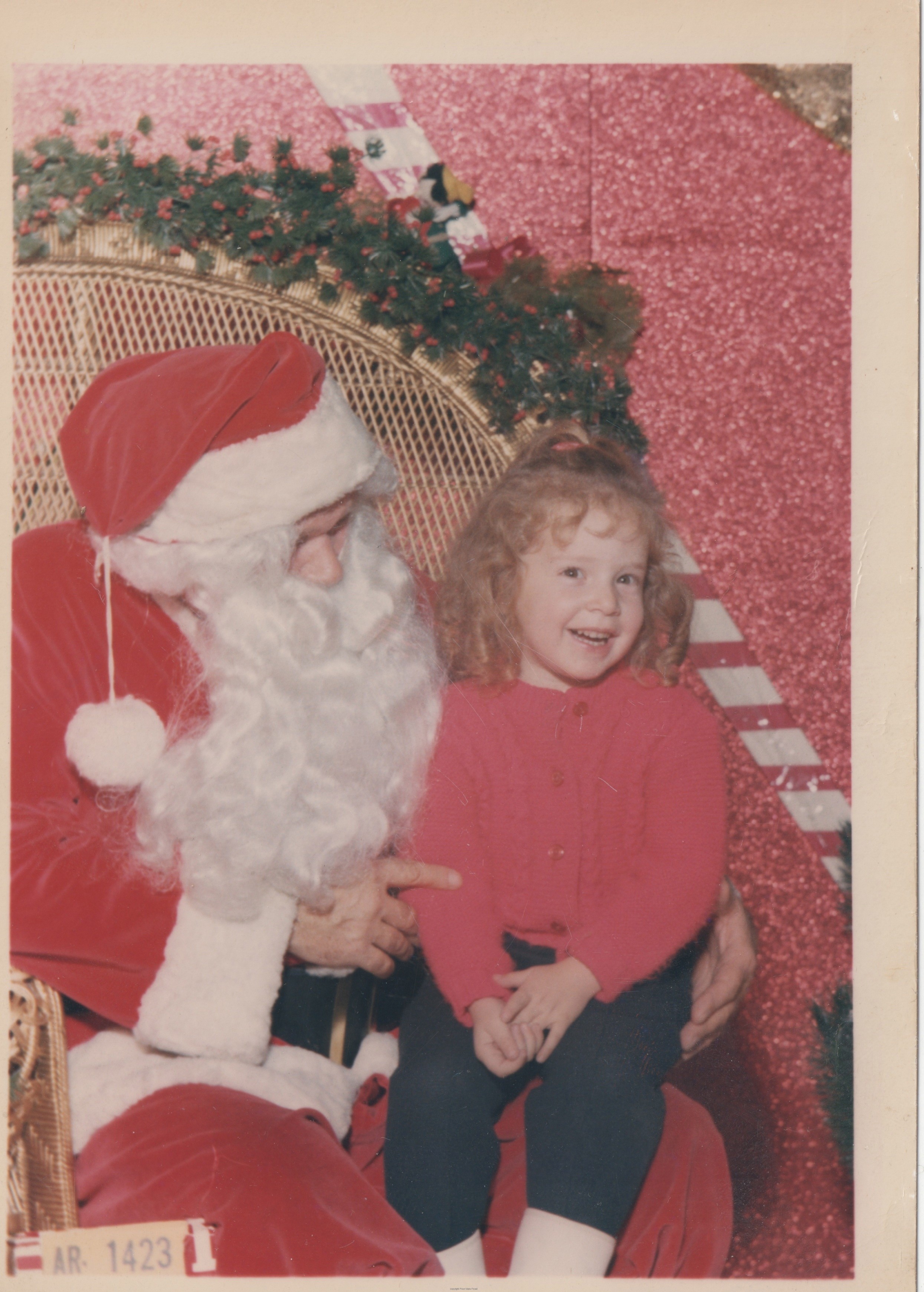
When they were very young, my friends were taken to sit on Santa’s lap at Macy’s; one year, my mother and grandmother turned the thumbscrews until my father relented and plunked me down on the lap of the truly fabulous 1970 Santa who asked me what I wanted for Christmas.

An electric menorah, I said happily, meaning the kind with the orange bulbs that you turn a little bit to ignite. They flicker constantly no matter what you do, like a sort of Judaic disco ball.

As I got older, my holiday desires and needs changed fairly radically: I began playing the guitar when I was very young, and by the time I was eight, I was fanatical about it, always hoping that my holiday would involve strings or picks or capos or that 1939 Martin D-28 I coveted. A few years later, when I started taking piano lessons, I infuriated my teacher, a short French man with a red combover; he was incensed that I could play as well as I could by ear, and proceeded to torture me with technique and theory. He eventually quit when he walked in for my lesson one pre-Christmas afternoon and found me staring at the ceiling and playing God Rest Ye Merry Gentlemen by heart, using both hands.

“Your daughter ees petulant,” he said to my father, who just smiled, handed him a five dollar bill and wished him a happy holiday. He never returned.

That Saturday, my father announced that we would be spending the day together while my mother was working part-time in Manhattan as a fur model.

“We’re going to the mall,” he said, as we drove out along Grand Central Parkway and then south, on the Cross Island. I assumed it was to do some shopping, but he had other plans, and as we ambled through the glittering corridors of 1970s consumerism — there was a store called Magik Candle that sold black light posters and spewed bilious clouds of incense into the air, and tee shirt shops where you could choose iron-on appliques featuring everyone from Loggins & Messina to the cast of Welcome Back, Kotter — he steered me along until we got to an enormous, carpeted showroom lined with pedal organs. And it was there that we began a special holiday tradition all our own.

When we got to the Wurlitzer store that first year, the salesman — a thinnish guy with greasy dark hair, dressed in a russet brown polyester triple weave suit with a sprig of fake holly stuck in his lapel — stood loitering nervously around the entrance to the organ showroom, looking like Mr. Bean.

“Bet I can teach the little lady how to play in no time flat–” he gloated to my father, slapping him on the back and winking at my diminutive, snorkel parka-wearing self as we pretended to stroll past on our way to the mall steakhouse next door, for a frozen Beef Wellington and virgin eggnog snack.

“I guess,” my father replied, shrugging his shoulders while I stood there.

“Why don’t you give it a shot, honey,” the salesman beckoned. “Let your daddy hold your coat, and sit right down over here.”

I took my parka off and handed it to my father while the salesman pulled the bench away from an enormous, four foot-wide pedal organ that sat on a low riser near the entrance to the store, its red levers marked TUBA and SOUSAPHONE and BOSSA NOVA. He flipped the ON switch and the organ purred like a kitten.

“Let’s set the beat for you,” he said. And he pressed another button marked RHYTHM, and a muffled, electronic uptempo began, untethered to any music or melody, like an arrhythmia.

“The keys are marked with numbers, honey, so just press the ones that correspond to these—”

He propped the EASY ORGAN 1-2-3 sheet music for Have a Holly, Jolly Christmas in front of me and pointed to the color-coded, numbered notes.

“Think you can do it, sweetie?” my father asked, feigning sincerity.

“I’m just not sure, Daddy –” I whined, looking over my shoulder.

“Come on, honey–” the salesman implored, impatiently. “You’ve already got your rhythm section. Let’s give her a whirl—Go on and play some Christmas jingles!”

A small crowd gathered around behind me, laughing at the fact that my feet didn’t even reach the pedals. I  pushed up my sleeves, took a deep breath, flipped the BOSSA NOVA lever to the ON position, and played the single-note version of The Girl from Ipanema, which I’d picked up from recently listening to my parents’ new Astrud Gilberto album. In the years that followed, I’d go on to play Delilah, The Green Green Grass of Home, and eventually, the first four bars of Positively Fourth Street, just like Al Kooper.

“That’s not very Christmas-y,” the scowling salesman said through his teeth that first year. He was embarassed and confused and hopeful all at once, and as he stood next to me on the riser, sweating, his face flushed a deep, holiday red. The crowd applauded wildly as I climbed down and took my coat from my father.

“Wow–” my father said to the salesman. “I guess it really is a cinch!”

“She’s a natural,” the salesman admitted. “I can have this baby sitting in your living room in time for Christmas dinner —” he added, taking a cordovan leatherette pad out of his jacket pocket to write up the order.

“I don’t think so,” my father replied, handing me my parka and ushering me away as the salesman blanched. “But thanks all the same — and Merry Christmas.”

A few minutes later, my father and I were sitting in a booth at the steakhouse next door, listening to the Muzaq version of Ave Maria, and sharing a Beef Wellington before heading back to Manhattan to pick up my mother.

My father took thoughtful sips of his gin Gibson from a small martini glass.

“I think we really got him — didn’t we,” he mused, pulling the tiny onions off their little plastic sword one by one.

“I guess so,” I said, sucking up my fake eggnog through an unraveling paper straw. I felt badly that we’d just bilked this guy out of the hefty commission he was certain he’d made, while onlookers quietly ran silent computations, envisioning their children flipping a switch and suddenly being able to play Lady of Spain, right out of the gate.

“Maybe someone else will buy one,” I added brightly, silently wondering exactly how many Wurlitzers could possibly ever be sold in the course of one Christmas season.

“Could be,” my father said, slicing into the tufts of puff pastry wrapped around the meaty hockey puck. “Could be.”

We ate in silence that afternoon and during all the Christmas afternoons at the mall for years that followed, until I got too old, and too good at playing keyboards for it to be funny anymore. It was years before I understood that the holiday was not about the mall and the Christmas consumerism and taunting the poor shlub with the plastic holly in his lapel, who probably never unloaded one damn organ; even though we lived in the city, it seemed to me to be about peace and quiet, and coming in from the bitter cold, and powdered hot chocolate with marshmallows that tasted like styrofoam, and the burnt sugar rime on the cinnamon toast that my friend’s mother down the street made every single Christmas, and still does. Each year, she eats it quietly before her adult children arrive, sitting alone in her kitchen and listening to an old vinyl Caedmon recording of Dylan Thomas’s A Child’s Christmas in Wales, while the dusty, unremarkable spinet piano of their childhood gathers dust in the corner, next to the tree.


indiebound


©2009, ©2010, Poor Man's Feast. All rights reserved. To reprint any content herein, including recipes and photography, please contact rights@poormansfeast.com