It happened at exactly 1:07 pm this afternoon, Eastern time.

She called my cell as I was sitting in a restaurant, having the Tuesday sushi lunch special.

I was minding my own business, wondering about the freshness of the so-called toro, when my phone vibrated and her number came up. Not being of the mind to take calls on my cell while I’m sitting in a restaurant, I let voice mail pick it up. I took a sip of tea, and listened to her message. She was talking through her teeth.

I have tried you everywhere. I called you at home. I’m calling you now. I demand that you call me back this instant. DEMAND.

And then she slammed the receiver down so hard that I heard the ringer vibrate on the old Princess phone that she refuses to get rid of, even though talking through two Dixie cups and a string would be clearer.

This is the conversation that my mother has initiated absolutely every Tuesday before Thanksgiving since 1978, when my parents divorced and my father invited me to attend a big, happy, holiday celebration at his sister’s home on Long Island. It was, otherwise, a fairly miserable time in my very young life, so Thanksgiving with a giant raft of cousins, their children, and my aunt and uncle turned out to be a bright spot. The food was very good, if extremely traditional. We’re all musicians to some degree, so there was always a lot of music. Eventually, I started staying over and spending Friday with them too, and then, a few years later, the whole weekend. I’ve done this every single year since 1978, apart from two: one year in the late 80s, I spent Thanksgiving in Woodstock, NY with some vegetarian friends, and roasted a stuffed pumpkin which leaked all over the inside of their oven and onto their heart pine floors. Last year, Susan and I rented a cottage in Mill Valley, and spent the holiday with her cousins who live in the Bay Area. Other than those two times, I have spent Thanksgiving with my father’s family every year since Jimmy Carter was in office. Since before the Iran Hostage Crisis. Since before John Lennon was shot. Since before Three Mile Island. SInce before Harvey Milk was murdered.

That’s a long time.

So the question Where are you going for Thanksgiving — the one that gets wielded, angrily, like a scimitar by my mother every Tuesday before the holiday — needn’t be asked, really. Really.

But, in the way that some people automatically begin their preparation for the holiday the minute the Halloween candy gets put away, her vituperative message is like a call to action for me. I start fretting about Thanksgiving dinner around noon the Tuesday before — that would be today — when she phones to remind me (in the spirit of the season, of course) what a lout I am, and have been, lo these many years. While she harangues, I wonder blithely to myself if my cousin Carol, who is a stellar cook, will plan to brine the turkey, or dry-salt it the way Russ Parsons now does thanks to Judy Rodgers. We have some food allergies in the family — I’m allergic to melon (crazy), my cousin Mishka is allergic to fish, my cousin Joan is allergic to nuts and fish — and so I have to remind myself not to worry because we’re really not a pecan-and-oyster stuffing sort of crowd.

While I hear her scream the litany of wrongs I have perpetrated over the years that I haven’t seen her on Thanksgiving, I make notes to myself about wine: Carol is an oaky chardonnay drinker from way back, and proudly prefers the hefty, syrupy style that American chard drinks often love. Nina, her sister, drinks only red because white wine is simply too acidic for her. Susan and I will drink red — a nice Pinot Noir, like maybe the Sinskey that I once had with my cousins some years back when they invited me to spend a few days with them in Aspen. So maybe this year we’ll surprise them with bottles of Heitz chardonnay, and, if we can find it, Van Duzer Pinot.

Right around the time that she asks ARE YOU LISTENING TO ME? and I mistakenly remind her that I have just cooked a fancy dinner for her and her friends over the Jewish holidays — it’s really the only time that she likes to trot me out as a doting cook — and that her cousins have invited her to their home in New Jersey the way they always do and she tells me that it will be just too embarrassing for her to be seen without me, that she’s too sick to death to bother eating anything and will plan to just lay in her bed and rot while everyone around her has a good time, I make a note to myself to remember to tuck our autumnal cookie cutters into the suitcase, in the event that Susan is asked to make the apple pie that everyone loves.

You’ve never spent Thanksgiving with me, I hear her shout. Never.

And I remember, through the short, bitter silences, and the accusations of neglect and the implication that I have chosen one side of my family over the other during this, the season of love and togetherness, that there was one other time that I didn’t spend the holiday with my cousins on my Dad’s side: instead, I stayed home in Forest Hills and made a small turkey for my mother and her soon-to-be second husband, Buddy. When my father had moved out, he’d taken the electric slicer with him, leaving me to hack away at the Butterball with a serrated Ginsu tomato knife.

“It cuts through steel,” Buddy said. “So you should be fine.”

Together, they sat at the table in silence while I fruitlessly searched for the ball joint that connects the leg to the body, like a blindfolded surgical student. My grandmother held aloft an open can of cranberry jelly — the stuff with the ridges — over a serving bowl, waiting for gravity to suck it out like a vacuum. And I, at seventeen, played the role of the Dad, serving everyone hunks of turkey that looked as though it had been carved with a dull axe, and had the general consistency of a Balsa Wood airplane. I don’t really remember eating much that night, although I’m certain I did.

Maybe this is why I’m not terribly fond of turkey, and only prefer it when it’s morphed into something else, like turkey soup with dumplings, or turkey hash, or turkey croquettes, or turkey pot pie. Maybe this is why I invariably wind up sneaking away during the holiday week and gorging myself guiltily on things that the Pilgrims most certainly never ate, and that have no bearing on this bittersweet holiday, like tofu, or Shanghai soup dumplings, or Penang curry, or a middling sushi lunch at a suburban Pan-Asian dive eaten while scribbling notes to myself about things to pack for our holiday trip to my cousins’ house.

I’ll never know for sure.

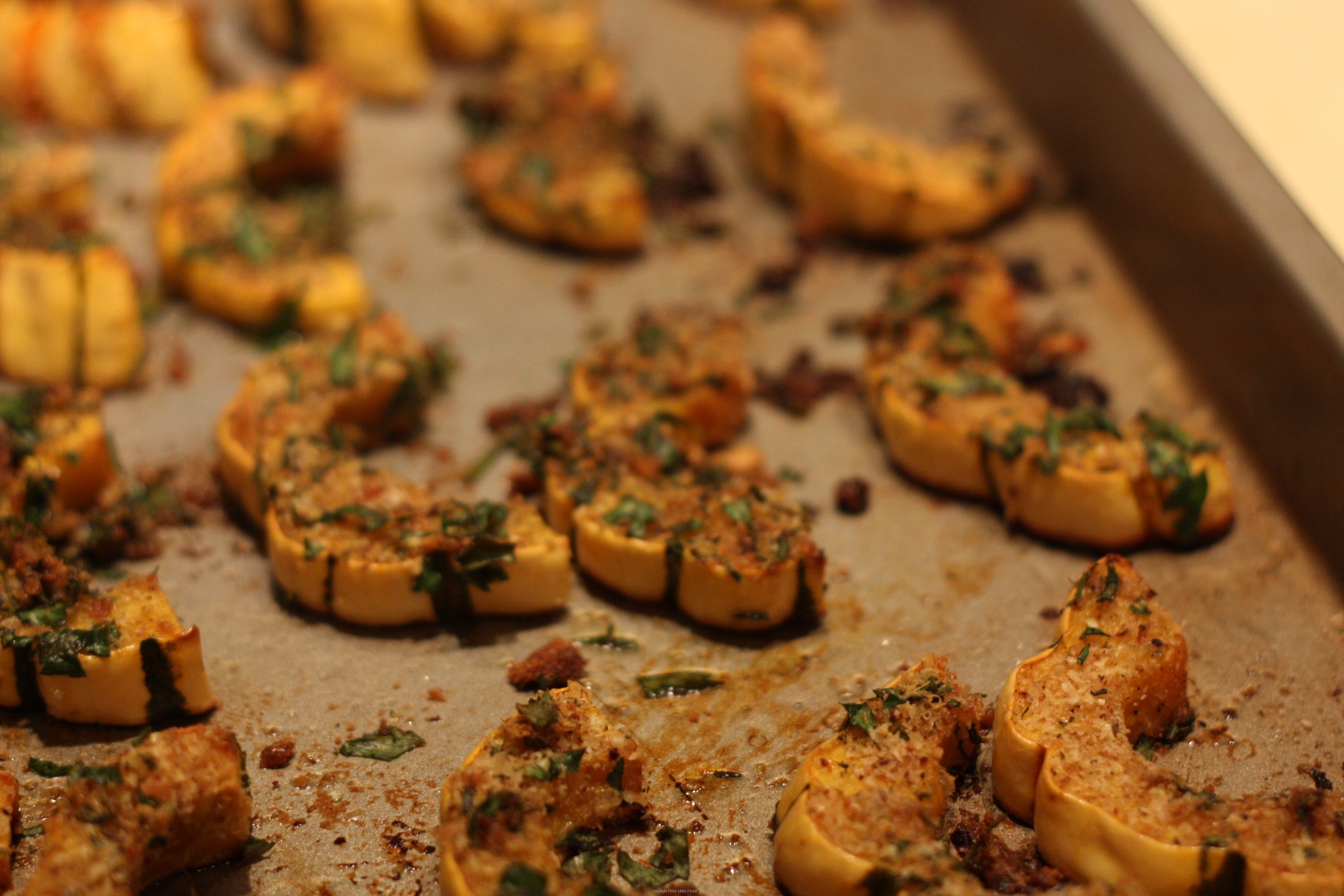
Crusted Delicata Squash with Dilled Yogurt

(adapted from Plenty by Yotam Ottolenghi)

The original version of this dish calls for pumpkin, which I just can’t cope with. It could be because of the exploding Thanksgiving pumpkin experience I’ve mentioned in the past, or it could just be because there are only two of us in the house and roasting a whole pumpkin seems excessive if you’re not doing it for a crowd. I happen to love delicata squash for three reasons: one, it’s so — well — delicata. Second: you can eat the skin. At least I can, and I do. Third: it takes virtually no time to cook, comparatively speaking. The bread-crumby, Parmigiana crust is a lovely counterpoint to the squash’s smooth texture, and the yogurt, which replaces the dish’s original sour cream, offers a tangy high note to the dish.

Serves 4

2 medium Delicata squash, sliced into 1/2 inch rings, seeds removed

1/2 cup grated Parmigiana Reggiano

3 tablespoons fresh breadcrumbs

6 tablespoons finely chopped parsley

2-1/2 teaspoons finely chopped thyme

grated zest of 2 lemons

2 garlic cloves, crushed

salt and pepper, to taste

1/4 cup olive oil

1/2 cup plain yogurt

1 tablespoon chopped dill

Preheat oven to 375 degrees F.

In a small bowl, mix together the cheese, breadcrumbs, parsley, thyme, half the lemon zest, the garlic, a small amount of salt, and black pepper.

Brush the squash with the oil, and sprinkle with the crust mix, making sure the slices are covered well. Place the squash on a greased, stick-proof baking sheet and roast for about 30 minutes, or until tender.

Mix the yogurt with the dill. Serve the slices warm, sprinkled with the remaining zest, and drizzled with the yogurt sauce.
Over the last ten or so years, I have sat on countless conference and symposium panels, dressed in different hats. Sometimes, I wear my prim editor’s hat — not quite a pillbox, it sits painfully safety-pinned to my head lest it be blown away in an electronic windstorm. Sometimes, I wear my writer’s hat — a vintage one, its gray hatband missing from years of benign neglect, it’s now pulled on so firmly that it’s hard to remove. Other times, I wear my baseball cap backwards so that the peak doesn’t cast a shadow on the speech that I’ve downloaded to the iPad that generally, when I am not reading it on train trips or long commutes, lives in my kitchen, right next to my stainless steel fridge.

Whatever hat I wear, there is always the inevitable question that comes up, either as the subject of the panel I’m on, or directly from an attendee:

So when, exactly, do you think the digital world will kill cookbooks?

My answer is always the same:

Never.

Sometimes, there’s guffawing. Sometimes, I hear strains of relief. Sometimes, people get up and shuffle out. But the fact is, there is nothing to worry about: cookbooks, contrary to Julia Moskin’s wonderfully-written New York Times piece about apps potentially rendering cookbooks obsolete, are not going anywhere. In fact, in the face of the more remarkable apps out there, like Dorie Greenspan‘s amazing Baking with Dorie, cookbooks will be better produced, more interesting, and more desirable for one reason: they’ll have to be.

As a longtime editor (I went straight to work for Random House after graduation from college in 1985, then took a break to attend cooking school and to work at Dean & Deluca as a specialty cookbook buyer; then went to Little, Brown and then to Harper for ten years; there were a few other editorial pitstops along the way) who came of age at a time when “food media” toggled back and forth between books and their television tie-ins, I saw cookbooks increasingly become products timed to release simultaneously with their on-screen counterparts. Bookstore shelves were packed with this “product” to the degree that the average shelf lifespan for the average “B” list book (in other words, a book produced by a midlist author who has not yet become a household name or a bestseller) was six weeks; the rule of thumb among chain stores was that if a “book product” didn’t “move” within that time period, it wasn’t going to, and it was sent back to the publisher as a return.

Qualitatively-speaking, the faster these “book products” were being cranked out to appear with their television tie-ins, the more flimsy and slipshod they became: paper quality suffered. Recipes weren’t tested. Edits were truncated. Photos were mistakenly repeated pages apart. Proofreads lost importance. Cookbooks suddenly became the equivalent of the inflatable Paul McCartney that my father bought for me in the mid 1960s, when The Beatles’ Saturday morning cartoon series eclipsed everything else in the same time slot: when inflatable Paul, who was made cheaply in China, sprung a leak, we just patched him up with duct tape, until his head was completely swaddled in it and he began to resemble Marley’s ghost. Inflatable Paul was never meant for the long haul or for snuggling with, in the same way that a lot of the cookbook “products” I speak of above weren’t meant for long haul cooking and certainly not snuggling: their spines would break and their pages fall out, but in the end it didn’t really matter, because it was really all about the television show. Cookbooks, in many cases, were thought of as a secondary “support” to a primary “new media” product, that being television, and a few years later, video.

Eventually, even as cookbook quality slipped, publishers began to fuss and fret about how the books were going to be used, or even if, in the face of this new media;  I remember the day I sat in an editorial meeting, and my publisher announced that “if home cooks can watch Jacques Pepin boning a chicken over and over on a video, they’re not going to buy a book to read about it.”

Years before I sat in that meeting, I was instructed by Joel Dean to carry the paperback edition of Pepin’s instructional opus, La Technique, in my department at Dean & Deluca. It was — it is — a remarkable book featuring black and white, step-by-step images for doing everything from correctly making choux pastry to filleting a flatfish. It takes time and patience and unerring focus to work from it; it assumes a certain level of concentration and dedication to task, as do all serious instructional books. When Julia Child described in both words and illustrations how to bake a baguette in 36 pages, she did not assume that her reader suffered from the media-related attention deficit disorder that now plagues us all; the affliction that thrives on, prizes and applauds the reduction of a human thought to 140 characters had no place in her work, as it doesn’t for anyone who wants to put method to steadfast practice. Julia, love her or hate her, assumed that her readers wanted to learn, and to learn thoroughly. Other instructional bibles followed, from Jacque’s to Anne Willan’s and James Peterson’s and, more narratively, Richard Olney’s, who instructed in words only how to turn a chicken inside out like a pillowcase for his poulet farci duxelles.

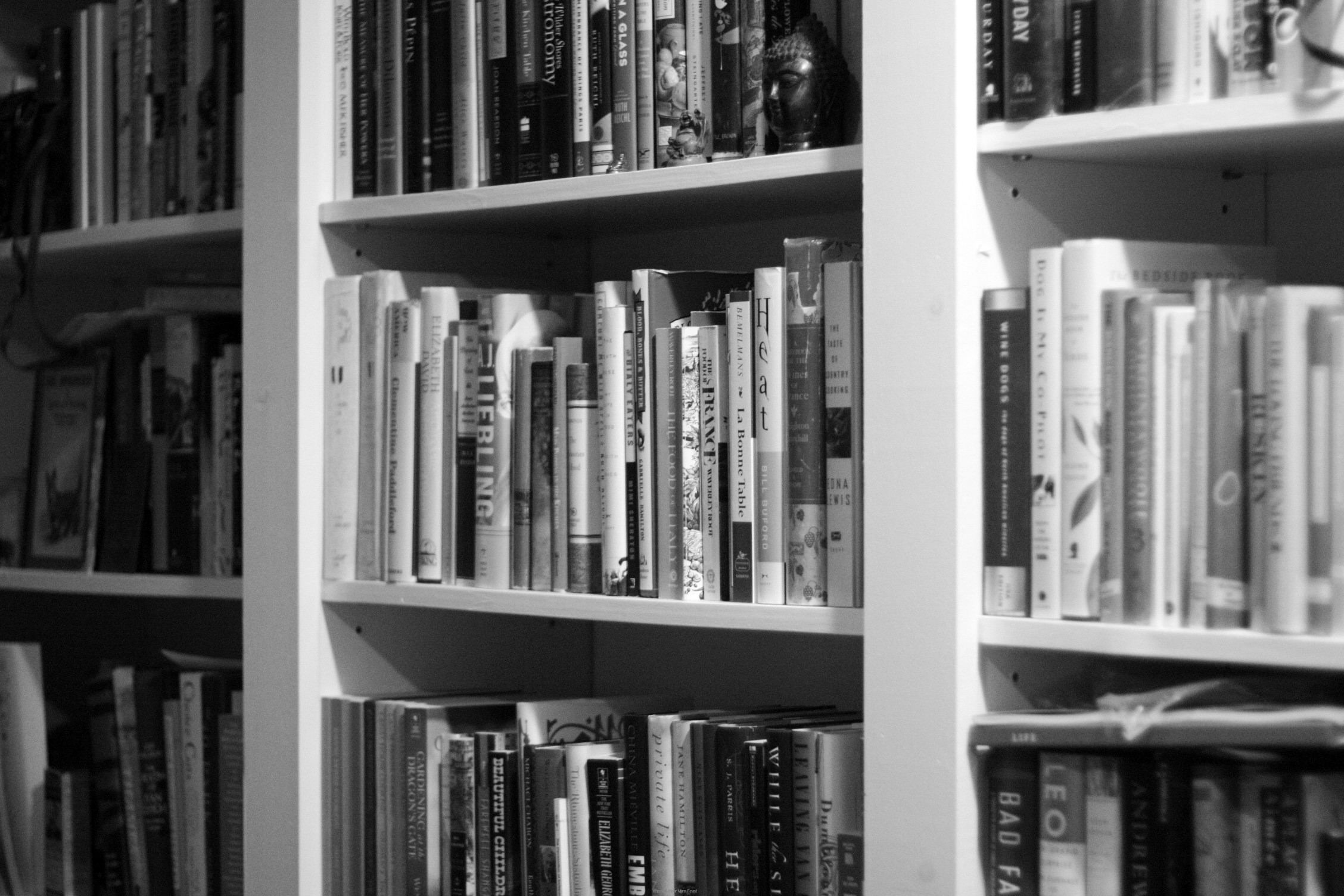
Beyond instructional content, cookbooks — good cookbooks; not the secondary product I mention above — are often read like straight narratives. Years ago, Paula Wolfert’s Mediterranean Cooking sat on my nightstand, and before I cooked from it, I read it like a memoir; when I was finished, I was drawn to the work of Lawrence Durrell and Paul Bowles (and if you’ve read Paula Wolfert’s work, you know why) and Elizabeth David. I cooked from the book too, and years later I still make the pasta con mollica di pane and bisbas michchi found within those pages; the book is alive with sights and smells and texture and poetry, and reading it, my brain wanders down alleyways it would never travel via a digital medium. When I made Wolfert’s paella, I accidentally splashed olive oil onto the recipe page; when I open the book today, I swear I can still smell it — I certainly can see it on the stained page, and I recall the dinner party I had the night that I made it, right down to the wine I served (Taurasi Salice Salentino 1995). Cooking and reading actual cookbooks show me where I’ve been; they reek of history, and anchor me in the way that, however vague, the assembly directions for Thanksgiving turkey in the 1951 Joy of Cooking anchored my aunt when it was just her and the book, and the concept of the iPad app was about as Jetsons as power steering.

Publishing is a sometimes fearful, ancient business that has, for the last ten years, been chewing on its collective fingers over what I call monomedia, or the belief that readers will get their information one way and one way only, exclusively, and not from books because they’re not sexy enough to compete with digitalia. To be clear, there is no question that cooking apps have claimed a seat at the publishing table, and rightly so: the ability to watch and re-watch Dorie Greenspan feel and poke biscuit dough so that you can actually see its correct consistency is unmistakably brilliant, and enormously valuable. I own the app, and use it, and will likely give it as a gift to many friends this season.

But to claim that the advent of the cooking app is going to render cookbooks obsolete is misguided; the digital must complement print, and vice versa, in order to achieve the innate balance between what Sven Birkerts calls, on one side, “the reading encounter, the private resource …” and on the other, “the culture at large, and the highly seductive glitter of mass-produced entertainment.” The response to the need for this reading encounter — this private resource — has been coming largely and most creatively from smaller cookbook publishers and highly-skilled self-publishers both in the United States and Britain who have eschewed the glitz and the six week bookstore sell-in, and instead purposely produced the kind of high production value cookbooks that are meant to be read, cooked from, cherished, and savored again and again. And they’re not going away any time soon.

Where Julia Moskin got it wrong is in describing the notion of “recipes that exist only as a string of words” as a relic. Recipes —  the writing of them, the printing of them — show us who we are; they speak of what Birkerts called in The Gutenberg Elegies,” the immobilization and preservation of language. To make a mark on a page is to gesture towards permanence.”

Cookbooks are about a sort of gastronomical cultural stability, and historical durability; they tell us who we are, as humans. Digitalia, in all its glitzy, glittering ability to visually elucidate, is at best, fleeting and illusory. And at every conference and symposium at which I’ve spoken, someone invariably stands up and announces in one breath that PRINT IS DEAD, and a few hours later, while sidling up to the bar for a glass of artisanal, small-batch bourbon, haughtily proclaims that his agent has just sold his next book.

“I grabbed the brass ring,” he says, “….again!”

indiebound


©2009, ©2010, Poor Man's Feast. All rights reserved. To reprint any content herein, including recipes and photography, please contact rights@poormansfeast.com