(For Christina Choi, 1977-2011)
My grandmother was the primary cook in my house when I was growing up, and much of what she made had a sort of Mitteleuropan bent to it: veal breast was stuffed with dried fruit, strudel was laden with cabbage, roast chicken was redolent of paprika, beef was braised with caraway and sour cream, and tea was drunk from a glass. Her preferred side dish always seemed to be potatoes and onions that had been haphazardly sliced and tossed into the bottom of the roasting pan, where they would soften and then caramelize alongside whatever else was cooking. She sometimes made egg noodles. She sometimes made rice. And on the most special of occasions, when she was really reaching back into her Austro-Hungarian genetic memory, I’d find her standing in the kitchen with an enormous, enameled, white colander through which she’d press a thinnish batter into the pot of rapidly boiling water beneath it. Minutes later, I was presented with a bowl of misshapen, butter-soaked knoepfli — what she called sometimes called spaetzle and other times, Little Rags — and a spoon.
There was nothing I loved more, and even now, I’ve been known to order whole dishes just because they come with a side order of this stuff of my dreams, which otherwise manages to get lodged in the recesses of my culinary brain alongside grape jam and latkes, and the other things I really like and have mostly forgotten about until formally presented with them.
A few months ago, I flew to Seattle for a few days to have a short meet up with my friend Molly. It was a totally miserable flight. Weather forced me to lay over in Chicago, and this was no Bourdain layover: it was the kind of layover where you find yourself sleeping in your clothes in a Motel 6 situated alongside a gun/pawnshop, and trying to not hear what’s going on in the room next to you just beyond the adjoining door. By the time I reached Seattle the next day, I was just this side of comatose. I mostly remember the dukkah that came sprinkled on the feta we ate at Sitka & Spruce the day I arrived, and how good the bread was. I can’t help but remember how incredible the pizza was that night at Brandon Pettit’s Delancey. Molly and I worked a little bit and talked an enormous amount, and the next day she took me to a tiny place called Nettletown in Eastlake, for lunch.
“It’s Christina Choi’s restaurant. The food is simple and lovely,” Molly said, as we drove over.
I was still a little catatonic, but my interest was piqued as I learned that Christina was half Swiss and half Chinese. And that you could get noodles and tea eggs and scallion fried tofu.
And knoepfli, for which, Molly said, Christina was known.
Nobody is ever known for their knoepfli.
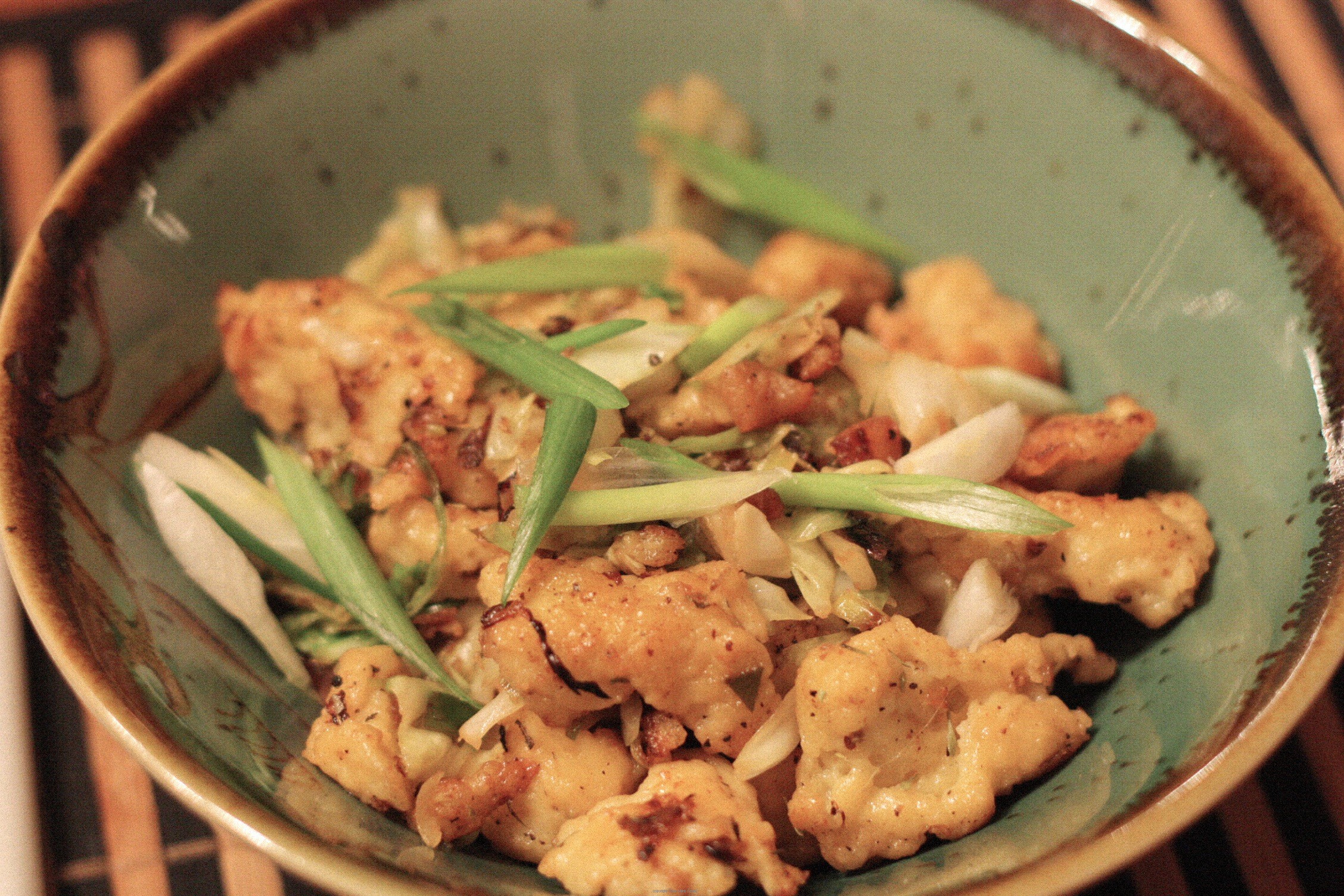
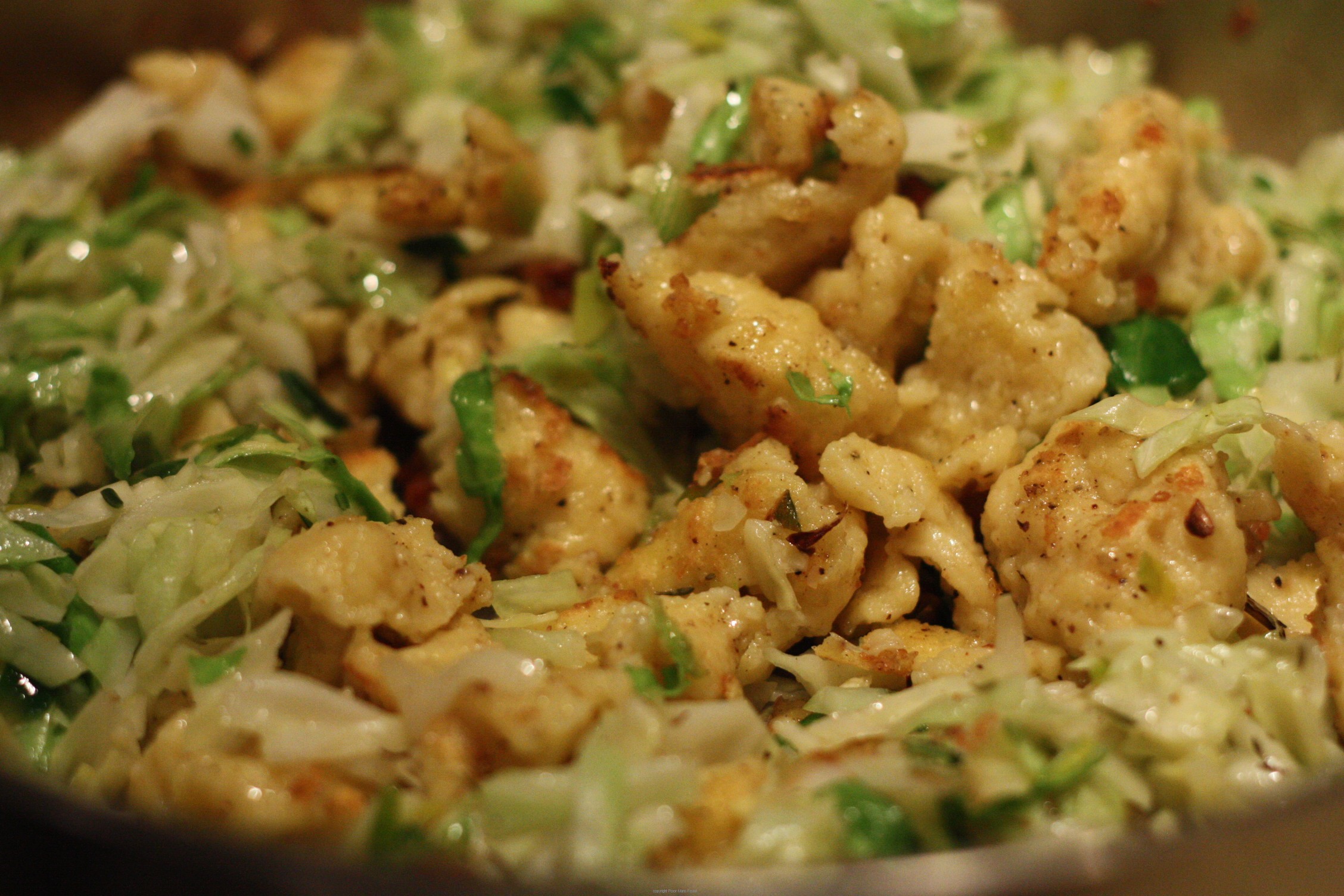
We sat down — the only people in the restaurant that afternoon — and at Molly’s suggestion, I ordered a bowl, and the knoepfli arrived, pan-fried to a lovely dark caramel, and laden with herbs, leeks, cabbage, and bacon. I think there was a poached egg involved. There might have been a drop of soy or shoyu, but I’m not positive. [Post pub note: A friend of Christina’s who posted a reply below pointed out that it was Maggi seasoning that I was likely tasting. Maggi is a umami-explosive Swiss condiment used heavily in Asian cooking–a lovely nod to Christina’s heritage. Thanks to Tea Austen.] Molly ordered something involving local, Rain Shadow bratwurst. I don’t remember anything else at that restaurant because I sat there, head down, indelicately shoveling enormous amounts of the tender, chewy, remarkable dumplings into my mouth. I don’t believe my eyes were closed, but they might as well have been, for the bliss I was experiencing.
Who was this Christina Choi person that she, at such a young age (34), could marry one side of her culinary heritage so seamlessly to the other? Why hadn’t I, on the other side of the country but still (jealously and vicariously) clued in to the gastronomical happenings in the northwest, heard about Nettletown, and about Christina Choi? Because, I guess, I wasn’t a member of the community.
I came home and told Susan what I’d had on my visit to Seattle. There were the Hama Hama oysters that smelled, sweetly, of the ocean, that we had at The Walrus and The Carpenter. There was that dukkah and the local feta at Sitka & Spruce. There were the small plates that everyone out there seemed to be comfortable eating as a matter of course. And then there was Nettletown’s knoepfli. I went on and on about it, like a lunatic.
“It was the very best thing,” I said to Susan, who, many years and another relationship ago, spent a lot of time in Seattle, and grew to love it. “—the very best. I can’t wait to go back, and to take you for the knoepfli.”
Every once in a while, in the middle of my working day, I’d peruse the Nettletown website, just to remember how great and interesting the menu was. And then, one day, out of the clear blue sky, my friend and colleague, Edible Seattle’s editor, Jill Lightner, emailed to say that the place was closing. They were successful, but I guess that Christina Choi wanted to do other things —- she was young, so why shouldn’t she? Still, I felt a sharp pang, knowing that I’d never again have her simple, sophisticated, rustic, Swiss Chinese riff on a dish of my childhood, for which I was willing to fly to the other side of the country to eat. There was something about the simplicity of it, its elegance, and its earthiness, and how near it was to my heart; it had captivated me as only truly simple, kind food can, and in the weirdest of ways, it wouldn’t let me go.
I never knew Christina Choi — I never knew that she had launched Foraged and Found Edibles with Jeremy Faber way back in 2001, and supplied the Seattle community with wild foods like morels, nettles, fiddleheads, and miner’s lettuce. I never knew anything about her, really — not about how much of a fixture she was in the very tight, very loving Seattle food world, or how big her family was, or how many friends she had. But when I heard that, on December 28th, after being diagnosed weeks earlier with a brain aneurysm, and having repeated surgeries, she died, I felt as though I’d had the wind knocked out of me. I spent hours reading the blog that her family created, Honey from a Weed — based on Christina’s favorite book that has long been one of mine — tracing her steps from diagnosis until the day that her family and friends had to say goodbye.
I don’t know what it is about food that forces connections like this. But I loved what Christina Choi crafted and the very personal, quiet gift that she gave to me — a stranger way over on the other coast — in a simple, delicious bowl of rags.
Pan-Fried Knoepfli with Cabbage, Leeks, and Bacon
Call it what you will — knoepfli, spaetzle, knopfle, spatzle — but at the end of the day, all these babies are are tiny dumplings made from a batter consisting of flour, egg, milk, and sometimes water, which gets pressed either through a colander or a special potato ricer-like contraption into a stockpot of boiling water, and when they float to the top, they’re done. It takes virtually no time for this to happen — maybe four or five minutes, tops — making the dish not only incredibly cheap (and a perfect foil for anything you’d otherwise toss with noodles), but really fast. I initially made my version of this dish with 2 eggs, which yielded a batter that was not unlike wallpaper paste; use 3 instead, and if you still cannot force the stuff through the holes in your colander, I give you permission to very gently drop strings of the batter directly off the tines of a fork into the boiling water while cursing like a longshoreman. But a colander is preferable.
Serves 3 as a side dish
For the knoepfli:
1 cup unbleached, all purpose f lour
1 teaspoon salt
3 eggs
1/4 cup milk
For the cabbage:
1/4 cup diced bacon
1 large leek, white part only, roughly chopped
3 loosely packed cups thinly sliced green cabbage
1 tablespoon fresh snipped chives
1/2 tablespoon thyme leaves
salt and pepper, to taste
1 tablespoon of olive oil
1 scallion, slivered
Optional: Fried eggs, slices of extra firm, fried tofu, Sriracha
Combine the flour and salt in a large bowl. In a separate bowl, beat the eggs together with the milk. Fold the egg mixture into the flour and stir well until the combination has the consistency of a thick batter. Cover and let rest while you bring a large stockpot filled with lightly salted water to a boil.
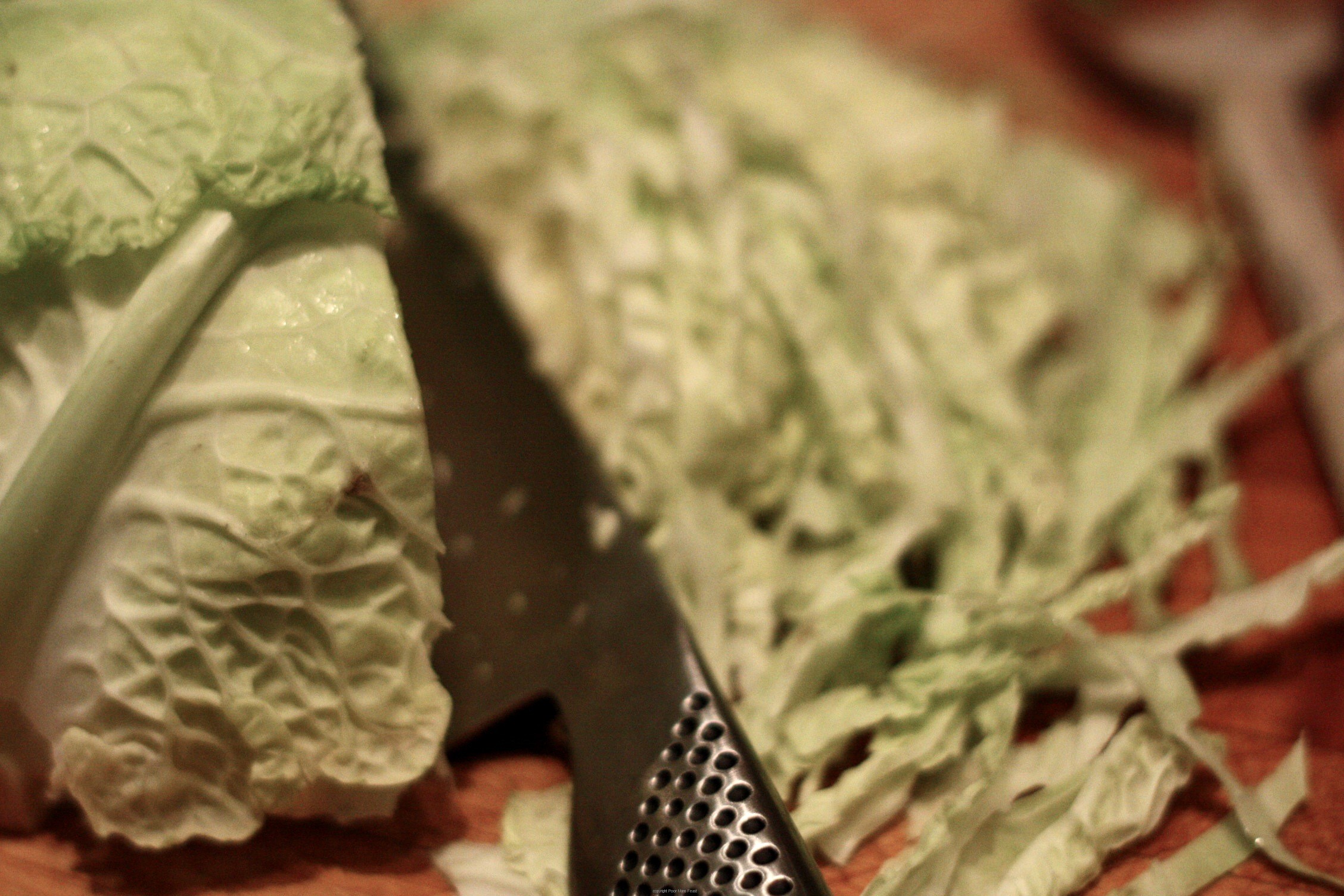
Meanwhile, in a large, straight-sided saute pan, cook the bacon until light brown and crispy, about 6 minutes, and wipe out all but a tablespoon of the remaining fat. Add the leeks to the pan and cook until soft, about 5 minutes; add the cabbage, chives, and thyme, and stir to combine. Cook until the mixture is a soft, wilted mess, about 12 minutes, and season to taste with salt and freshly ground black pepper. Remove to a bowl, and set aside.
When the water comes to a boil, carefully nestle the colander over the top of the stockpot, and using a wooden spoon or a silicone bench scraper, force the batter through the holes and into the water; they”ll resemble little rags. When they float to the surface, strain them and add them to the saute pan along with the olive oil. Cook until they begin to turn a light golden brown, and then add the bacon, cabbage, and leek mixture back to the pan. Cook together for another five minutes, and then serve hot, topped with a fried egg, or slices of tofu, or nothing at all beyond a squirt of Sriracha, a drizzle of Maggi, [Post pub note: Thanks to Tea Austen for the hint!] and a handful of slivered scallion.