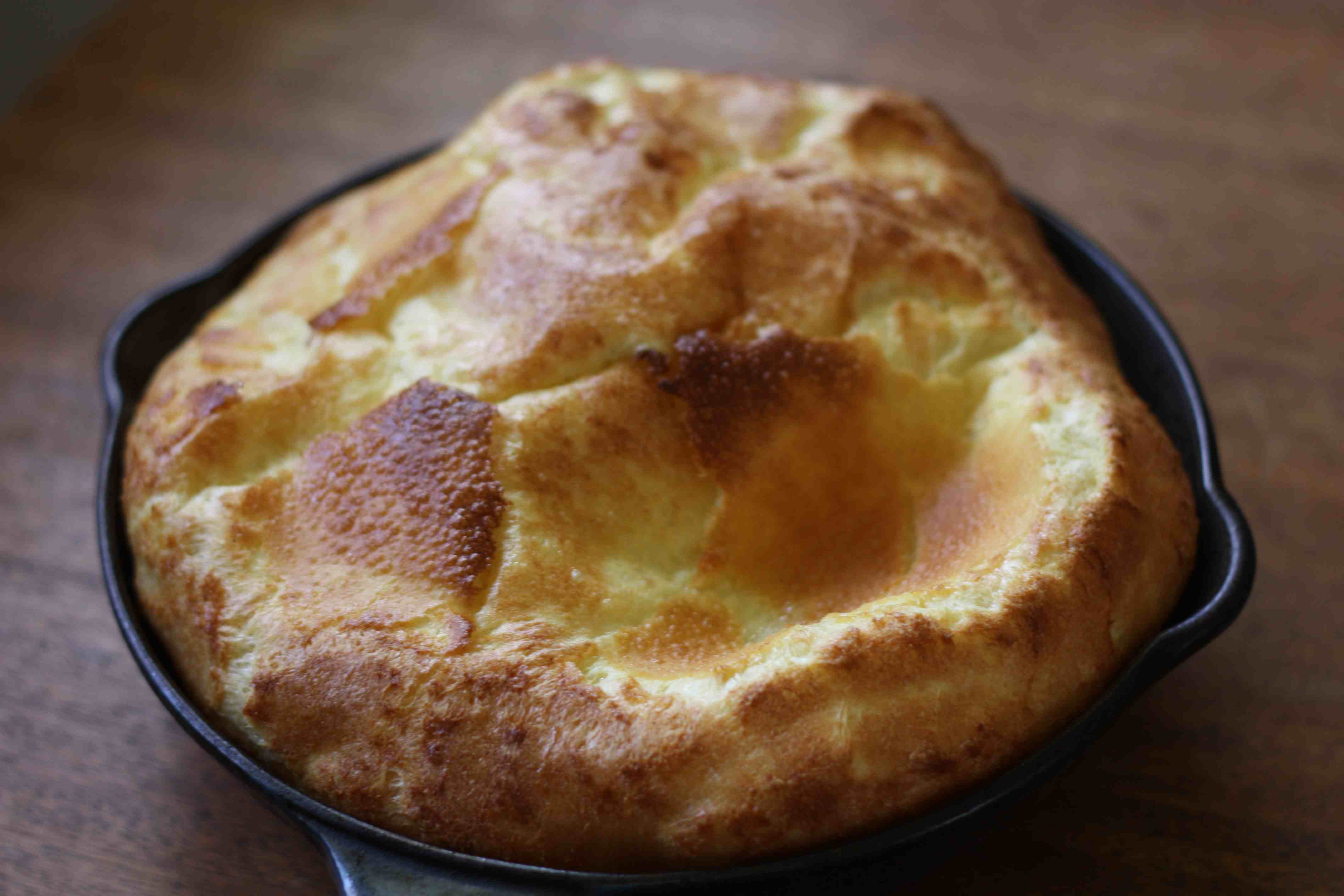
The perfect solution.

It’s a problem that we always face in my house: I want smoked fish in the morning, and Susan would rather have a cinnamon bun. If I yield to pancakes or waffles, I have to have them with bacon, or ham, for salt balance; if Susan had her way, her early food (anything served before 1 pm) would be slathered with honey. Or jam. And possibly sprinkled with confectioner’s sugar. Assuming she’s not eating a blueberry bagel.

Until fairly recently, this resulted in our eating the same thing on lazy mornings–who likes to cook two separate dishes?–and one of us always wound up feeling shortchanged. If Susan made pancakes, I’d eat pancakes, but then I’d have to have a meat product of some kind to take the edge off the sweetness. If I made poached eggs, or omelets, Susan would need something involving preserves, and if she didn’t get it, there was an inevitable midday yen for a cookie of some sort.

Both Susan and I were at home on Friday, reveling in the fact that we could sleep as late as we wanted to, and move around as slowly as we needed to, and it wasn’t even the weekend yet. By the time we were at the table, drinking tea and reading the paper, it was almost noon. By the time we decided on food, it was almost one. And by that time, Susan had decided on pancakes.

But I didn’t want pancakes. I didn’t want anything sweet first thing, because I never do. I didn’t want any toast, and we didn’t have any bagels, or fish in the house. What to make for a simple meal that could be either sweet or savory and enjoyed any time of the day?

The pancake that’s not a pancake. It takes virtually no time to put together, and when it comes out of the oven, it makes everyone happy: it can be sliced in half, or in quarters, and doused in maple syrup or honey; dolloped with fresh or stewed fruit; sprinkled with cheese and shoved back into the oven for a minute or so; drenched in chile sauce; or topped with an egg; or served with a salad. The possibilities are endless. Even better: it’s cheap as air, since you don’t have to run out to the store to buy a container of buttermilk, which you will use once and then find in the bowels of your refrigerator in eight months. Better still? It contains three ingredients (not including oil for the pan, and pinches of nutmeg and salt), all of which you likely have.

The best news of all? The sweet and savory battle has officially been declared a draw. Peace, at last.

Simple Baked Pancake

Variations of this recipe exist virtually everywhere; in some places, it appears to be Dutch, and in others, German. Some recipes call for the inclusion of butter in the batter, and some don’t. The only caveat: it has to be eaten immediately, and begins to fall the minute it’s removed from the oven. This version, which is one of the easiest I’ve ever seen, comes from Elizabeth Alston’s Pancakes and Waffles (HarperCollins, 1993).

Serves 2

1 tablespoon mild olive oil

2 large eggs

1/2 cup milk

1/2 cup all purpose flour

pinch salt

pinch ground nutmeg

1. Preheat oven to 450 degrees F. Grease a nine inch cast iron skillet with the oil, and place in oven for five minutes.

2. Beat together the eggs, milk, flour, salt, and nutmeg. Pour batter into the hot pan, and bake, uncovered, for 18 to 20 minutes without opening the oven door, until pancake is puffed and crisp. Cut in wedges to serve.
France on My Brain

March 31, 2010 · 5 comments

I go through phases in the kitchen; I suppose everyone does. Mine tend to be fairly drastic and existential, though; they often last a long time, and they wind up encompassing not only what’s going on on my stove (these days, simple French), but also what I’m drinking (Brouilly), and what’s playing on my iPod (Django Reinhardt). As for my propensity for wearing striped shirts, that bit of sartorial whimsy has its truth in the fact that I’m short and strongly built, and I want to make sure that no one ever mistakes me for being tall and thin.

These phases also effect what’s on my bedside table; lately, I’ve been reading a lot of Richard Olney, and not just his classic The French Menu Cookbook, Lulu’s Provencal Table, and Simple French Food. I recently pulled his memoir, Reflexions, off my shelf, and was surprised to discover that once I started reading it, I couldn’t put it down. I was even more astonished to discover that the subject of one of Olney’s paintings (which I will put up here if I am granted permission to do so) bore a jaw-dropping resemblance to my Grandma Bertha, a fact that even stunned Susan, who responded to the picture by asking what my Grandma Bertha was doing in France with Richard Olney in the 1950s when her family thought she was in Brooklyn, up to her ankles in schmaltz.

Reflexions is a wonderful bit of memoir that positively reeks of the author; it’s colorful, difficult, a little bit snarky, packed from cover to cover with texture and flavor, and is, generally speaking, utterly delicious. Meals in Paris with James Baldwin in 1954, followed by Olney’s gorgeous painting of the writer? Gossiping with Julia Child about M.F.K. Fisher’s writing? Gossiping with Elizabeth David about everyone else? The purchase of a ramshackle house in sun-drenched Sollies Toucas? The years of dining and entertaining, and the sort of friendships with people like The Peyrauds of Domaine Tempier that would evolve into life-changing relationships for everyone from Alice Waters to Kermit Lynch? If you’re like me, and you yearn for the kind of reading that, on a miserably wet, drenching day, will transport you instantly, you must buy this book. Instantly. Did I say instantly? Instantly.

It would make sense, then, that late yesterday afternoon, after hours stuck in my car during a torrential rainstorm, being re-routed along the (flooded) local parkway between my mother’s house in Manhattan and mine in Connecticut, I would crave something warming, inexpensive, and (of course) vaguely French. I didn’t want to stop at the store on the way home, though; I wanted to get into the house, get out of my damp clothes, put on my slippers, and cook something long and slow that would be waiting for Susan when she came home from work. All I had in the house, beyond leftover Passover brisket, were onions, middle-quality Gruyere, stock, and a baguette. And with those ingredients kicking around, there was only one thing for me to make: onion soup.

Yes, yes, I know. It’s Passover and I shouldn’t be eating a baguette. I also shouldn’t be eating a soup combining beef stock with cheese. I also shouldn’t be drinking Brouilly and listening to Django Reinhardt and daydreaming about the lamb shank recipe from Simple French Food. Shouldn’t, shouldn’t, shouldn’t. It’s already been established: I’m probably going straight to hell.

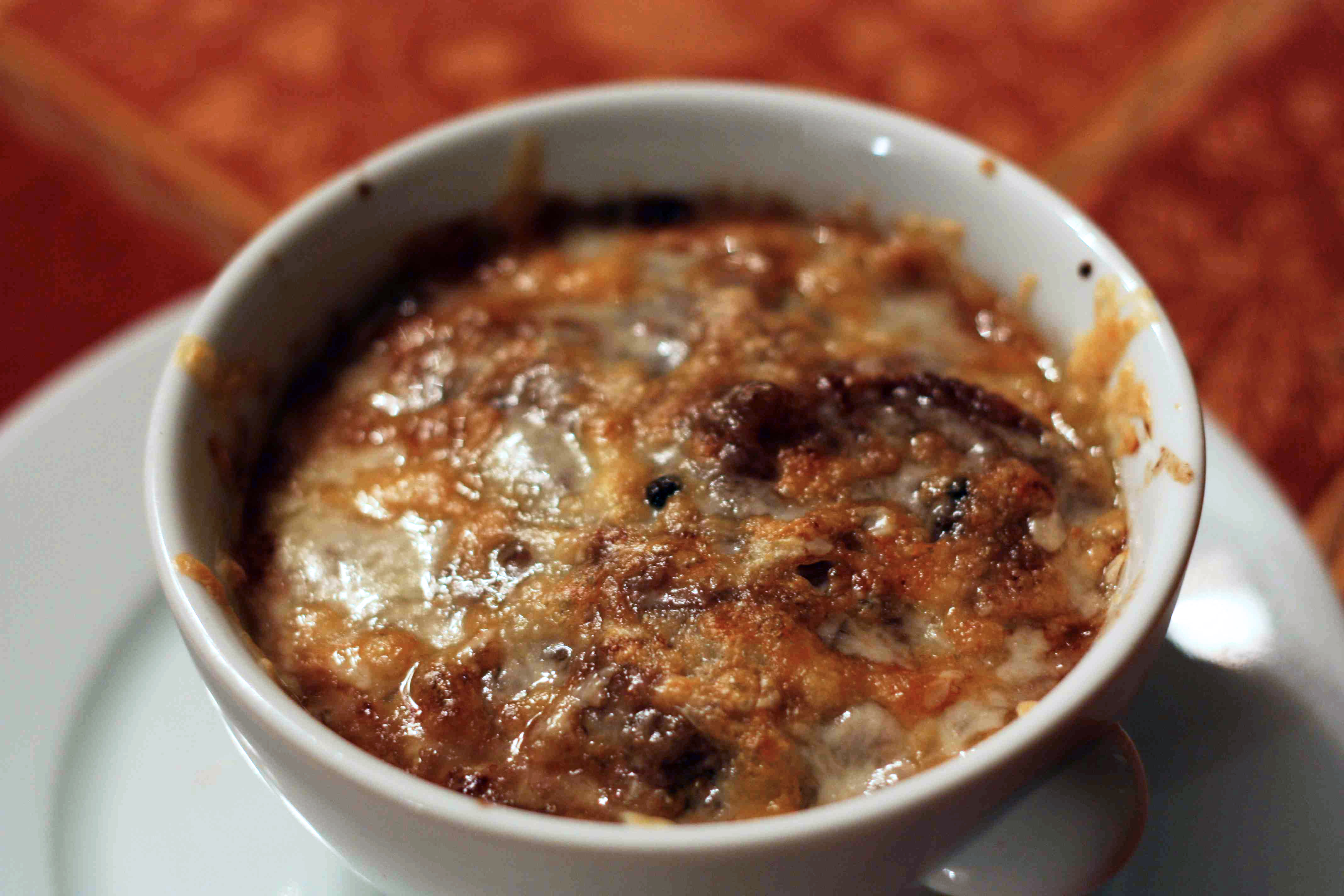
As my father would say, “C’est la guerre.” Redemption can take all forms: last night, mine came in a white porcelain bowl.

Soupe a l’oignon gratinee

There are about as many different versions of this soup as there are bistros in Paris; some (like this one) add a drop of flour to thicken the broth, some (like this one) add a sprinkling of sugar to hasten the caramelization. From that point, its preparation becomes a balancing act between beefiness, sweetness, and the necessity of a high note to brighten up the often murky flavors. My secret: a splash of Banyuls vinegar.

Serves 2

2 tablespoons clarified butter

5 medium onions, peeled and sliced thinly into rounds

1 tablespoon sugar

1 cup dry red wine (I used a Cote du Luberon)

1 tablespoon all purpose flour

2 sprigs fresh thyme

6 cups strong beef stock

salt, to taste

1/2 teaspoon black peppercorns, lightly crushed

1/2 tablespoon of Banyuls (or other sweet red wine vinegar)

4 baguette slices, toasted

Gruyere, grated, as much or as little as you prefer

1. In a heavyweight, four quart sauce pan set over medium heat, melt the butter. Add the onions and toss well. Reduce the heat to low, sprinkle with sugar and stir, cover, and let cook down slowly, until the onions take on a golden, caramel color and are slightly jammy in consistency, about 15 minutes.

2. Pour in the wine, raise the heat to medium, stir, and let simmer for about five minutes, until the wine just begins to evaporate. Sprinkle in the flour, give the mixture a stir to combine, and add the thyme. Stir in the stock, taste for salt, and add the pepper. Simmer for five minutes, then reduce the heat to medium low, and cook uncovered for 15 minutes, stirring occasionally. Add the vinegar, stir, continue to cook over low heat for another five minutes, and remove from heat.

3. Preheat your broiler. Set two deep soup bowls onto a rimmed baking sheet. Ladle the soup into the bowls, stopping about half an inch from the rim. Float the two baguette toasts in each bowl, and then top with the Gruyere. Broil until golden and bubbling, and serve immediately.

indiebound


©2009, ©2010, Poor Man's Feast. All rights reserved. To reprint any content herein, including recipes and photography, please contact rights@poormansfeast.com