I grew up in a culinarily conflicted household: my father loved food and what it meant, for all its gastro-cultural implications—it didn’t matter if it was high or low, rich or poor. My mother loved restaurants mostly for their social implications, and when I once asked her what she thought of the 21 Burger (served at the club she frequented in the late 1950s before she met my father) and whether it was as good as everyone swore it was, she just stared at me.
“They have a burger at 21?”
Anyway, growing up in the late 1960s and 70s with the Manhattan food scene in my backyard meant one thing: Craig Claiborne. We might have been bombing Cambodia; somebody might have been busting into Daniel Ellsberg’s office in the middle of the night; the Mets might have won the World Series; Armstrong might have walked on moon; Patty Hearst might have been calling herself Tanya Somebody-or-Other; but my father generally blew right past the front pages of the New York Times and went straight for Claiborne’s columns, which ran the gamut from feature stories on stellar home cooks (Marcella Hazan was one), to restaurant critiques, to instructions on how to make Eggs Sardou or Sweetbreads. The world, my father thought, could wait for the latest news story; it would not rest, however, until it read Craig Claiborne and learned how to make Shad and Roe Grenobloise or Lee Lum’s Lemon Chicken or Gigot au Pastis. It wouldn’t sleep unless it knew that the plum squab at Oh-Ho-So was worth the schlep down to West Broadway, or that the pasta primavera at Maxwell’s Plum didn’t have the consistency of spackle.
My father purchased Claiborne’s first New York Times Cookbook back in 1961, the year before he married my mother. Midway through their marriage, he bought a revised edition (co-authored with Pierre Franey) and gave it to his non-cooking wife. It sat on our living room bookshelf for years, and when they finally divorced, I claimed it, and it lived with me through four years of college, countless New York City apartments, a job at Dean & Deluca, cooking school, a move to Connecticut, and marriage. Other books have come and gone, and the black-jacketed, stained copy that I made off with when I realized that my mother cared about Craig Claiborne as much as I cared about Karl Lagerfeld‘s ponytail, has dipped in and out of bookshelf obscurity in my house, often being overshadowed by bright, four-color celebrity chef-authored tomes that assume I have a quart of glace de veau sitting in my freezer at all times (I do not). It’s been easy to forget, amidst a roiling sea of trend, how remarkable Craig Claiborne’s New York Times Cookbook was for its time, and — dated thought it may be in spots — still is.
Recently, I spent some time leafing through my old, falling-apart kitchen book—a faux-leather bound lab notebook I bought years ago at the Harvard Coop, and which I’ve pasted up with recipe clippings and articles, all from the Times. There are a slew of dishes from Molly O’Neill and Florence Fabricant, Johnny Apple and Mark Bittman, Marian Burros, and Amanda Hesser—all yellowing and dribbled upon and dog-earred despite the cellophane tape. There are a few hand-written, wine-stained scribbles citing things like Claiborne, pg 402, Picadillo, amazing. I clipped, cooked from, altered, adapted, sometimes mangled, and generally had my way with those recipes from the Times for years, and, like wallpaper you grew up with and just never paid attention to, totally took them for granted.
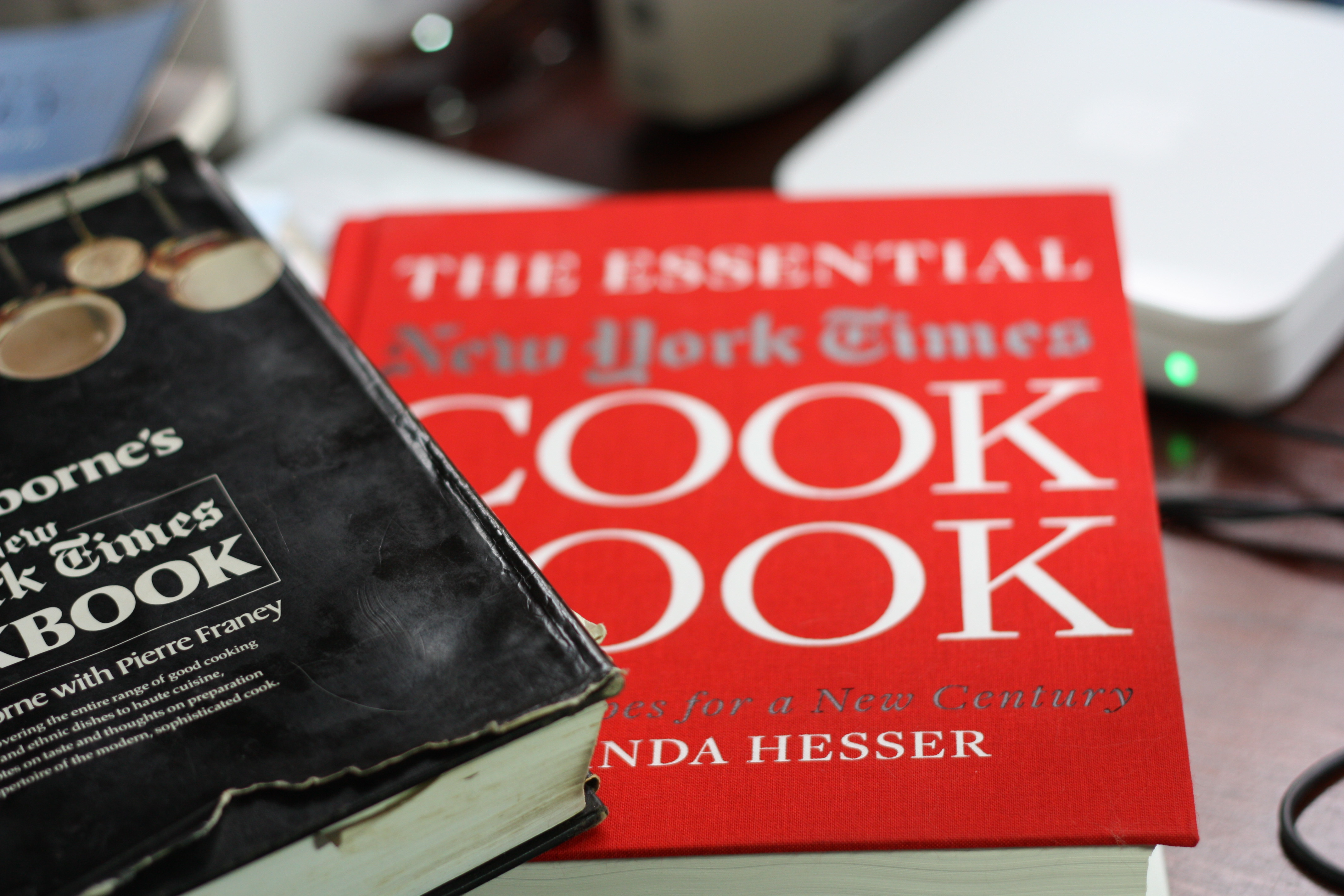 So when Susan’s gift of Amanda Hesser’s mind-boggling The Essential New York Times Cookbook showed up in the mail the other night, the timing was perfect; I had the flu, so I hunkered down on the couch and read every recipe—the best of the best, from Bittman and Burros, from Amanda herself, from Johnny Apple and Florence Fabricant, from early Times readers with names like Aunt Addie and Bob the Sea Cook, and from Claiborne—all 1400 of them. For hours. Many of them made me smile; some made me swoon; others—like Craig’s recipe for creamed onions—made me cry, and remember my father’s rapturous relationship with this man he never met, who made him proud to be a hungry New Yorker and a fanatical Times reader. And it made me go back to my old 1970s edition, which I hadn’t cracked open in a while.
In 1988, when Dean & Deluca moved from its original location at 121 Prince Street to 560 Broadway, we employees were allowed to invite two people each to the opening party; for reasons that escape me now, I gave my tickets to my mother and her second husband, Buddy, a furrier who loved good food as much as my father did. I stood at the back of the store in my apron while Buddy schmoozed Lauren Hutton at the front door.
“I think your mother has a new friend,” my colleague Gordon said, motioning over to where she was standing, about five feet away, near the Metro shelving piled high with Mauviel copper.
There he was: Craig Claiborne. Dressed in an impeccably tailored dark gray Chesterfield coat, his reading glasses perched on the end of his nose, he stood chatting with my mother, whose sable jacket was casually thrown around her shoulders.
What could they be talking about? Methods for preparing leeks vinaigrette?
“Come, my dear,” he said, linking arms with her. “Let’s go visit the lamb chops.”
They strolled over to the meat case, bent down, and peered in; Craig gazed at the prenatally tiny ribs while my mother, not sure what she was looking at—or with whom—stared down a pork loin.
“I met the nicest man,” she told me when the party was over, and we were walking to Raoul’s, down the street, for dinner.
“He says he’s a food writer.”