
In Bed with Elizabeth

November 17, 2010 · 12 comments

Dear Elizabeth,

First: it’s been such a long time since I’ve written, and for that I apologize. It’s so easy to be pulled away by iPhone and iPad and email, by the constant, humming connection and the dull, relentless silent nudging. (They say it’s really not good for the human brain, don’t they—that it dilutes focus and imposes a sort of prefabricated ADD onto one’s otherwise reasonably healthy psyche. I’m beyond starting to believe them.)

Anyway, it’s that season…you know it all too well—the damp gray one that accompanies the last autumnal cold snap and settles down a layer of crunchy velvet frost on everything that’s left in the garden. Sure, it makes the kale and the chard sweeter, but it wreaks havoc on the rosemary which, now sitting in large clay pots (which will doubtless crack before Spring; made in Tuscany my EYE), is hugging the back side of the house for warmth. But the preserved lemons are perched on a shelf in the basement, and just yesterday I discovered a trove of anchovy paste in the pantry tucked behind a few bags of Steve Sando’s beans, and I felt like the culinary cavalry was on its way back to my kitchen.

But really, the reason I’m writing is that I’m just getting so tired—so weary—of all the culinary deconstruction going on these days. Just the other night, some young, pierced child in server’s whites plunked a plate down in front of me containing a deconstructed turkey; it amounted to a pressed, sous vided square of white and dark meats topped with a thin layer of skin. In truth, it looked like Peking Duck, except for the fact that it was seated on a small puddle of stuffing foam. Stuffing FOAM. Who made the executive decision that stuffing should be foamed? As any American will tell you, stuffing is usually the only interesting, edible thing about our Thanksgiving dinner! Foam? Dear god. Tell me honestly: Am I being inflexible and priggish?

I understand the concept of culinary evolution, but the flipside of all the excitement surrounding that brilliant Adria fellow is that anyone who even thinks they remotely have any talent in the kitchen (and I daresay more money than brains) runs the risk—especially during the holiday season—of being lured into their local cookware shop to plunk down $800 for a Polyscience Sous Vide Immersion Circulator, or a home foamer that will enable them to change the molecular structure of their family’s traditional holiday Bacalhau. (Would you have carried those things in your shop? I don’t THINK so.) For heaven’s sake, I say, Learn how to make a good piece of salmon, or that delicious rice pilaf that Suleiman shared with you during the War. Learn how to figure out when the risotto is done or how to cook a duck over an open flame without immolating it or yourself. But please, leave the foaming and the sous vide tools alone: they’re far more expensive than bread makers, Mood Rings, and Pet Rocks. And as you said in that Sunday Times piece so long ago,

“The first thing I want to know about a recipe, whatever its cost, is whether it’s going to produce real food as opposed to a piece of frippery nonsense.”*

Amen, sistah, is all I have to say.

So I’m writing this note to you all tucked in at a hotel in Brooklyn; I’ve just finished tagging along on a photo shoot. Our deadline is fairly crazy, the recipes are pouring in like Fox’s U-Bet into an egg cream (chocolate sauce, sort of what you’d drizzle over Spotted Dick), my brain is on overload, and here I lie—in an enormously fluffy bed behind which is perched a large, headboard-sized blue light that is casting a deathly pallor on everything around it, including me. The godforsaken WiFi (sort of like HiFi, but invisible) is barely working (I guessed it wouldn’t), and so I’m delighted that I brought your omnibus along for reading at the end of each day. The heck with Stieg Larsson! Anyway, as we were snuggling up, I hit upon your recipe for Bacon and Lentils from French Country Cooking, and decided that there is no reason at all why I shouldn’t make this for our Thanksgiving celebration out in California next week. I’ve been planning on making turkey-as-porchetta—anything to infuse the damn thing with flavor and kick off the shackles of its balsa wooden traditional Roast Beast-like holiday self. (I maintain that turkey the way Americans prepare it is a lot like New Jersey: it’s a thing you travel through on the way to somewhere else. Nobody looks forward to Thanksgiving dinner. It’s the sandwiches, turkey pie, and stew they want, and not foamed.) But then I discovered your recipe for Salmis de Dinde a La Berrichonne: braised turkey with bacon, mushrooms and red wine. And I thought “this is a sign from Elizabeth.”

And so, this will be our dinner next week. Would it be possible to make a sort of quasi-Miroton from the leftovers? What’s your thought? Just curious.

Forgive my ramblings, Elizabeth. You’re forever in the forefront of my mind and kitchen, and so,

All best to you in the great beyond,

Elissa
Salmis de Dinde a La Berrichonne

From Elizabeth David’s French Country Cooking

As ever, Elizabeth David’s recipes made assumptions: that you had a sense of how large an average claret glass was; that you knew a turkey over a certain size would be relatively flavorless; and that bigger isn’t necessarily better. This recipe—a fairly basic slow braise—doesn’t offer too many specifics, which is a signal to the reader to focus; put down the iPad and iPhone; and pay attention. For those who must have exact measurements: a traditional Claret glass is 4 or 6 ounces; the turkey should probably weigh no more than 8 pounds.

First of all, prepare a stock with the giblets, neck, and feet of the turkey, browned in butter with an onion, a carrot, a clove of garlic, thyme, bayleaf and parsley. Sprinkle with a tablespoon of flour and let it turn golden, then add a claret glass of red wine and 2 ounces of water, and leave to simmer for 1 hour.

In the meantime, cut up the turkey, dividing the legs and wings into two pieces each and the breast into four pieces. Season them with salt and pepper. Put 3 ounces of butter into a casserole or braising pan, and when it is melted put in the pieces of turkey; let them turn golden on each side, take them out and keep them aside. In the same butter put 1/4 pound of bacon cut into small squares and 1 pound of small mushrooms. When these in their turn have browned, take them out and to the butter and juices in the pan add a claret glass of red wine and let it simmer, 2 or 3 minutes, then add the prepared stock, through a strainer.

Put back the pieces of turkey, covered with the bacon and the mushrooms, and add 2 tablespoons of brandy. Cover the pan and cook very slowly for 1-1/2 hours. Serve garnished with triangles of fried bread.

* Quote from the Sunday Times, 9/11/58
The Butcher and the Stew

November 8, 2010 · 4 comments

So I was reading the paper over the weekend, and I found myself panting like an out-of-breath mastiff at an article called Grass Fed-Up by Alexandra Jacobs. I looked in the mirror and wondered: Is this me she’s talking about? Have I become that recognizable, insufferable pain in the ass who goes on at dinner parties about sous viding my Easter abbachio in imported Japanese plastic wrap, or having insider fruit information about what day the Astrakhanski Watermelon is going to show up at the Farmer’s Market in Union Square so that I can gloat about the fact that I beat out Peter Hoffman for a key ingredient he needs to make his watermelon borscht every summer?”

We all know the type: I worked at Dean & Deluca in the 1980s, and I remember a certain crowd showing up at the cheese counter to ask exactly how old the goat was who produced the milk for that Coach Farms pyramide, as opposed to this crottin. Was it peppered with Tellicherry peppercorns crushed in a mortar and pestle, or were they Micronesian Pohnpei peppercorns delicately bruised under the weight of a small olive wood mallet?  When the cheese guy couldn’t tell them conclusively, they turned on their heels and left. Not long after, one of our buyers came in with an Italian-imported electric polenta maker—a $200, single-purpose, brass-riveted, unlined copper pot outfitted with an internal heating element and a rotating midget balloon whisk that promised to blend the cornmeal at exactly the right speed for exactly twenty minutes (the same amount of time it took my great-grandmother to make mamaliga with a splintered wooden spoon in her kitchen in Czernowitz) before shutting off automatically.  And honestly, in the almost twenty-five years since, things have gotten worse. A lot worse. Because while food is the new black, as they say, there seem to be far fewer food geeks actually preparing real, simple, delicious food well than, say, torturing the hell out of some uptrend ingredient that has to be made with this particular tool or roasted on that particular three inch thick slab of pink salt that’s been chipped out of the Himalayas and sold via catalog to some poor unsuspecting home cooking schmuck for $160. Do I sound annoyed? I am. I can hear it now, twenty years hence:

“Remember the time when Dad started cooking every dinner on a salt lick?”

“Yeah, those were the days—crazy! Where the hell is that thing now?”

“In the basement, with grandma’s fondue pot that’s sitting in the box marked KEY PARTY.”

After I read the article in the paper, I could pinpoint the moment when I began to get nervous about being one of these people, though, and it has nothing to do with the fact that I have a larding needle in my kitchen drawer, and extensive plans for curing duck breasts in my downstairs fridge this winter, or making rabbit pate wrapped in home made puff pastry for Christmas. It’s worse than that.

It all started with a guy named Steve. He’s my butcher. Notice how I said my butcher, as opposed to my neighbor’s butcher. I’ve become very proprietary about this man, which is an interesting thing, being a lesbian, and all. He’s the guy in town with the four foot long meat case tucked into the corner of  a local deli. He sells beef, local lamb, local pork, and fish that comes from the Sound and from the organic trout farm in a neighboring town. He cures his own sausages, and makes his own jerky. A few weeks ago, I popped in for a chicken, and he had a few pig tails sitting in the case. Pig tails. Pig. Tails. In suburban-Cracker-Barrel-Christmas-cheeseball New England.

“You have your own butcher?” one of my friends asked.

“Yes,” I said, “I do.” I tried not to sound like too big a jerk.

“You don’t buy your meat at the grocery store, like the rest of us?” she asked.

“No, I don’t.”

“And you don’t live in, like, Berkeley? Or Brooklyn—?”

“I did live in Brooklyn, once,” I told her. “But now I live in the suburbs.”

“Wow–” she said, “I’m totally impressed.”

And I thought, you know, I’m such a yutz. I could hear myself talking, and all I could think of were those art collectors at Dean & Deluca and the pyramide, and the night a few years ago when the triple sitting next to us at Chez Panisse loudly and crudely trashed their meal—simple, local pork elegantly prepared three ways—as not being fancy or tall enough. I wasn’t telling her this to impress her. I was telling her because I was happy about the fact that I could walk up to this guy’s counter on any given day, ask him what he’d just gotten in, chat with him about what was in his case, and then go home with something totally unexpected. Like pig tails.

Every time I’ve shopped there, I’ve come away with ingredients that, independent of each other, are remarkable; put them together—the lardons from his house-smoked bacon, the fresh beef bones, the cubed chuck—cook them very slowly on a freezing Saturday night, and you wind up with something utterly captivating. It’s the difference between slowing down, buying small and local, being able to have a relationship with your butcher or your fish guy, and cooking simply and carefully; or gloating about beating out Peter Hoffman on the melon line at the Farmer’s Market, just to say you did, while the fruit, untouched for weeks, rots in your fridge.

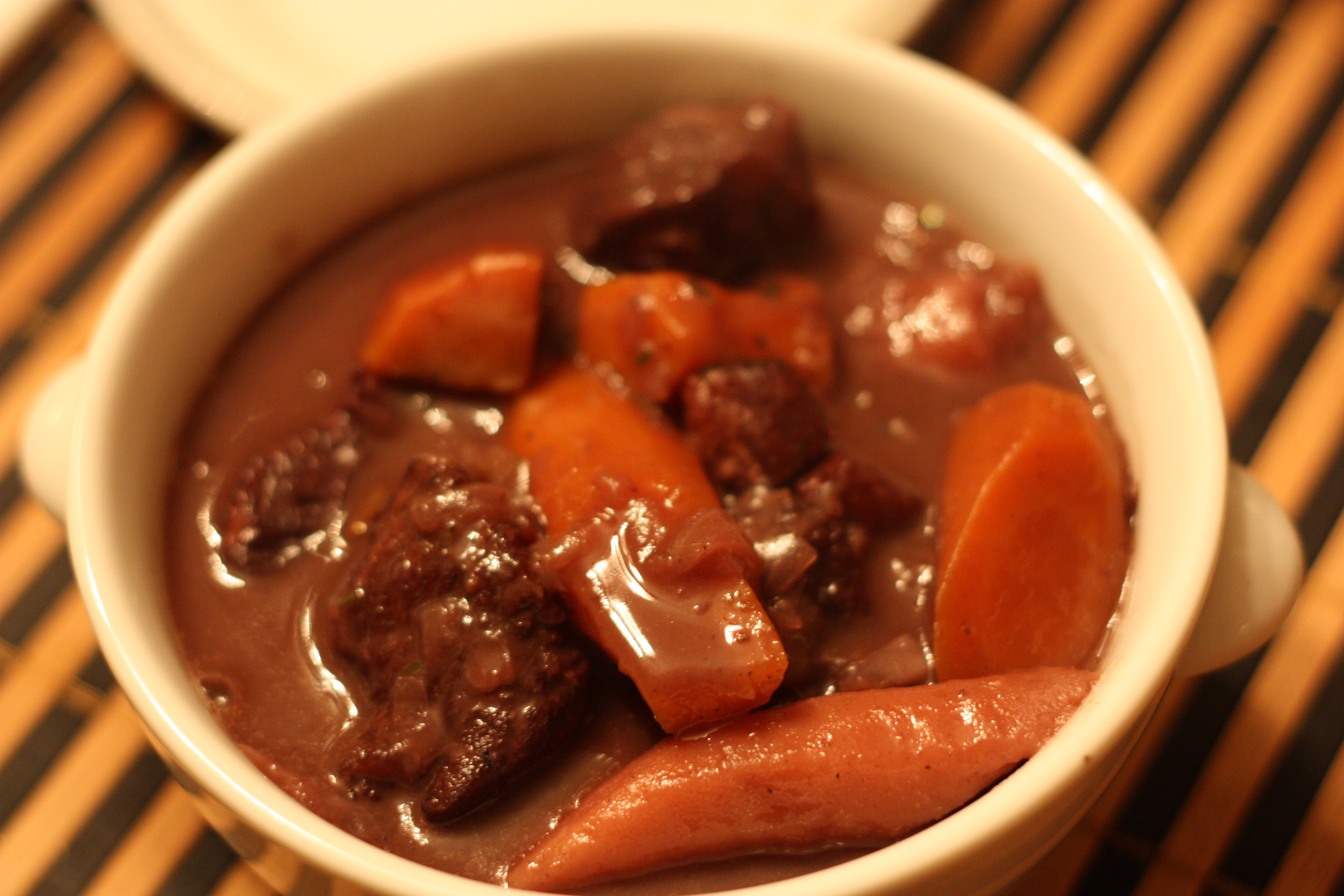
Beef Stew in Red Wine with Root Vegetables

You don’t need your own butcher, but really–it’s nice if you can find one. If you can’t, just make it a point to look for better—not necessarily fancier—ingredients. Buy a few of them, and treat them with kindness. And for god’s sake, make it a point to cultivate a personal relationship not only with the people who grow or produce your food, but with your food itself.

This past weekend, I had all the time in the world to make this stew; I knew I wouldn’t be home again on a weekend until December. Susan was suffering from a cold. The last of our garden was giving us huge handfuls of herbs, and we had a few half-empty bottles of red wine kicking around the kitchen.  When I saw the fresh beef bones sitting in Steve’s meat case, all I could think about was Jennifer McLagan’s book, Bones; the long autumn afternoon in front of me; and the depth of flavor that would be the result of a slow braise. I wouldn’t dare call this Bouef Bourguignon, but I would call it very good.

Serves 4

1 pound beef chuck, cubed

1 cup dry red wine plus 1 750 ml bottle

sprigs of fresh rosemary, thyme, winter savory, sage

3 cloves garlic, smashed

salt, to taste, plus more for cooking

black pepper, to taste, plus more for cooking

1 fresh, meaty beef bone, cut into thirds (by a butcher)

2 tablespoons grapeseed oil, divided

1/4 pound slab bacon, cubed

2 carrots, shaved and sliced into thirds

2 parsnips, shaved and sliced into thirds

1 medium onion, coarsely chopped

1 shallot, diced

1 Bay leaf

1 tablespoon unsalted butter, for finishing

Place the meat in a shallow baking dish, cover with 1 cup wine, and the rosemary, thyme, savory, sage, and garlic. Sprinkle with salt and pepper, toss well, and cover with plastic wrap. Let stand at a cool room temperature while you go about your business for up to 3 hours.

Preheat oven to 450 degrees F. Place the beef bones in a deep 5-6 quart Dutch oven with one tablespoon of oil, sprinkle with salt, and roast, uncovered, for 40 minutes. Remove and set aside. Drain the fat, set the Dutch oven over medium heat, and add the cubed bacon. Cook until the fat has rendered out completely, and the bacon is crisp, about 10 minutes; remove with a slotted spoon, and set aside. Using paper towels and tongs, carefully blot out all but a tablespoon of the fat.

Reduce the oven heat to 350 degrees F. Place a colander in a large bowl, and drain the meat, reserving the liquid, and separating out the herbs and garlic. Pat the meat dry. Set the Dutch oven over medium high heat, add the grapeseed oil, and when it begins to shimmer, add the meat in batches, and brown completely. Remove to a shallow bowl.

Add the carrot, parsnip, onion, shallot, and 1/4 cup water to the Dutch oven. Raise the heat to high, and using a wooden spoon, scrape up all of the caramelized bits of meat from the bottom. Place back in the oven and roast, uncovered, for 15 minutes, allowing the vegetables to brown slightly.

Remove the pan, add the meat, the reserved marinade, the herbs, garlic, meat bones, bacon, and Bay leaf. Pour in the remaining bottle of wine, which should nearly cover the rest of the ingredients. Cover, place back in the oven, and simmer for 3 hours, giving it a stir occasionally. Remove from the oven, uncover, and remove the beef bones. Set a colander in a large bowl, and strain out the vegetables, herbs, and meat. Return the sauce back to the Dutch oven along with just the vegetables and meat, raise the heat to medium high, bring to a lively simmer, and reduce the sauce by a third. Finish by swirling in the butter.

Serve in warm bowls.

indiebound


©2009, ©2010, Poor Man's Feast. All rights reserved. To reprint any content herein, including recipes and photography, please contact rights@poormansfeast.com