What's for breakfast after a bunch of too-too meals? A bowl of jook.
I’ve been out of touch for a while, putting a cookbook-on-a-crazy-schedule to bed, and it seems like Thanksgiving in the Bay Area happened a million years ago. Christmas is now upon us next week, and I’ve had all sorts of visions of a holiday spent doing what I usually do, and cooking things I ordinarily wouldn’t. One year, I made cassoulet with homemade sausage and duck confit. Another year, I considered making a boned out guinea hen stuffed with a boned out quail, and filled with pate (like a highbrow turducken). This year, I’ve been thinking about assorted terrines and pates and crepinettes wrapped in caul fat, and I still may attempt the latter for New Years with our dearest friends. But complicated and fancy are now officially off my dance card: two weeks in the Bay Area pretty much did it to me. Call it overkill. Call it too too.
In some exquisite places we visited, the food was too tall, and threatened to put one of my eyes out.
In other places, the food was too forced—shoehorned—into a self-conscious, studied, prepackaged simplicity, like when rich kids buy flannel shirts from Paul Stuart and then distress them with sandpaper.
And in other places, the food was too aggressively simple in that late 1970s cuisine minceur sort of way—so much so that it lacked flavor and texture and color on the whole. In one such establishment, Susan, not reading the fine print on the menu, wound up leaving an additional 20% on top of the service compris, bringing our tip to a head-thumping 37%. Ouch.
But there were places where the food was just right, and they were high points as existentially revelatory as they were delicious: the sushi and Ankimo (monkfish liver) at Takara in Japantown were so remarkable and the fish so fresh that you could actually taste the sea air. And this place was in a mall (the Peace Mall, but still).
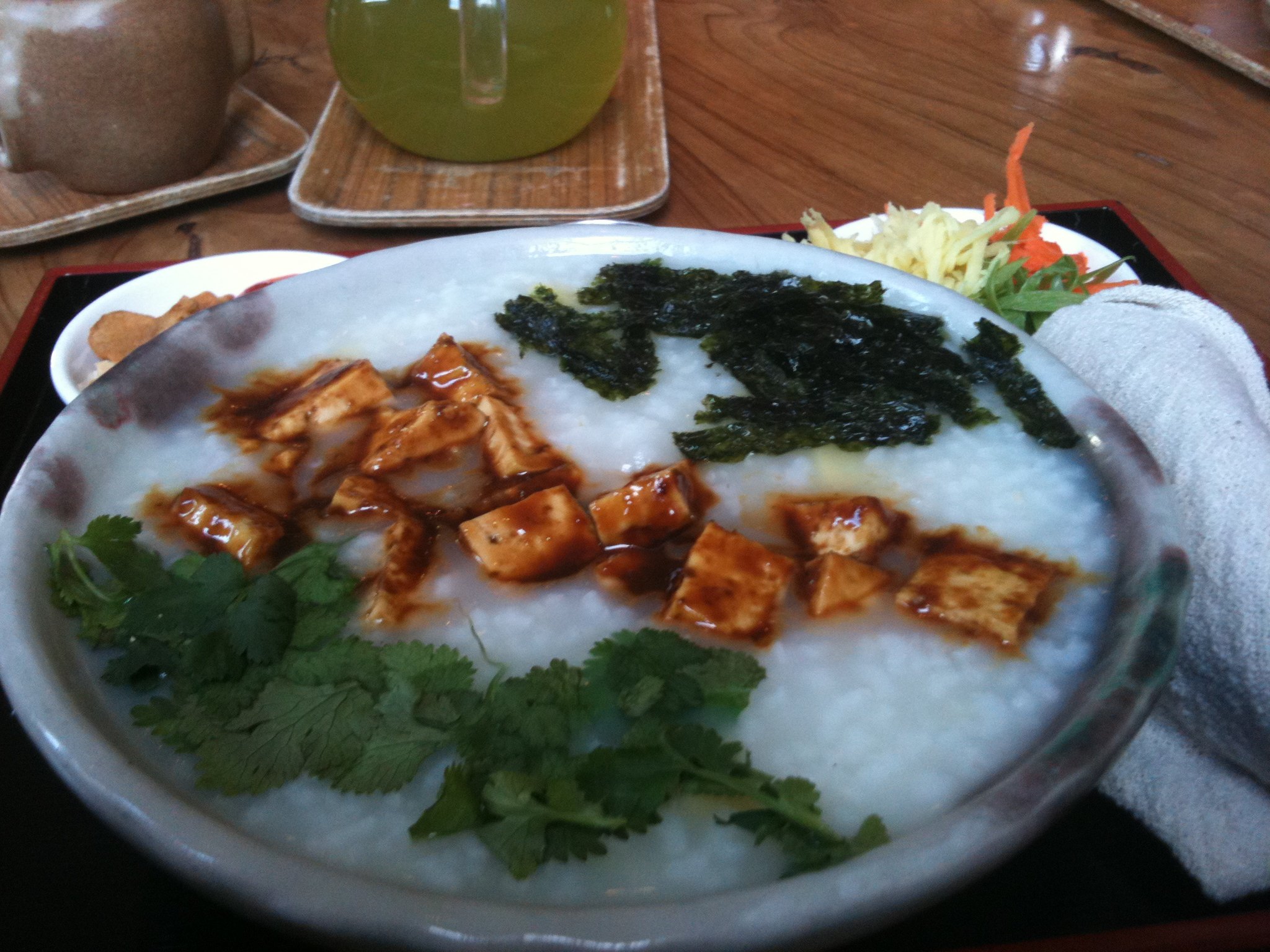
A big bowl of Petit sale—braised lentils and lightly cured pork belly — at Bistro Jeanty in Yountville is still the subject of our dinnertime conversations, and really, all it was was pork and beans that someone paid attention to. The morning after a late dinner with friends in the Mission involving what had to be a bucket of demi glace, we had breakfast at Samovar , a lovely little tea house on Page Street, across the way from the San Francisco Zen Center. Susan had tea soup—a bowl of brown rice topped with smoked duck, wakame, and shitake mushrooms over which was poured a piping hot kettle of mild green tea; I had the jook–a slow-cooked, mild rice porridge with braised tofu, scallions, toasted garlic, peanuts, nori, Sriracha, tamari, and cilantro. I found myself wondering why anyone would ever crave greasy bacon and eggs for breakfast—a shock to the just-roused digestive system if ever there was one—instead of something soothing, and this is coming from someone who admittedly often craves bacon and eggs for breakfast.
“This is the best thing I have eaten in my entire life,” I said that day at Samovar, repeatedly, slurping my porridge.
And right then and there, it was true. Except for the petit sale. And Susan’s tea soup. And the nearly-naked sushi in Japantown. And maybe the tablespoon or so of monkfish liver drizzled with a little bit of Ponzu.
So, simple is a theme in our kitchen again, and it’s not going away anytime soon. We came home the other night to an almost-stale baguette, onions, a large wedge of Parmigiana Reggiano, and a Mason jar of vegetable stock. There was only one thing I could make, so I did: a panade, which is sort of what happens when you make soupe a l’oignon gratinee, only you remove most of the soupe. Simple, at its best.

Panade, before.

Panade, after.
Anyway, as we hurtle into Christmas and I begin to think about our meals, I’m realizing how un-fancy I want them to be. I don’t want a mousse, or even a goose. Call me the Grinch.
I want unfettered, non-hysterical, un-vertical, soothing, slow-cooked, warming, and uncomplicated. I want a seven hour leg of lamb that you salt and pepper, dump in a roasting pan, put in a slow oven, and turn once in the middle of the afternoon, right around the time that the good movies come on. And maybe a bowl of lightly steamed and then roasted Brussels sprouts, drizzled with honey and soy and a dash of hot sauce, and eaten like a snack, at room temperature.
Or maybe pork and beans, or better still, green tea and rice soup.
And a bowl of jook on Christmas morning.
Christmas Morning Jook
Serves 4
In Korean, it’s called congee; in Vietnam, it’s chao; in Thailand, it’s chok. When I was a child and feeling under the weather, my Italian godmother used to make me a bowl of pastina, which isn’t made with rice at all, but still managed to lodge itself in the same gastro-emotional recesses of my brain as its Asian porridge cousins. Whenever I’ve had it and in whatever form, it’s always been a welcome respite from excess. Easy to prepare, jook needs two things: patience (instant jook doesn’t, or at least shouldn’t, exist), and an assortment of toppings that should be neither palate-shocking nor extravagant—tofu that’s been cooked in tamarind sauce; leftover cooked greens; crispy shallots; slivered green onion; diced, smoked meat (pork or duck are especially good); a handful of chopped peanuts; a poached egg; crumbled nori; braised mushrooms; a drizzle of salty tamari or soy; and maybe a dash of hot sauce—and suitable for folding-in.
8 cups of water
3/4 cup long grain white or Jasmine rice
pinch of salt
1. In a large saucepan, bring the water to a fast boil over medium high heat. Stir in the rice and reduce the heat so that the mixture calms to a slow, gurgling boil. Cover just enough to allow some steam to escape, reduce heat further, and simmer very slowly for about an hour and a half, stirring frequently.
2. Spoon into bowls and top with as much or as little as you like from the list above; I happen to think that less is more.