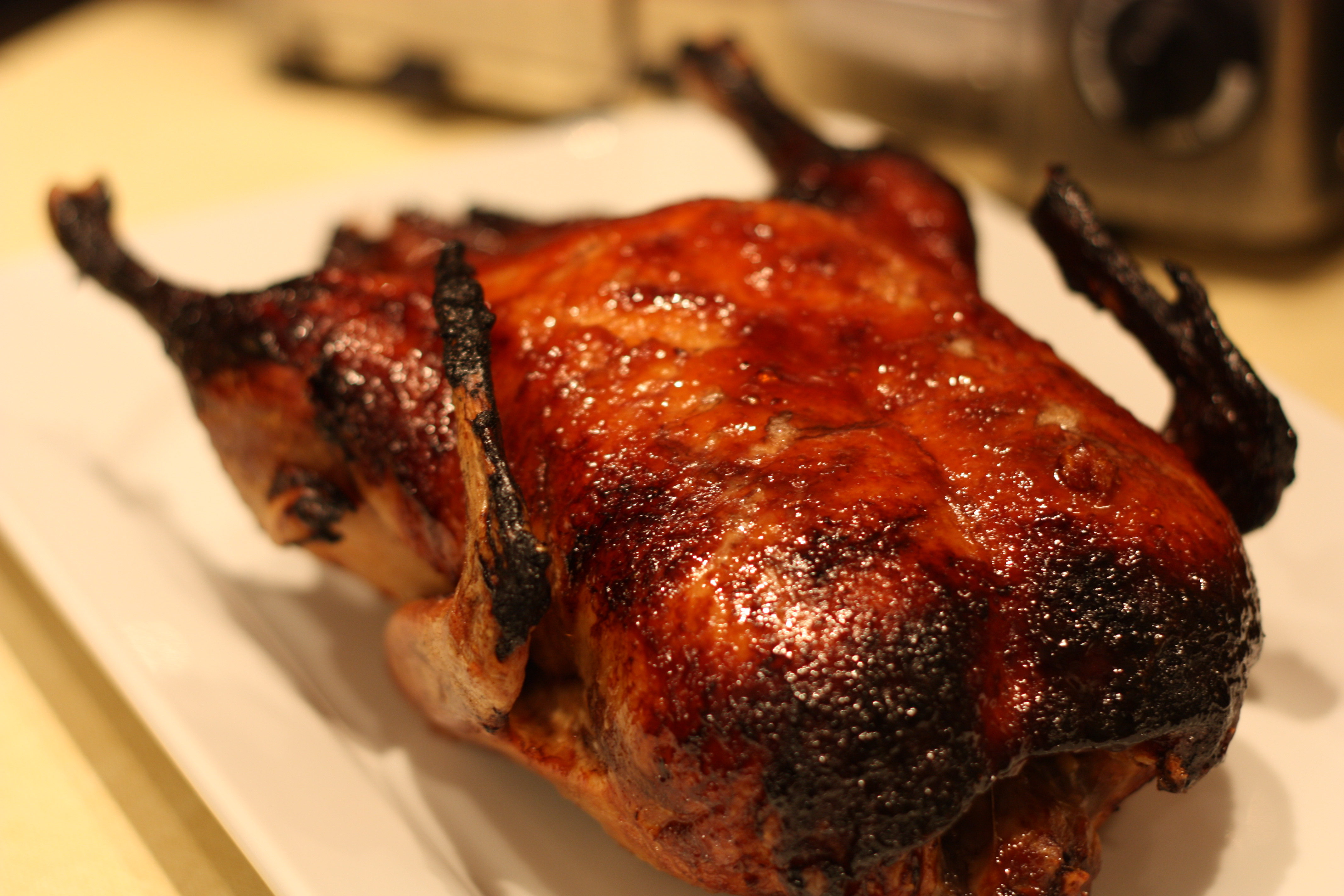
The holidays do strange things to some people’s kitchens, and when the season is over, we generally breathe a sigh of relief. I know I do, which is why—now that it’s January 1st—we’ll be having tofu for a while.
For some reason, in my house during the holidays we wind up going down the game bird route; a little while ago, I had lunch with a friend who sipped a strong cup of Typhoo while curled up on my living room sofa, kvetching for all she was worth about the fact that her English husband had suddenly demanded a brace of pheasant for their holiday meal (either Christmas or Boxing Day, I’m not sure which). She asked what we were going to serve and what I personally thought of pheasant, and I told her I really couldn’t say; I’d never made one (much less a brace), but my local grocery store was selling pheasants for $25, and maybe now was the time to at least try one. She agreed in theory, adding that if you don’t wrap the bird in a substantial amount of fatty bacon, it takes on the consistency of balsa wood, which is why she’d be serving her husband filet instead.
“‘Because,’ I told him, ‘no one likes pheasant in this damn house but you, and you bloody want a BRACE, which will cost us a fortune, and only you will eat it.'”
Merry Christmas, I added.
The fact that we were even having this conversation in suburban New England was odd, yet indicative of a strange thing that happens in my neighborhood year after year: game birds start showing up everywhere, and no one really likes them (or even knows what to do with them). One Christmas, I bought a guinea fowl because I’d never made one before; I found scores of recipes calling for larding and barding and wrapping and spit-roasting, and it was only when I remembered that somewhere in Cooking for Mr. Latte, Amanda Hesser roasted a guinea fowl for her boyfriend (now husband Tad Friend) that I breathed a sigh of relief. Enough with the fussing; it was a plain roast with salt and pepper, and much better than anything wrapped in fat. That said, we’ve never had another one. So, I spent the $25 on the pheasant. I’m suffering from a small crush on Nigel Slater at the moment so I made his recipe for a simple braised pheasant with celery and sage, and it was delicious. It had the consistency of damp wood shavings, but still—it was quite tasty.
But guinea fowl, pheasant, and quail (which I love, but only grilled, and only during the summer when I can get away with nibbling on their splintery little legs using my fingers) aren’t the only game birds that show up in my local market: there’s goose (which I’ve never made because I can’t justify spending six figures for what ultimately will result in a pint of goose schmaltz), and then there’s also duck (which some may argue isn’t a game bird at all). Feeling sort of jaunty, I decided that we should avail ourselves of said duck for Boxing Day dinner. My recipe? A riff on Jake Tilson‘s Blizzard Duck, which involves boiling the bird to render much of its fat, and then plunging its steaming self into a snow drift in order to both stop its cooking and to seize up the skin, which should help in the crisping process. Because really, who wants flaccid duck skin? I don’t. Especially not during the holidays.
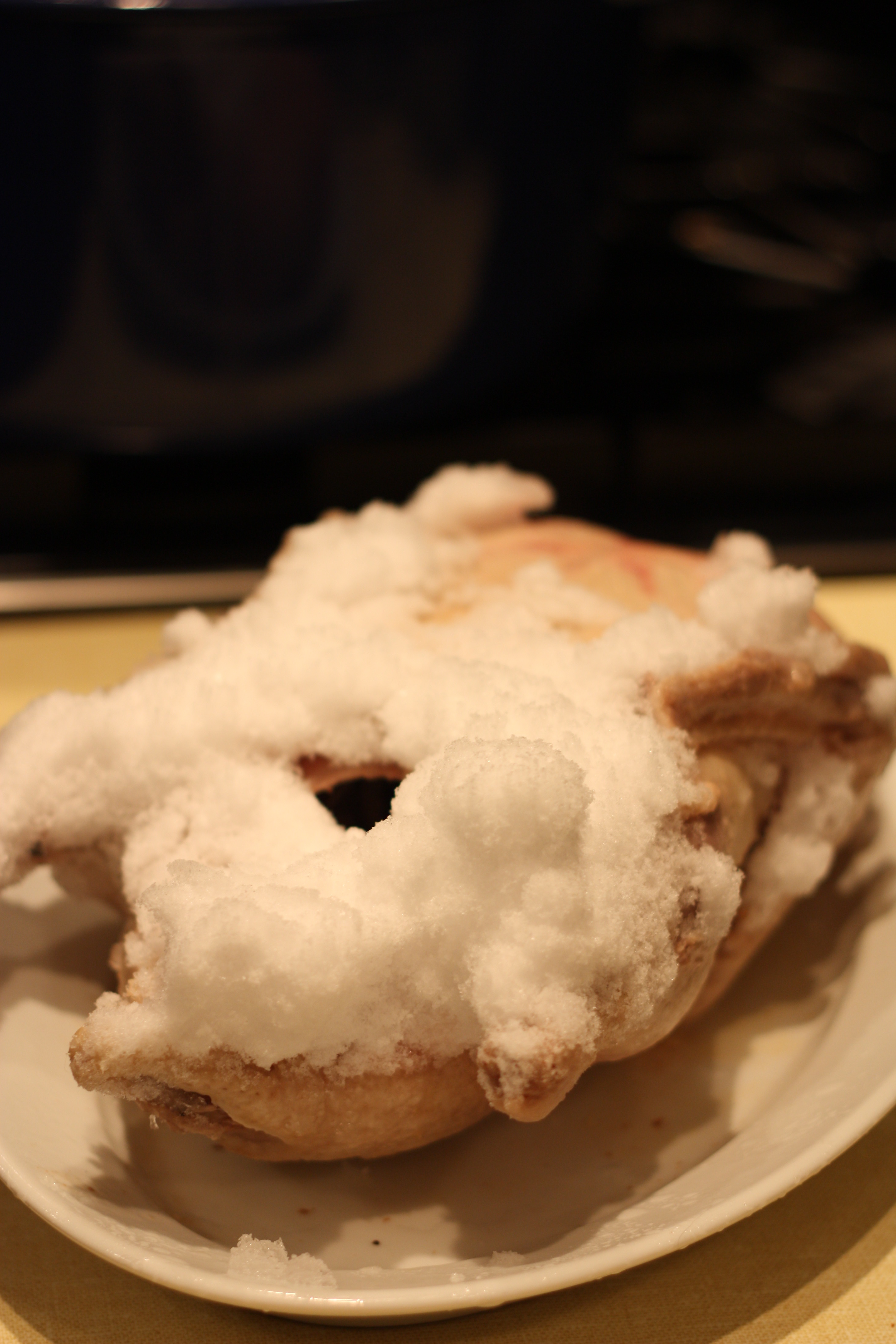
Blizzard duck, just out of the snow.
Mercifully, it snowed a few hours before I put the duck into the stock pot. Susan didn’t bat an eyelash, took our shovel, went out onto the deck, and created an aesthetically-pleasing three foot pile of freshly fallen flakes; when it came time, I removed the duck from the water with my longest tongs, carried it outside, and thrust it into the snow drift for the required fifteen minutes, after which I removed it, put it on a platter, and realized that while the skin was indeed taut and the pores sealed shut, the general consistency of the bird had become sort of bouncy. As in basketball-bouncy.
“No worries,” I told Susan. “From this point forward, I’ll make my duck recipe: plum-glazed, slow-cooked, crisped to a nice mahogany shellac.”
“You mean like the one you immolated on the grill last year?”
That was the one.
I roasted and roasted for hours at 200 degrees; I glazed and I roasted some more. The result was delicious, if somewhat fatty and drippy and gooey; the flesh tasted like, well, duck. We had copious leftovers including rillettes that were delicious and redolent of juniper and orange and cognac. And plummy fat.
“So are we done with this game bird experimenting for a while?” Susan asked.
“We are,” I told her. “At least until next Christmas.”
And then I went grocery shopping, and found a holiday pheasant on sale for $8.99.
It’s sitting in the freezer until next week.
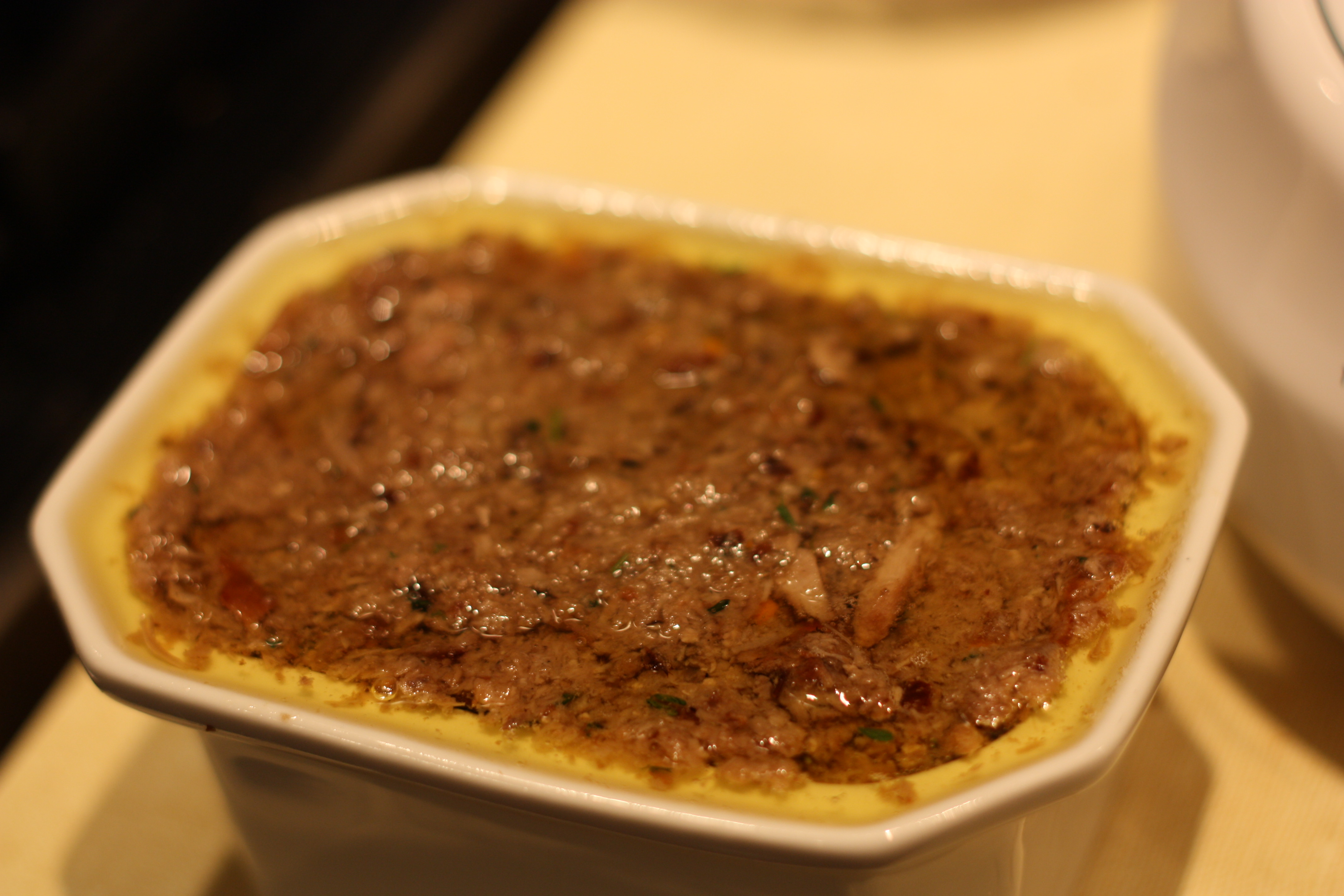
Duck Rillettes, minutes after preparation
Duck Rillettes
Rillettes of any kind are not for the weak of heart, but they are the uber-Poor Man’s Feast dish if ever there was one; designed to use up every scrap, bit, slice, and drop of meat (usually pork), this traditional country French dish involves cooking the meat slowly with a substantial addition of both salt and fat, cooling it, and then shredding or mashing it to a paste. This version—which infuses the meat with quatre d’epice, orange zest, and cognac—is significantly lower in fat and, lest I infuriate my French friends, quite untraditional (but delicious nonetheless).
2 tablespoons extra virgin olive oil
2 tablespoons duck fat
2 pounds leftover cooked duck meat, including some skin, coarsely chopped
8 juniper berries
3 whole allspice
3 black peppercorns
1/4 teaspoon quatre d’epice
4 sprigs fresh thyme
1 Bay leaf
2 tablespoons orange zest
1/4 cup cognac
1 tablespoon salt, or to taste
1. In a large saucepan over medium heat, warm the olive oil together with the duck fat until fragrant, and add the chopped duck meat. Toss well with a wooden spoon to combine and reduce the heat to medium low. Stir frequently to keep from sticking; if the fat appears to be burning, remove the pan from the heat.
2. In a mortar and pestle, roughly grind together the juniper berries, allspice, peppercorns, and fold it into the saucepan with the duck. Add the quatre d’epice, thyme, bay, and orange zest, toss well to combine, and increase the heat to medium. Warm the mixture thoroughly until it is quite fragrant, and stir in the cognac. Taste for seasoning, and add the salt (or more, if necessary). Remove from heat.
3. Place the mixture in the bowl of a food processor and pulse it until it resembles a coarse paste (or pound it in a large mortar and pestle). Fold it into a ceramic 2 cup terrine lined with fresh thyme sprigs, pressing every large spoonful down tightly. Top with more herbs, wrap in plastic wrap and foil, and then top with the lid. Keep the rillettes refrigerated until an hour before you’re ready to serve them; remove the wrappings, replace the lid, and let come to room temperature. Serve with warm toast rounds.
Will keep for a week under refrigeration.




If you ever tempted to try a goose again there is a wonderful organic farm near me that has all the different game birds you could desire, including goose. My dad was always partial to a nice goose on Christmas, bizarre for a nice Jewish boy but there you go. Once I found this place it was ideal.
Found you here through FIne Cooking, and so glad I did! Making a rillette is one of those things that’s been on my list for a long time.
Looking forward to reading.
Hi Kimberley, Many thanks for reading! Let me know how it goes with the rillettes! Happy New Year! -Elissa@poormansfeast.com
Too funny! Giuliano has a wonderful recipe for duck in How to Cook Italian; however, he hasn’t made it recently. You’ve inspired me to dig it out. I’ve not had rillettes and would like to try them.
Lael, the rillettes are great. But my guess is that your bubbe’s chopped liver is better!