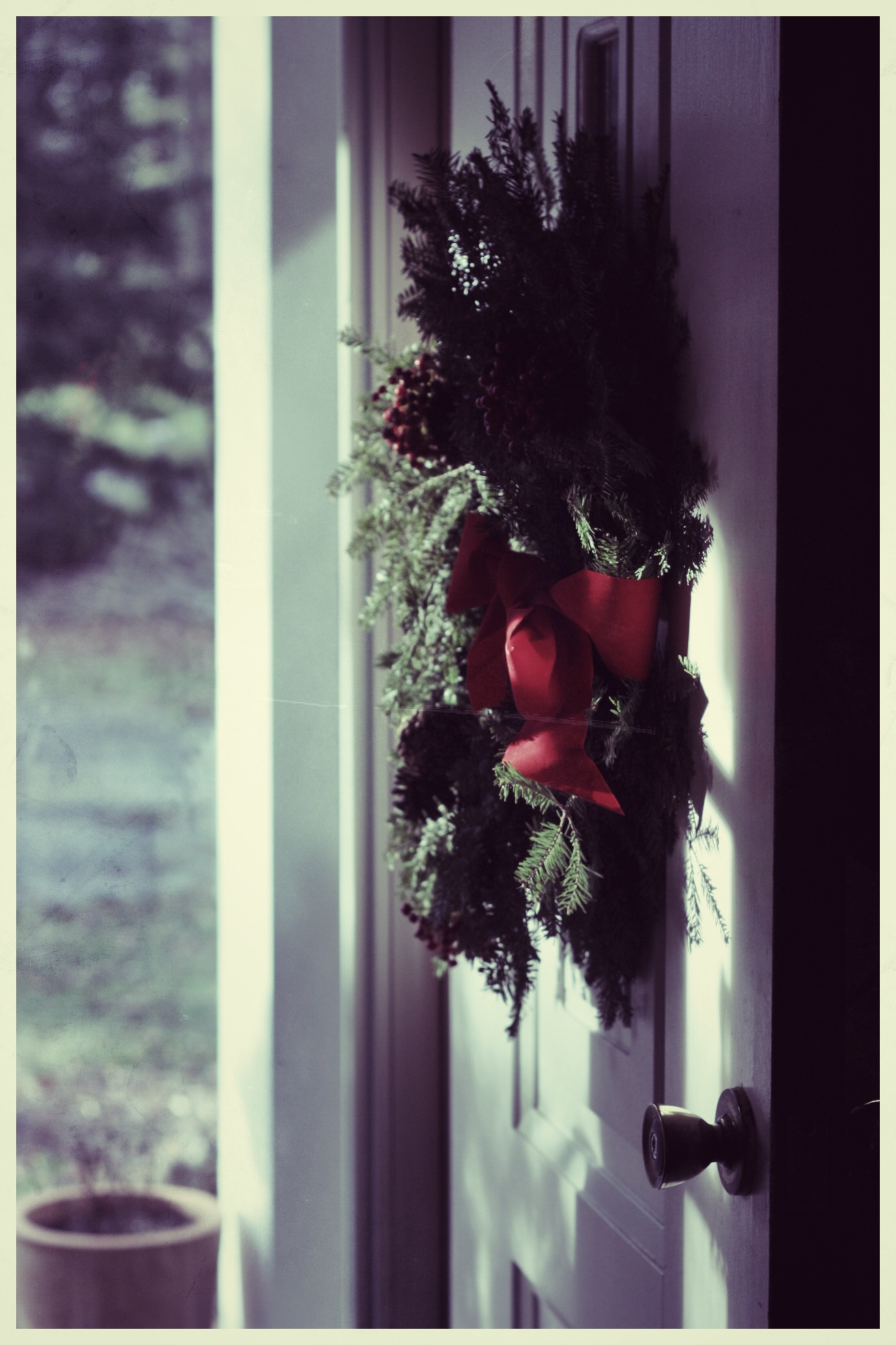
ChristmasDoor

Every night, there is another celebrity Christmas special to watch: The Osmond Brothers, wearing shearling coats like the one my father had from his dude ranch days, and which my mother incinerated, sing carols from Temple Square in Salt Lake City, enormous flakes of snow settling down on their thick, gorgeous, Mormon eyelashes. John Denver, wearing a metallic silver, yoke-front, western-style shirt sings Merry Christmas Little Zachary, a song to his new baby boy, from inside a heated glass geodesic dome atop a mountain in Aspen, while Annie Denver and a passel of their hippie EST friends watch contemplatively through matching round granny glasses. There are The Waltons, the father of whom is forever getting stranded in a freak snow storm high atop Walton’s Mountain, leaving Livvy Walton, and the children, and Grandma and Grandpa worried sick — too worried, even, to sit down at their massive farmhouse table laden with the gifts of the season that Livvy bought with spare change hoarded all year in her apron pocket, and then hidden in a blue glass Mason jar, here, in the midst of The Great Depression. There’s the Andy Williams Christmas show, and The Partridge Family, The Brady Bunch, The Carpenters, Bob Hope, and Dean Martin, who sings Ave Maria. There’s Perry Como, who my mother swoons over, and when Bing Crosby sings The Little Drummer Boy with David Bowie, I yell for Gaga, my grandmother, who is frying latkes in our kitchen.

https://www.youtube.com/watch?v=ADbJLo4x-tk

She comes running down the hallway, nearly tripping over the dog, and her eyes grow misty when she sees the rocker and the crooner — Bing in a blue golf sweater, Bowie in a tight shirt and sport jacket, a massive gold cross dangling around his neck as though he needs to convince viewers of his devotion — standing on a dark, muted set decorated demurely, like an empty parish house attached to a very old church: no glamorous, kicking Rockettes dressed like snowflakes, or camels or sheep or Wise Men. Instead, a piano, and a Gothic window behind the two singers; fake snow might be gently falling in the fake woods outside.

My favorite song, Gaga says, wistfully, standing over me in my bedroom with a Teflon spatula in one hand and an oily kitchen towel in the other, as we watch the little Sony Trinitron television that my parents have given me for Hanukah. She begins to hum along in her low, guttural mezzo-soprano with one of the weirdest duets ever assembled for modern television, between a 1940s movie star with a strong religious, right wing streak and an emerging history of brutality against his vast brood of lilywhite children, and a space oddity named Ziggy Stardust, who apparently likes boys. And sometimes, girls.

Come they told me, pa rum pum pump um

A new born King to see, pa rum pump um pum

Our finest gifts we bring, pa rum pump um pum

To lay before the King pa rum pump um pum

Rum pum pum pum, rum pump um pum…

So to honor Him, pa rum pump um pum

When we come…..

Gaga loves this song; she’s loved it since she first heard it on her kitchen radio in the late 1950s, when my mother was out of the house and singing on network television, and Gaga was home alone while my grandfather was working at his furniture store, supplying most of south Williamsburg with beds, chairs, desks, tables, and the rest of the mundanity of life. Here, in the third floor apartment that Gaga shares with her husband and daughter, where they have lived since before the war, I imagine her sitting in the kitchen, turning the amber nobs on the old burled walnut RCA wooden radio that used to stand in the living room — replaced by the General Electric console television they bought when my mother began appearing on The Galen Drake Show — and tuning in a local station playing popular music. It’s Christmastime, and her Italian neighbors who live both upstairs and downstairs have decorated their windows with wreaths and tinsel, and tied balsam roping around the banister from the ground floor all the way up to the roof. Sweet, yeasty clouds of hot, baking panettone – the ripe, pungent souring of the biga, the apricots and raisins and Fiori di Sicilia — slither out from beneath her neighbors’ doors, and Mrs. Lambiazi who lives two flights below her comes up to borrow extra egg whites for the Torrone she’s making for her son, who is coming in from Providence with his new wife and baby. By the 24th, Gaga tells me thirty years later, the building will begin to smell like a fish market: her neighbors are making baccala and scampi and fried eel, and there’s so much hocking and pounding and chopping and shouting in Italian going on in every apartment that she turns on the radio to calm her nerves, and sits down at her kitchen table to listen, alone, and hears, for the first time, The Little Drummer Boy.
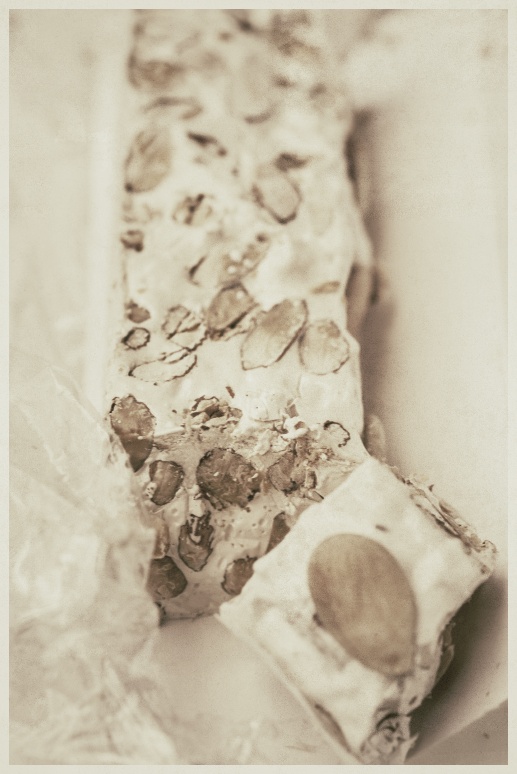
Torrone with almonds

These are the smells of life and of sustenance, she tells herself, that separate the banal from the joyful. She longs to cook great, vast holiday meals that her family — her four sisters and their husbands and children, her own daughter and husband — will love, that they will flock to. But her sisters have scattered, some to Florida, some to Queens, and her daughter is afraid of food — she had been a heavy child who sold the sandwiches that she carried with her to school, and who starved herself to lose weight so that she could be on television — and her husband, who can’t keep weight on no matter what she feeds him, treats it like the fuel he pumps into his Plymouth. So Gaga makes her weekly chicken soup, and her weekly blintzes, and her weekly brisket as though it’s nothing more than a chore, and it is eaten — if it is eaten at all — mechanically, angrily, on-the-run, and entirely without pleasure.

Christmastime swirls around Gaga, and it sucks her in; over the years, she’s come to love it, to live vicariously through the goodness of it, through the noise and the food and the psychic heart nourishment that she so desperately yearns for. In Brooklyn, the holiday doesn’t care whether she is Jewish, and neither do her neighbors: Christmas climbs the steps of her apartment building and creeps up into the rattling radiators and into the pipes, and when Mrs. Lambiazi shows up one Christmas Day carrying a sheet of steaming Lasagna Bolognese, meat and cheese together, and Gaga says Thank you but I can’t, Mrs. Lambiazi tells her in Italian that she is now family — Tu sei la nostra famiglia — and that it comes from her home, and her heart, and that Gaga must. And so she does.

There are only three Christmas songs that Gaga truly loves and will listen to: White Christmas, because it was written by Irving Berlin, and she loves anything written by Irving Berlin; The Christmas Song, because she loves Nat Cole; and I’ll Be Home for Christmas, which she also loves but can’t get through anymore — if only in my dreams — since the morning, fourteen years earlier, when Mrs. Lambiazi got the telegram about her older son who was at Anzio with his battalion. Gaga heard the screaming from two flights up and ran down the stairs to find her neighbor collapsed on the kitchen floor, the radio on, her baccala still simmering in a pan of water on the stove above her.
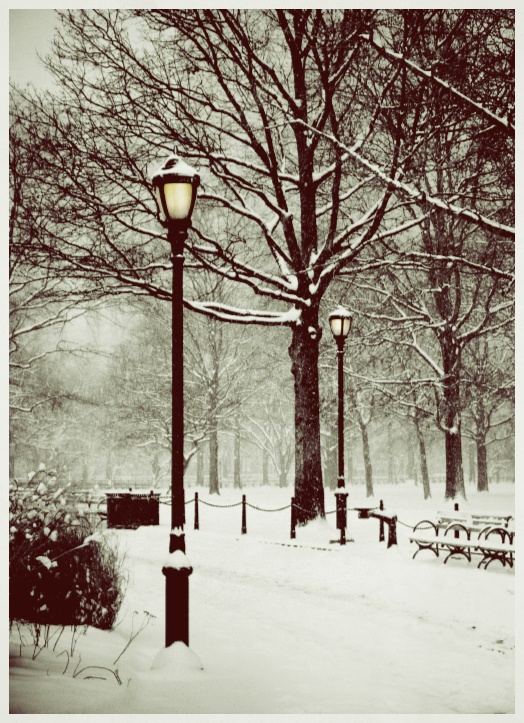
BrooklynSnow_Snapseed

If only in my dreams Gaga hears, and she has to take off her glasses to wipe her eyes; once she starts, she can’t stop, so deep is her feeling for Mrs. Lambiazi, but really, for her own life and situation, for her longing to feed people, and to fill a house with the kind of warmth and laughter and music she’d had when she was younger and living in her mother’s home on South Fifth Street, before all of her sisters had married and moved out, and she, the eldest at thirty-three, was left behind, and people began to talk.

The first time Gaga hears The Little Drummer Boy, alone in her Brooklyn apartment, she loves it for its simplicity and its message of peace, and its lack of commercial excess; years later, on this night, in my room in Forest Hills, she sits down on the edge of my bed and together we watch Bing Crosby and David Bowie while her latkes cook in the kitchen down the hall, and all she can think of is Lasagna Bolognese, and the smells of simmering baccala and balsam roping, and life, and sustenance.

Thanks. Giving.

November 25, 2014 · 24 comments


Plimothroch

In 1974, when I was 11 years old, I took part in a Thanksgiving play at school. Gaga, my grandmother, ran out to the local fabric store on Austin Street in Forest Hills, and came home with enough polyester yardage to make me an outfit that she was certain would replicate what Priscilla Alden wore on the day she stepped off The Mayflower. Borrowing a neighbor’s sewing machine, Gaga turned into Gramma Walton, and sewed me a long gray dirndl skirt, a matching gray blouse, and a white smock that looked a little like a Zen rakusu. There was also a gray bonnet, which I distinctly remember trying on with Seasons in the Sun playing in the background.

You look like a real Pilgrim, my grandmother said proudly, and I did, until my mother insisted that I wear the gold chai that she and my father had given me for my birthday a few months earlier.

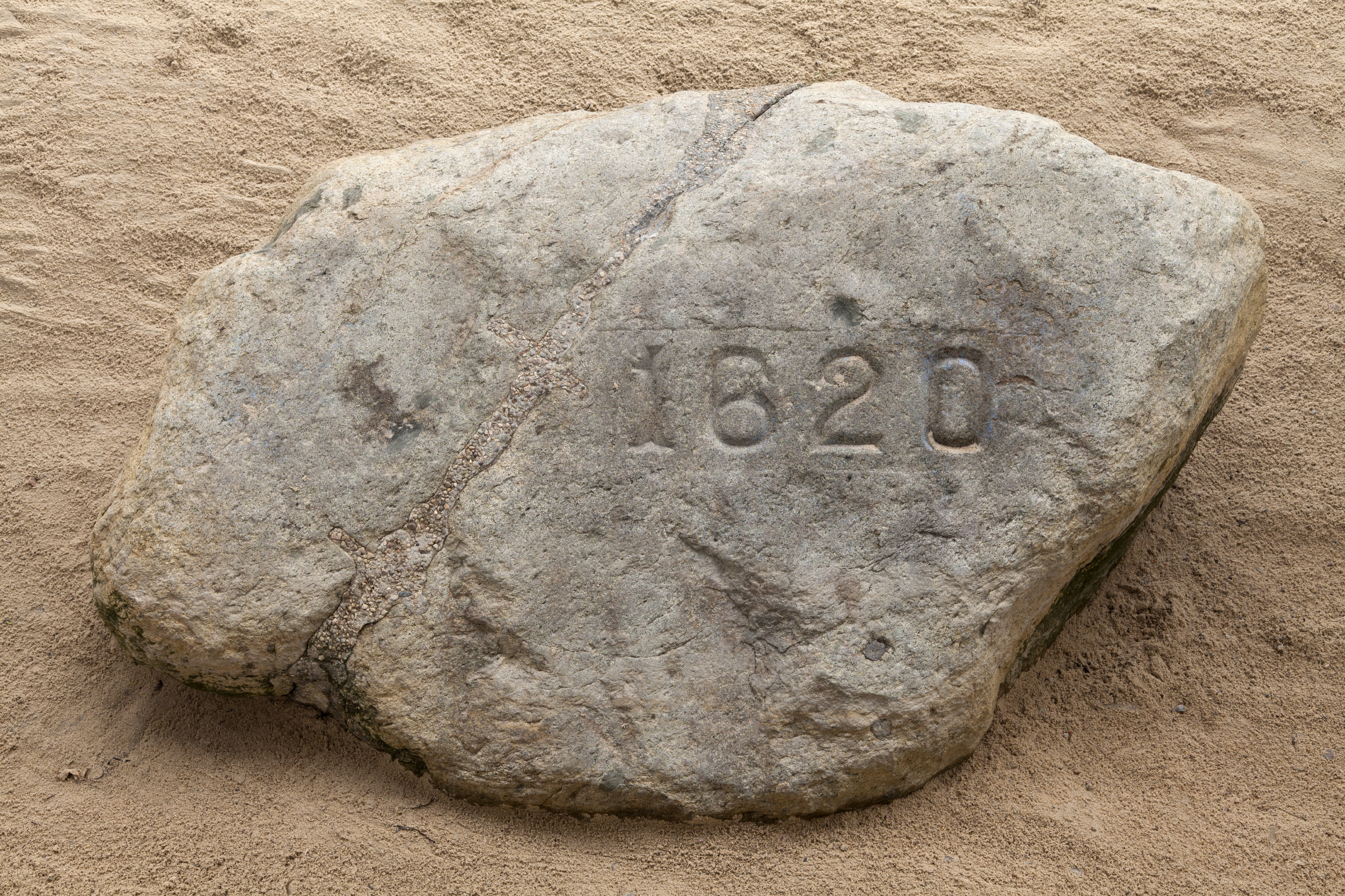
When I stepped out onstage into the vast, black, cavern of silence that was my grade school auditorium and the audio visual guy threw the massive switch on the giant spotlight, my mind went blank; to this day, all I can remember is “My name is Priscilla Alden. In 1620 I landed on Plymouth Rock…..” That was it for me before I began to develop a weird sort of bonging in my ears. I had memorized a three-hundred word speech about the long, awful journey from England, and the happy and helpful Indians (sorry; this was before the days when we said Native American) and how they gleefully taught the men and women of the Mayflower how to plant corn, until everyone came down with the flu and died. But the spotlight that hit me might has well have been a two-by-four: I stood there, in shock, my eyes wide open, my bonnet slightly askew.

Loser, one of my school friends whispered, laughing from the wings; I burst into tears and had to be ushered from the stage.

I’ve had a tense relationship with Thanksgiving, its tradition, and its meaning, ever since.

For a long time, the holiday was marked by the presence of Danny Kaye and Joseph Walsh singing Wonderful, Wonderful Copenhagen in Hans Christian Andersen, which I used to watch every Thanksgiving morning while Gaga was in the kitchen, putting the marshmallows on the sweet potato and Corn Flake pie. I’d sit in front of the television with my arm around my Airedale, Chips, and we’d sway back and forth together like a pair of idiots, singing along about the salty old queen of the sea. This went on for years, until things started to go south in my parents’ marriage, and I spent the morning hiding out in my best friend’s apartment around the corner, while our Thanksgiving meal was prepared in silence and ultimately eaten with the sort of enmity that’s usually reserved for warring nations.

https://www.youtube.com/watch?v=24SPhbpeAzE

After they divorced, I spent roughly fifteen years celebrating Thanksgiving with my father’s sister and cousins, and their children; there was music, and great food, and — because we smushed Hanukah into the celebration — toys and games for the kids. Eventually, the children grew up, as children do, and started their own families; they scattered to different parts of the country where they began to make their own traditions.

This year, like last, Susan and I are having sixteen people to our table: my mom will be with us, along with some single friends and their very young children, and our neighbors and their teenage children (and some teenage friends of the teenage children). There will be nearly as many vegetarians as meat eaters, and so while there will be two heritage turkeys — one done on Susan’s dad’s old 1959 Weber Kettle grill, one done in the oven — there will be far more vegetables on the table as there will be poultry. I suspect — I hope, anyway — that there will be much laughing, and joy, and happy eating sounds before many of us pass out in a tryptophan haze.

But still, I struggle. I struggle with the meaning of Thanksgiving—a holiday that can be so overwhelming that it leaves me frozen and a little panicky and unable to form words, like I was that day on the stage at PS 174, when I was dressed as Priscilla Alden with a chai.

This year, though, as I was applying the salt brine to our turkeys, keeping busy, keeping moving, searching for the meaning, as ever, I remembered.

IMG_7629

I remembered late September, and our friend Deborah, hiking with us and her husband Patrick, and their dog, out into the hills amidst the scrub and across the arroyos near her home in New Mexico, and visiting the vast and glorious Santa Fe Farmer’s Market, and breathing the roasting Hatch Chiles and meeting Dorothy Massey at Collected Works, and going back to the house to await the arrival of Deborah’s friends, and cooking and laughing and listening to music and feeling like if the house next door were available, we would buy it without a second thought.

I remembered Becky Selengut walking us out into the woods somewhere south of Tacoma, Washington on a soggy, gray day early last month, and, for the first time in my life, foraging pounds and pounds of magnificent Chanterelle mushrooms, slicing them way down into the ground with the small, ancient folding knife I found buried in a pile of sawdust in my late mother-in-law’s garage before we sold her house last spring. There we were, Susan and Becky and I, in the middle of nowhere, finding gobs and gobs of mushrooms, real food, from the earth — the actual EARTH! — covered in dirt and Douglas Fir needles, and at last, I learned why the act of foraging is as electrifying and thrilling as it is grounding. It gives and it gives; the key is not to take and take which, it seems, is the human impulse.

IMG_7812

IMG_7824


IMG_7860

IMG_7881

I remembered Barbara Marrett, Susan’s dearest friend from college, who we never see, and who welcomed us to her home in Friday Harbor on San Juan Island, the veritable ends of the earth. There was the long drive to Anacortes from Seattle, and the way the air became sweeter and warmer, and the ferry ride that left me weeping for the beauty of the water and the mountains — I tried to hide my sobbing from Susan; I told her it was just the wind — and arriving there and being introduced to a guy, just an old grisly guy, who plays sea shantys on a button accordion at a local pub a million miles away from anything, and it turned out to be Mike Cohen, who I’ve listened to for years, and whose brother is John Cohen, of The New Lost City Ramblers.

IMG_7916

And how Barbara, who happens to be the Communications Manager at the San Juan Islands Visitor’s Bureau and knows every single square inch of the islands and the incredible farmers/producers/growers/wine-and-spirit-makers who live and work there, introduced us to the miraculous food of the islands. And how, on our last night, she and her lovely man, Bill — who plays the harmonium, and leads chanting! The harmonium! Like Krishna Das! — invited friends for dinner, and the salmon, which Bill caught, was extraordinary, and the friends were as warm as bear hugs, and the night ended with hours of guitar and mandolin playing and a bunch of old hippies sitting around and crooning, as old hippies tend to do. When we got ready to leave the next morning, I stepped outside to breathe the air off Barbara’s deck, and heard rustling in the trees less then eight feet from where I was standing; someone had come to say goodbye.

IMG_7939


IMG_7928


So this Thanksgiving feels different, somehow; I get it, I understand. And I’m grateful.

Sauteed Mushrooms on Toast

It might seem a little bit lackluster to put up a simple recipe at a season of such great excess; maybe that’s the point. The fact is, amidst the giant turkeys and the platters of vegetables and stuffing and tables creaking under the weight of our bounty, I sometimes think that Thanksgiving needs to be scaled back; the food needs to be simpler, less fussy, and more, well, of the earth. The day that Susan and I went foraging with Becky Selengut, author of the seminal book on mushrooms, Shroom, we came home with a gift that literally changed the way I think about food. There was nothing to do to these chanterelles but give them a (very) gentle wipe, a quick chop, and a saute in a hot pan with some sweet butter. And give thanks for them.

Serves 2

1-1/2 pounds of the freshest Chanterelle mushrooms you can find, gently wiped of dirt

2 tablespoons unsalted butter

sea salt

4 slices sourdough bread, toasted, and rubbed with a clove of garlic

fresh parsley, chopped

Give the mushrooms a quick chop; remove any woody stems, and save them for stock. Place a large cast iron skillet over medium high heat, warm the butter in the pan until it stops foaming, and add the mushrooms to the pan. Lower the heat a bit and cook, stirring frequently, until the mushrooms have released their liquid and most of it has evaporated, about 8 minutes (taking care not to burn them). Season with a little sea salt and spoon them out onto the toast along with their buttery juices. Sprinkle with some chopped parsley leaves, and serve immediately.

indiebound


©2009, ©2010, Poor Man's Feast. All rights reserved. To reprint any content herein, including recipes and photography, please contact rights@poormansfeast.com