 The last holiday we spent with Susan’s Aunt Millie was Christmas, and she arrived at our house on Christmas Day wearing bright blue running shoes and a hot pink Kangol Furgora bucket hat, the kind that LL Cool Jay might have worn to fend off a chill.
We both loved Millie, and as Susan’s sole surviving aunt—at one time there were five of them along with their brothers —we wanted her with us because, at 96 and without children of her own, she would have otherwise been alone. A remarkably devout, deeply spiritual woman of the sort who used to hand-feed raccoons Oreo cookies and once put a Mezuzah on her door frame just to “cover her bets,” Aunt Mil woke up the day after Christmas, sat at our dining room table, patted the dog on the head, and proceeded to devour in the neighborhood of seven blueberry pancakes in less then ten minutes, which is saying a lot for a tiny woman who was five years old when World War I ended.
We all had a wonderful time, but when Aunt Millie began to have small strokes a month or so later, we knew that the end was probably near, and it was. We saw her a while ago, when we dropped in and she was sitting in her living room, in her bright blue sneakers, having a snack and watching mass on television; she couldn’t speak much but she beamed happily, and we talked about the next holiday we’d spend together. When she was moved to nursing care and we spent a short afternoon with her, I kissed her on the head before we left, and said “no dancing. Okay?”
And she looked up, smiled, and said okay.
So her passing the other day wasn’t exactly a shock, but still difficult nonetheless. We spent the afternoon with Susan’s mother and cousin, doing the dreaded task of gathering clothes and making arrangements. And it was some time during our visit to the funeral home—right around the point that the funeral director suggested a pink vault because it was more ladylike—that I realized just how bizarre this whole process of dying is for the people who are left behind, and who do all manner of odd things in response to a loved one’s departure from this earth. It really doesn’t seem to matter what your background is: the universal truth is that when people lose someone they love, things can get a little bit wonky. And that’s a best case scenario.
We spent the afternoon making plans; when the funeral director said the casket was “thirty-three,” Susan’s mother thought he meant $33,000. I told her no, she was thinking of Elvis’s casket. But it just wouldn’t sink in. Why would a casket cost more than her first house? Did it have a bathroom? It made no sense. We told her, and told her again. And again. She demanded that we bring a slip along with us for Millie’s outfit, because otherwise, it wouldn’t hang right. Fair enough. We couldn’t argue with her. Comfort is comfort, in whatever form it comes, and grasping for it in times of distress is human nature. Even if you know, in the deepest recesses of your mind, that your sister’s dress not hanging right during her funeral won’t really be an issue.
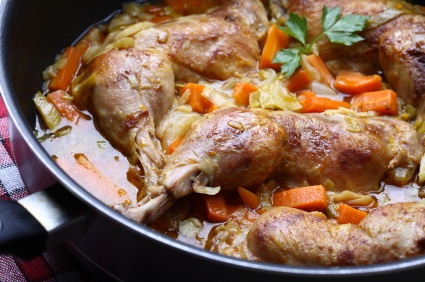
At the end of the day, I brought Susan and her mother home and then went out shopping. What to feed people who are heartbreakingly sad? What to make for a woman who, for the first time in her 92 years, is without an older sibling to care for? The most soothing, comforting, and calming meal I could think of: Walter Wells’s recipe for Chicken in the Pot, which was published last year on Dorie Greenspan’s wonderful blog.
Neither of us thought that Susan’s mother would eat anything; we assumed that, at best, she’d just pick. But after finishing the entire bowl, she picked it up and drank down the broth, declared it the best meal she’d ever eaten in her entire life, and then sent us home to get some rest.

Aunt Millie's Rapper Hat
Chicken in the Pot
(adapted from Walter Wells, via Dorie Greenspan)
A lot of dishes purport to be comfort food, but are really cloyingly rich; this one is not. Instead, the chicken, which has been lightly browned, is enveloped in a mild broth and surrounded by vegetables and herbs. Served in shallow bowls, it’s the perfect one-dish meal to serve when times are rough.
2 tablespoons extra virgin olive oil, separated
3 small new potatoes, halved
3 carrots, peeled and quartered
2 celery stalks, quartered
3 shallots, peeled and halved
1 head of garlic, broken apart into cloves but not peeled
2 small turnips, peeled and quartered
3 sprigs thyme
1 sprig rosemary
1 3-pound chicken
1 star anise
1 cup chicken stock
1/2 cup white wine
salt and pepper, to taste
1. Preheat oven to 350 degrees F. In a large, heavyweight cast iron pan set over medium heat, warm one tablespoon of oil until it shimmers. Add the vegetables and reduce heat to medium low. Cook slowly until they begin to caramelize, tossing them from time to time. Remove them to a medium heavy Dutch oven, add the herbs, toss, and set aside.
2. In the same cast iron pan set over medium heat, warm the second tablespoon of oil until it shimmers. Place the chicken, breast-side down in the pan, and brown to a dark golden, about six minutes. Rotate, and brown the back. Place the chicken amidst the vegetables in the Dutch oven, and add the anise.
3. In a small pan, warm the stock together with the wine until it barely simmers, and season to taste. Pour over the chicken. Seal the Dutch oven with heavy-duty foil, and cover with the lid. Place in the oven, and roast for 50 minutes.
4. Remove the chicken to a platter, let stand for five minutes, and then carve. Scoop some of the vegetables and herbs shallow bowls, top with the chicken, and ladles of the broth. Serve with warm bread.