There was a definable period of time back in the mid-1970s when every Sunday afternoon seemed to be punctuated by a silent lunch in my father’s mother’s Brooklyn kitchen. It wasn’t so much that we didn’t have anything to say to each other. What rendered me speechless was the fact that, for a very long stretch, her food was particularly odd and usually involved a lot of staring.
One one occasion, she tottered over to me from the attached kitchen, whose thick, white walls had been painted annually since 1934, making it impossible to close the cabinets. I was sitting opposite my father, who was reading a properly folded New York Times and drinking a cup of Sanka, when my grandmother shuffled around behind me and put down a soup bowl whose contents resembled exactly the Pepto Bismal I’d been dosed with a week prior, after coming down with a stomach bug. I just looked at it.
My grandmother shuffled back to me a minute or so later, and dolloped a heavy tablespoon of thick, white sour cream in the middle of the bowl.
“Swirl it around—” she said.
I sat with my hands at my sides and stared.
“Try it,” she implored, untying the flowered apron from around her substantial waist.
“I don’t eat pink food,” I replied, looking at my father for help.
“What does she mean, she doesn’t eat pink food?” my grandmother asked him. I loved it when my family talked about me like I wasn’t there.
“She doesn’t eat pink food, mom,” he said. “You heard her—-”
“She’ll eat this,” she responded, pointing at the bowl and staring at me.
I picked up my fork and gingerly dipped the tines into the rose-hued liquid, and tasted. It was sweet and peppery and earthy, and I loathed it. I put my fork down and stared at the bowl. A minute later, it was removed. I heard it land in the sink from a great height.
A week later, we were back at my grandmother’s apartment, having another lunch. We had just seen Young Frankenstein at the Ziegfield in Manhattan, and it was all my eleven year old self could do not to act out the various parts. I thought that both it, and I, were hilarious. My grandmother was unmoved.
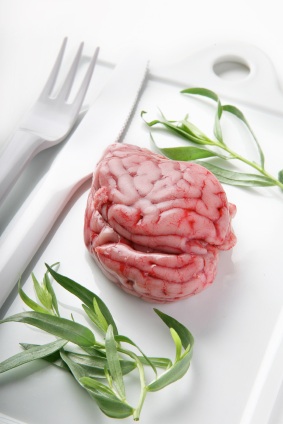
“Sit,” she said, and I did. My father was in the other room, on the phone with my mother who had stayed behind in Forest Hills. My grandmother toddled into the kitchen and opened the refrigerator door. I heard the telltale bang of jar lid against counter, and then the sound of released air compression. A plate was put down in front of me, and on it was a small, gray calves brain.
The words Abby Normal coursed through my mind, and I just stared.
We stopped having lunch at my grandmother’s house right after that, since it was clear that she had absolutely no sense of what was appropriate to feed kids, and what wasn’t. This wasn’t a situation like the ones my friends complain about today, where they can’t get their children to eat a piece of fish, or a spear of asparagus. This woman was feeding me borscht, and brain-on-a-plate, and wondering why I wouldn’t eat it.
Years later, after my parents divorced, I’d spend pretty much every Saturday night at my grandmother’s house, along with my father, who was living there for a while. And every Sunday morning, I’d shudder in fear over what might be served to me at the breakfast table. One day, she ambled over to me carrying a cottage cheese container shrouded in an air of culinary mystery. I knew that what was inside was probably not what was on the label. I looked at my father for help.
“You’ll eat this–” he said, “Trust me.”
I trusted my father implicitly when it came to food; after all, he was a man who would drive for two hours to get to a pastrami sandwich.
My grandmother pried the lid off, and inside was a strange amalgam—a sort of spread that looked like a beige combination of cottage cheese mashed together with cardboard packing material. She dolloped some on my plate, and my father handed me an indefinable Scandinavian cracker that had the consistency of styrofoam.
“Put the spread on the cracker,” he said–“Just try it, once.”
It was remarkable, if you like fish for breakfast (which I do). Somehow, my grandmother had gotten it into her head that blending together large curd cottage cheese with skinless, boneless sardines was a good idea. I’m not sure how she got to it, and even now, I would make fun of it, but I can’t: it was delicious, and to this day it remains one of those weird things that I eat when I eat alone. When Deborah Madison and Patrick McFarlin‘s book, What We Eat When We Eat Alone came out last year, it was this dish that I immediately thought of, mostly because Susan doesn’t want to be in the same house, or the same state, when I make it.
But now that I work from home full time, she doesn’t have to be.
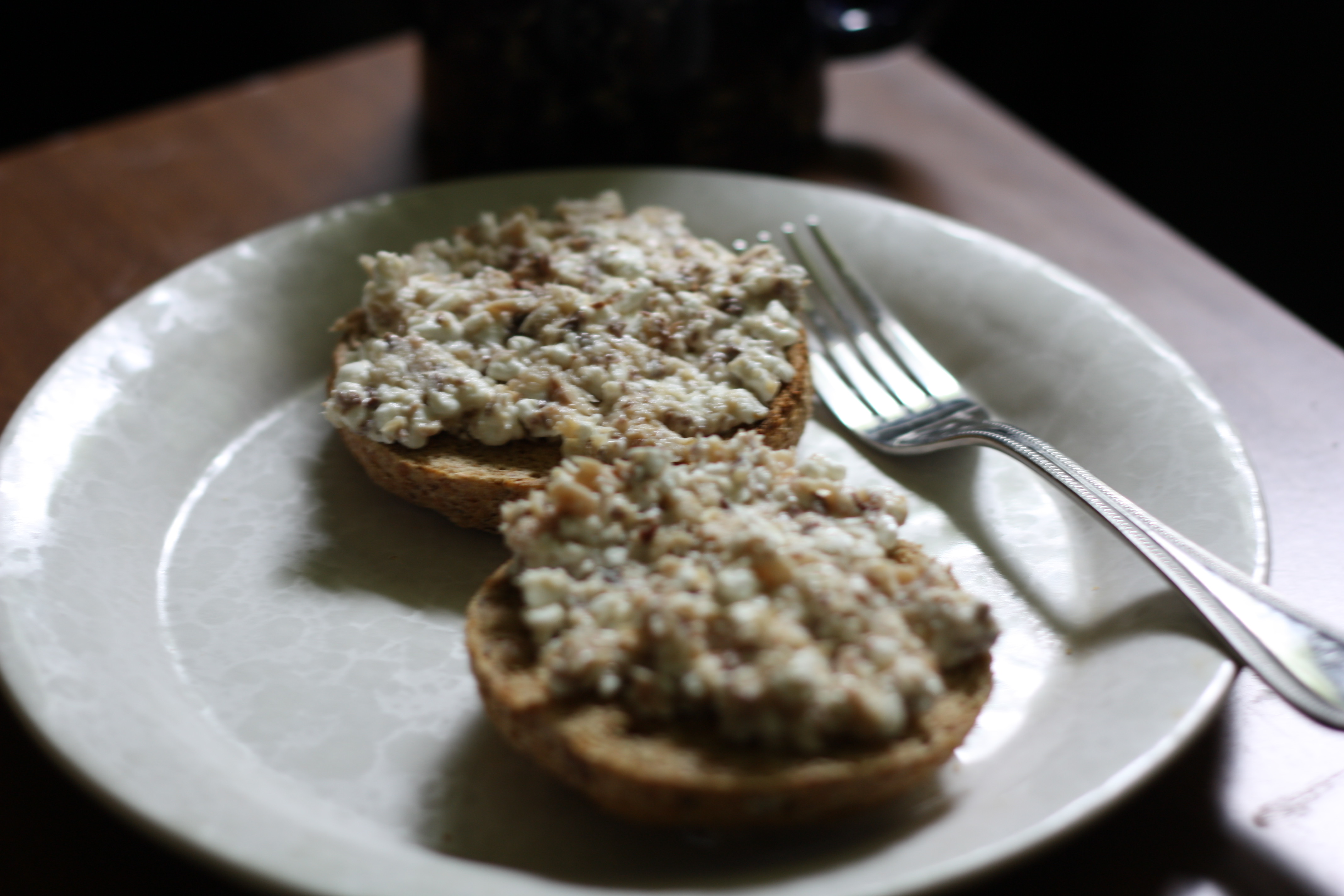
Cottage Cheese and Sardine Spread
Cheap, simple, and actually packed with calcium, this is a spread that either you love, or you run screaming from. When Susan and I go grocery shopping together and she sees me standing in front of the canned fish, she knows what’s coming next: a trip to the cottage cheese department. A quick and easy lunch that’s ideal for when you’re sitting in front of the computer and on deadline, I usually eat it on Wasa crackers, or a whole grain bagel, or similar edible cardboard.
Serves 1-2
3/4 cup large curd, unsalted cottage cheese
1-2 tins skinless, boneless sardines packed in water, drained
Possible additions: finely diced cucumber, dill, finely diced scallion
1. Spoon out the cottage cheese into a medium bowl, and fluff it up with a fork.
2. Add the sardines, mashing as you go. The resulting spread should be an even combination of fish and cheese.