When my Aunt Thelma closed out her New York apartment and moved down to Florida permanently, much of what she had lived with over the years was distributed among us: my cousins and I found spaces in our homes for a lot of the furniture that had followed her from place to place, from the Jamaica Estates house to the Woodstock house to the Long Island house to the Floral Park apartment. I moved my aunt’s bedside desk and chair into our bedroom—hers was the first desk I ever saw double as nightstand, and I remember it from when I was barely three, and spent a lot of time thinking about how a bedroom desk is a different kind of desk, and one meant for far more personal note-writing than, say, the office variety. My cousins moved her oak table into their kitchen in Virginia; my stepmother has her den coffee table. The olive drab luncheon china cabinet that sat in my grandmother’s Brooklyn kitchen—the chicken fat-infused one that my aunt inherited and then used to store Maxwell House Passover Haggadahs and a mound of crushed velvet yarmulkes collected from the family’s spate of 1960s and 70s weddings and Bar Mitzvahs—lived in her daughter’s house for years, and then was brought to my kitchen, where it was stripped of its Napoleonic pediment and repurposed as a freestanding spice cabinet, with different shelves for Mediterranean and Asian ingredients, and a third one for baking.
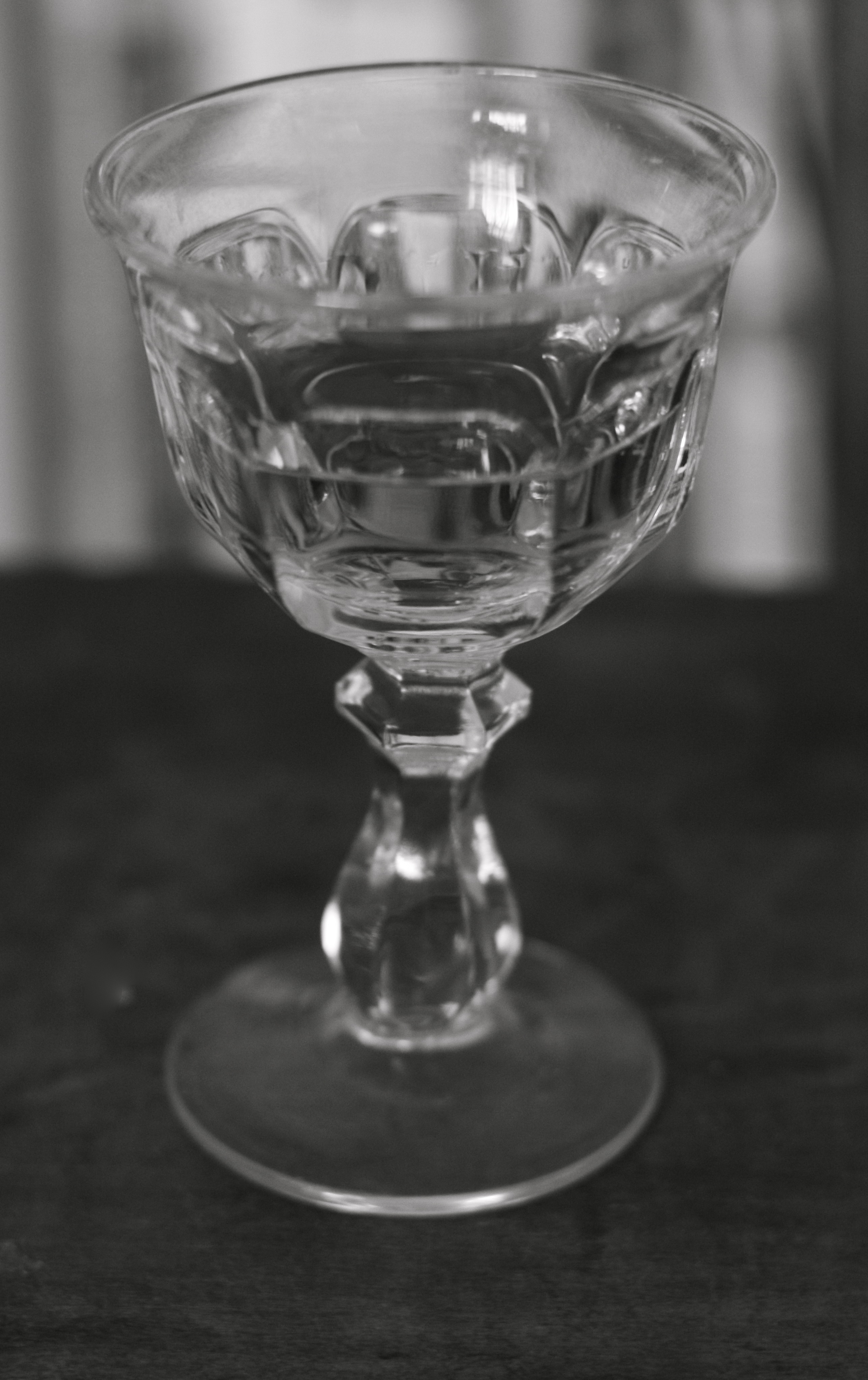
When all the furniture was claimed, and my aunt moved to her new home in Florida, there were only a few things left: a haphazard collection of platters, crazed with age; and two sets of glasses — large and small sized versions of the same pattern — that I hadn’t seen since I was a very young child. We took the platters (since I love, and collect platters), and packed them up.
“What about the glasses—” Susan said, staring at me as I lifted one up to the light, smiling one of those automatic, Proustian smiles that happens naturally when you’re reminded of something you haven’t thought about in ages.
“Let’s just take the small ones,” I told her, rolling them up in cream-colored packing paper.
“But wouldn’t we get more use out of the bigger ones–?”
She was right, we would have, although big, heavy glasses with wide, tulip-ish bowls don’t generally work for me, or anything that I drink, for that matter.
But the little ones — the ones that Aunt Thelma put at every child’s place setting during every holiday dinner — were the ones I wanted, and the ones I liberated. These were the glasses that I remembered—the ones that were filled with a few teaspoons of wine during Passover, and the ones we mysteriously dipped our tiny fingers into when it came time to recall the 10 Plagues of Egypt, each drop of wine signifying God’s sorrow and the tears shed in mourning for that nation. We all tasted our first cream sherry in those small glasses, and as we got a little bit older, the young, white Bordeaux that my aunt insisted we all grow accustomed to having with family dinners. She believed, and still believes, that if you de-mystify wine for children at an early age, they grow up unencumbered by temptation; wine, instead, becomes a normal, sweet part of life rather than exceptional, and delicious though it may be, mundane.
Those glasses—all eight of them—now sit in my open kitchen cabinet, right next to a few stemless Riedels and a couple of stacks of Picardie tumblers, which I use for everything from wine to pots de creme. In the years that we’ve had them here, I haven’t used Aunt Thelma’s glasses once, but I can’t bring myself to wrap them up and put them away, or to relinquish them to the basement, or, at a deep discount, to some stranger’s hands during our annual yard sale. They’re a direct connection to that time when we were all younger and safer, and the biggest concern any of us had was that we shouldn’t accidentally dump that tiny glass of Manischewitz all over one of the more interactive Haggadah pages that demanded our less-than-nimble participation during the Passover Seder.
But the other night, after I’d stopped working for the day and before Susan came home, I finally took one down, gave it a quick rinse and dry, and poured myself a finger of sweet sherry—a wine that I keep out of habit as opposed to love. It had been a crazy, tense day filled with high emotion and insane deadlines, and all I wanted to do was slow down and celebrate it being five o’clock. I could have used any glass, but with my cousin Mishka’s baby on the way and Passover being right around the corner, it seemed a natural choice.




Liberating the small glasses! Yes, Elissa, that is what the time of sharing items from a parent’s or relative’s home means. You are hoisting certain items from boxes or nests of other things only to give them life again.
Our parents died a few months apart in 1982, when my 4 sisters and I ranged in age from 25-36. Little did we know of the liberation process, but it was soon on our shoulders. To deal with dividing and sharing the physical pieces of the mosaic of our lives, we turned to a deck of playing cards. If only one sister expressed interest in an item – any item, be it a piece of lace or a highboy bureau, a stove or a Persian rug – that item went to her. If two or more of us gave a nod, out came the cards. High card took it, and we moved on. Years later, we visit each other’s homes and feel the warmth of our parents through cherished home furnishings. When the sisters visit here, they know I’m cooking on Mom’s 6-burner, which I liberated with the Queen of Hearts.
How beautiful Toni–xxx
When my aunt Rose died, two days before my 50th birthday, rather then cancel a birthday bash I had planned for myself, I went forward and celebrated life, just my aunt Rose would have wanted me to do. I went to her home and was told to take a few items from her home. I took a large octagonal wall mirror which I use to get dressed in on a daily basis and a porcelain elk which sits in my library. Thanks for the memories Elissa.
My mother, who is still alive, has been giving away various kitchen goods to me and my sister for years. The giving doesn’t always work out according to her plans. She gives me an entire silver service when I’m visiting, with no time to pack it for a flight, so I give it to my very busy sister, who loves it, and when I visit her, I often polish it for her and we both enjoy the results. On the other hand, I’ve ended up with some ceramic chickens —colorful nests for hard-boiled eggs or a chicken stew—which I’ve no past connection with —even my mother had forgotten about them—but I adore them, as it turns out. None of these objects have the weight of those little wine glasses, but oddly, they do have some. They are, after all, things that played a part in my mother’s life until she decided they didn’t any more. My father also offered us wine as children, but those glasses are long gone. The pleasure of having wine with food, however, is not, a most valuable gift, to be sure!
None of my friends or family will drink slivovitz with me, but I never feel alone when I pour a few sips of the fiery liquid into one of my Zayde’s ugly little cordial glasses – he is nearby.
Funny. My Zayde taught me to drink slivovitz too…..
When my grandmother passed away all I wanted was the Wishing Well cookie jar. No jewelry, no furniture, no bits and bobs, just the cookie jar. Memories of childhood rise out of that squat brown container, it was usually filled with store bought sugar wafers (I liked the pink ones) or those windmill shaped spice cookies. Cookies cured all childhood hurts and celebrated all childhood happiness, cookies doled out for no reason at all other than love.