There are some times, as a writer, when words escape me. Usually, there’s some sort of emotional conflagration involved and no matter how I try to sit down and write, I can’t do it. Because, as I’m often reminded, all I’m doing is writing about food, and that can feel a little bit flimsy at times.
This happened to me, rather severely, in early September of 2002. I was living in Harwinton, Connecticut, in a town of 3,500 that had only gotten its first stoplight a few years before. One lovely summer’s morning weeks before, Susan and I were out in the garden, up to our knees in compost; we came back in to the house to get some water, and the phone rang. It was my stepbrother; he said the four words that no one, ever, ever wants to hear: “There’s been an accident.”
We left the door unlocked so that Susan’s mother could come and get the dog, and raced down to Long Island. Simple story: Car accident. My father and his longtime companion, who I consider my stepmother. He never regained consciousness.
Over the years, I’ve written about this a lot; anyone who knows me, and knew him — really knew him (as opposed to just believing they knew him) — knows that we had a peculiar relationship: he was my best friend. He introduced me to food. He introduced me to humor. He introduced me to Perelman and Thurber and Allan Sherman and Le Pavillion. He introduced me to the understanding that life has far less to do with money (although it admittedly never hurts), and far more to do with experience, sensitivity, joy, and kindness.
And his greatest happiness came, he once told me, when I finished my first whole plate of Holsteiner Schnitzel at Luchow’s. I was eleven.
Food, he said, was experience; it was life. It was a Proustian conduit, a time machine, and it had the ability to jettison you back to other places and experiences—to the safety of your grandmother’s kitchen, or the raw, cold gravity of a stranger’s dining room when you’ve been left there as a child, to eat weird, unrecognizable food, fed to you by people you don’t know. Food, he said, was equal opportunity.
Between the time that he died and early September of 2002, I had a lot of work to do; there was a mountain of insurance papers and attorneys to deal with, and grief, I was told, had to be postponed to another time that was perhaps a little less inconvenient for everyone. I tried to be dutiful, and ultimately I was. But it eventually caught up with me.
“Maybe you should write,” Susan said to me. I tried, but I couldn’t.
Rosh Hashana—the Jewish New Year—fell on September 7th 2002, and Yom Kippur, the Day of Atonement, fell on the 16th. Although we were never religious in my home, we did celebrate the holidays together, and this would be the first year I would spend without my father, and the first during which I would light a memorial candle in his memory. Smack in the middle of the week was the first anniversary of 9/11, and I lost my appetite. I started to feel a little bit uncertain about my own feet and like my balance was off, as I did once when I got off a cruise ship. So I read everything I could get my hands on: C.S. Lewis’s A Grief Observed; Leon Wieseltier’s Kaddish. I read Madeleine L’Engle and Harold Kushner and Elizabeth Kubler-Ross and Thic Nhat Hanh and everyone in between. And nothing helped bridge the gap between life and death and mourning and living and remembering. And nothing, anywhere, talked about cooking and eating as a form of psychic nourishment.
And then, one morning, I went out for the newspaper, and there, in the dining section, was a short piece by Amanda Hesser, called “A Meal with Loved Ones Closes the Circle of Life.”
Feeding yourself is a way of healing, of embracing your existence, of remembering the lost, and of pushing forward.
Amanda went on to quote Kathleen Purvis, food editor of the Charlotte Observer, on the meaning of round food in the Jewish faith.
A round food is symbolic because a circle is closed, and it signifies that you have no words to speak your grief.
In that piece, Amanda went to her stove. She didn’t try anything new, as she said. She made a comforting dish meant to be shared in peace.
That September, I had no words to speak my grief, but after reading that article, my appetite came back, little by little, and I’ve never forgotten it.
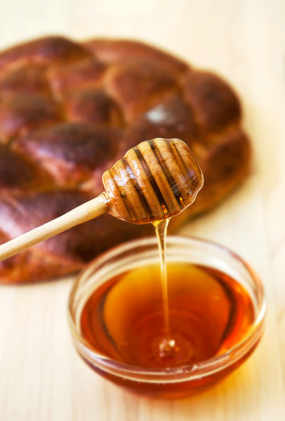
Yesterday, while cleaning out my office in preparation for a move to a larger space across the hall, I found Amanda’s piece, buried at the bottom of a drawer; stained, a little bit dog-eared, it managed to show up in my life again right before the start of the Jewish New Year, which is tonight at sundown. It’ll just be me and Susan and our animals. In the coming days, I’ll be lighting a memorial candle for my father, and spending a day in quiet meditation. The one symbolic food we’ll eat will be challah.
Always plain. And always round.


a lovely piece…. thank-you!
A friend forwarded this piece to me, and as I inch towards the three-year anniversary of my own father’s death, I’m glad to have a reminder that we can share more than tears this holiday season. L’shana Tova.
Thank you Naomi and Karen-
Oddly, I had a lucid, yet sad dream about my dad last night. I haven’t been able to shake it all day. Partly, it stemmed from writing yesterday about the last meal that I remembered eating with him, a passage that will probably not make it into the next book but I had to write it anyway.
Monica posted your piece on her FB, and I think that somehow, I was meant to read it. I remember that piece by Amanda, too. I still have it somewhere. This year marks the 30th anniversary of my father’s death. I’ve been debating doing something to mark the passage, and now I know. Dinner. Specifically, his chicken and dumplings, something I’ve been meaning to master. Thanks for this.
Thanks for posting, Kathleen. It’s such an odd thing, and it never changes—never seems to get any better. Just different, I guess.
Beautifully done, your article brought tears to my eyes. Thank you so much for sharing. I will look at this year’s Challah with new vision.
Thanks Lael. Shana tova to you and yours-
So touching and beautifully written – bravo Elissa!
Thanks Tracey–we loved our dads, didn’t we.
What an exquisite gift you’ve shared, Elissa. I’m coming up on 25 years since my father died, and while he was the sort who viewed food as nothing more than fuel (that’s what he said, but I’m not sure in retrospect that he completely believed it!), we shared other precious aspects of life. Those memories are good ones that warm my heart daily.
Thank you so much Carol—
My dad and beloved stepmom were in town last weekend, and we had the pleasure of several meals together, so your beautiful words have a special resonance, Elissa. Dad is frail but still vibrant and I treasure every moment with him. L’shana tova to you and your family.
Elissa, beautiful post. I especially appreciated the part about your father’s greatest happiness being when you finished your “first whole plate of Holsteiner Schnitzel at Luchow’s.” I hope you’re having a good holiday tonight.
Thank you, this piece also touches close to my heart.
I kept seeing references to you and this post on Twitter and Facebook and finally clicked through. What a lovely article and tribute you’ve written, thank you for sharing.
I have no such fond memories of my father and was nourished by yours–a perfect blend of honey and sadness. May your New Year be sweet.
What a beautiful piece, Elissa. L’Shana Tova.
What a beautiful tribute to food and love. Thanks for sharing.
So very dear and touching. Thank you! And happy new year……
Thanks so much Amanda. My father lived for Luchow’s Holsteiner Schnitzel.
Happy New Year from Alicia and Ben
There’s so much I want to say but don’t know where to start… I felt the same way when my father was sick and died–food was tasteless.
Most of all, your piece encourages me to keep writing my story. I always doubt, will anyone care to read it? But I know I care to read such stories by people I’ve never met; they give me so much strength. I’d like to give strength to other people…
Shana Tova.
Beautiful, and so true. Hope you have a sweet new year …
Elissa, thank you for this moving post and yes, writing about food seems flimsy sometimes, except when you stop and think about how it also brings us together and evokes so much. When my dad died I was just out of college, still a kid really. The first thing I did was cook up massive amounts of food for the people who came over after the funeral. It was a way to postpone grief, but also to comfort myself when I could not embrace all the feelings of sadness and fear–what would I do without him? My family didn’t really understand. But when the friends and relatives came over, it gave us something to share while the grief was sinking in and brought us together.
{ 1 trackback }