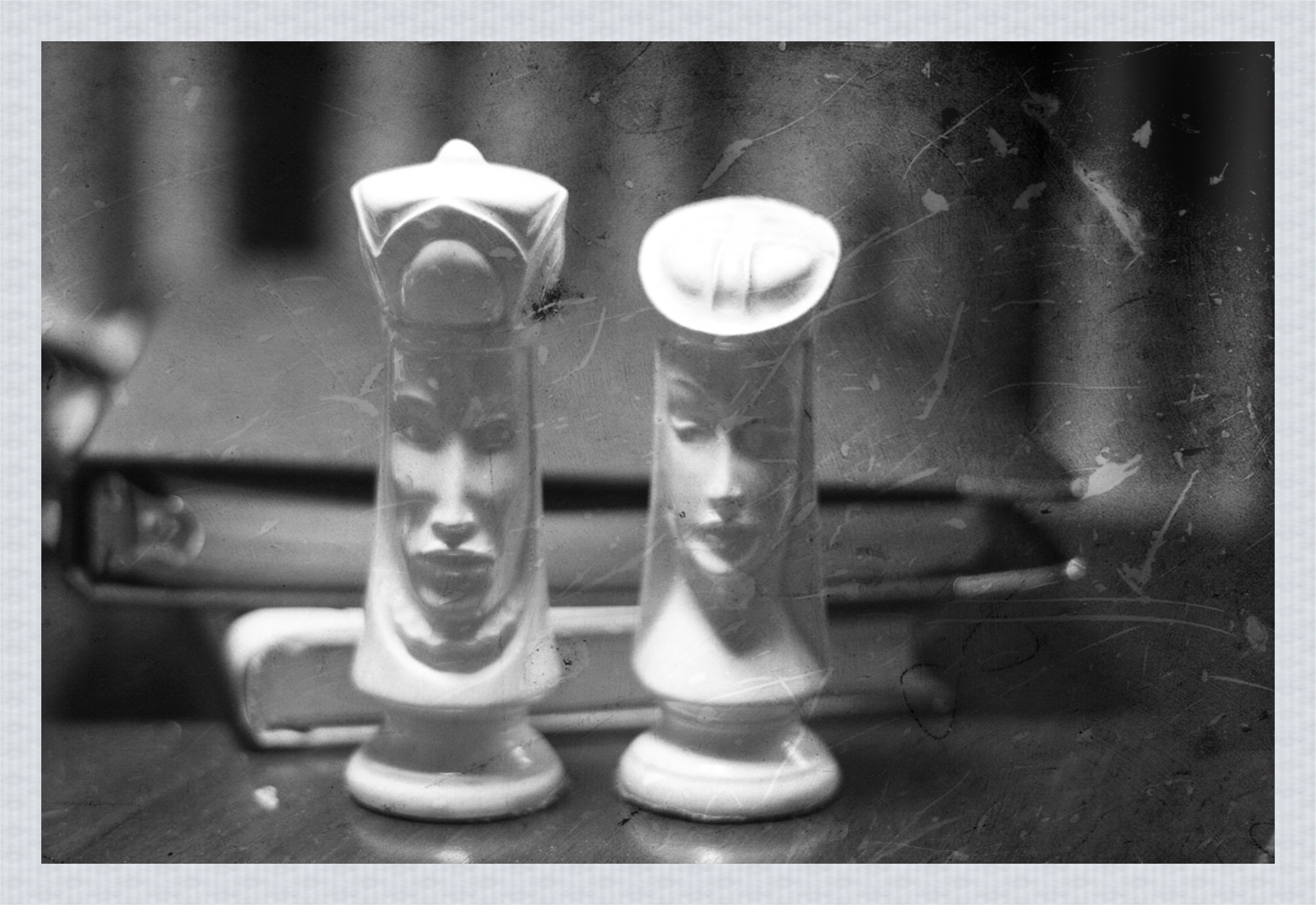
Bits and pieces of our life together show up everywhere, loudly, spontaneously and unannounced. It’s just not something you ever expect, is it, to blindly reach into a jumbled shoe box of ancient cancelled checks and small yellow canisters of old Super 8 film — the things he inexplicably saved long after his marriage was over — and pull out the only two remaining pieces from the 1950s chess set that you last saw sitting on your parents’ Danish modern coffee table when Nixon was in office: the rest of the set — a black marble and white alabaster number that your father bought at that chess store down in Greenwich Village one night after hearing Coleman Hawkins play at the Village Gate — is missing, and the things that he saved, that he carefully squirreled away and wrapped up in a yellowing shroud of worthless bank notes that tracked his every expenditure over the course of nearly two decades, were the King and Queen.
Like many people who became instant grown ups after coming home from The War, my father was a great believer in the promise of tradition: The 2.5 children, the dogs, the chicken in every pot, the vacations, the family dinners, the house in the suburbs, the sensible and clunky Mercedes sedan, and eventually, the station wagon. We never had the Mercedes — just a nice, gray El Camino that my mother accidentally set fire to one night in North Carolina, when we were driving home from a trip to Florida. And the day he proudly, finally, came home driving a 1967 royal blue Chevy Impala station wagon the length of a yacht, my mother took one look at it, gasped loudly, and said “Take it back Cy, or I’m leaving you.” She grabbed my four year old hand, turned around, and off we we marched, back upstairs to our apartment.
The things in our house that spoke ostensibly of family and togetherness and conviviality were his, not hers: there were the sets of early 1960s Arabica Ware, the tidy fire engine red service for eight that a friend of his had brought back from Spain in the late 50s before he met my mother. There were Super 8 cameras and projectors and an enormous, collapsible metal screen, and reel-to-reel tape machines on which he’d record his young nieces singing. And on a low shelf in the bookcase in the living room, next to the stacks of Charlie Ventura, Yma Sumac, and Mohammed El-Bakkar albums there were two cookbooks: Craig Claiborne’s New York Times Cookbook, and Dione Lucas’s The Cordon Bleu Cookbook, both of which my father had bought for himself as a bachelor — the former in 1962 right before he married my mother, and the latter, in 1948, before moving into his own apartment in Boston.
My father worshipped Dione, as he called her, like she’d been a personal friend; sure, there were the odd accusations of frequent inebriation and general wackiness, but Lucas believed that the preparation of good food is merely another expression of art, one of the joys of civilized living, and my father agreed wholeheartedly. Which is why it was apparently not unusual to find him standing in his bachelor kitchen on Commonwealth Avenue a few hours before a hot date, preparing Sole Veronique, which required the peeling of grapes, and essentially, the manual dexterity of a brain surgeon.
To my knowledge, my father never prepared Sole Veronique for my mother when they were dating, which should have been a telltale sign that it was doomed from the start. Because if you can’t bring yourself to peel a grape for the woman you’re going to marry, something is obviously wrong. Sure, there were the silver tip roasts that my father taught her how to make (bring to room temperature, massage with salt and pepper and nothing else), along with the perfectly rolled omelettes and the foie de veau and the fondues, and the Chicken Paprikash that the chef at the Csardas Restaurant gave him the recipe for after he pleaded like a baby.
But peeling grapes for my mother? He should have known.
Eventually, when my father moved out, he left behind the cookbooks, which I carried with me to college. But he took with him the Super 8 cameras and the projectors, the reel-to-reel tape recorders, the Arabica Ware and the plates, the Yma Sumac and Mohammed El-Bakkar albums, and the giant, collapsible screen, which now sits in my basement, covered in a thin rime of dust, in a perfect little suburban home that I’d like to think he would have loved; although we don’t own a projector, I can’t bring myself to give the thing up, or to clean it off. In the same way that I can’t somehow manage to part with the King and Queen, who stand in my office on a bookshelf, looking away from each other, disjointed and confused.



I love your ruminations about your parents. It’s like looking into the soulful development of a future foodie.Thanks!
Your stories are the best surprise I could get at 2:30am. Round, elegant, bittersweet, extremely well written. Thank you!
Oh my! How I wish I could write with such grace and perfect imagery. I was a child in France during the war. The Nazis wanted my father’s sheep so he pulled a switcheroo and exchanged the good ones for sickly ones in the dead of night. Remembering such stories can make for a little heartache of longing…