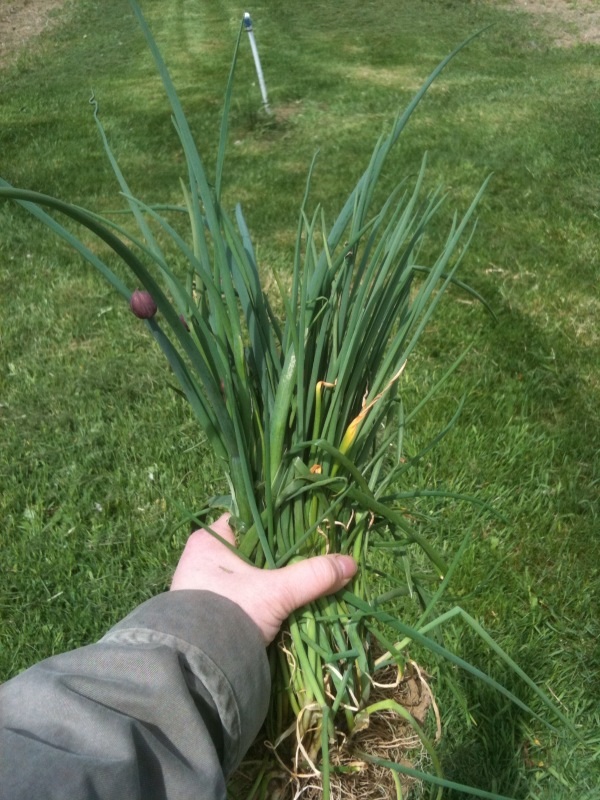
Garlic chives: a perfect food.
I’m not exactly sure when it happened; maybe I’ve only just noticed it. It seems that, for whatever reason, glaring, wild-eyed mediocrity is running rampant these days. And it’s really starting to bug the hell out of me.
This isn’t to say that I’ve not ever taken shortcuts that have inevitably impacted whatever it is I’m doing, be it painting, cooking, or cleaning. You know the story: you want to hang something, you don’t properly measure, and you wind up with twelve holes in your wall, and a crooked picture. You hope that no one notices but someone always does, usually at a dinner party.
At some point, mediocrity became culturally acceptable in our country (and others—it’s not just us). When life became more profit-than-process-and-quality driven, and people like Carly Fiorina decided that it was better to crank out so-so product to satisfy projections and profit target rather than to maintain standards of excellence, things went straight down the old hell hole. This truth can be applied to almost anything; just look at Toyota. Who sold out? Why did the Corolla I recently rented in New Mexico rattle like a Yugo, instead of run smoothly, like the solid little cars I’ve always rented? Why do some of the books I buy fall apart weeks after I bring them home? Why is it okay to do just enough to get by at work, and hope that no one will notice? Have we gotten that lazy? Is life just one big game of Three Card Monte?
The food world certainly hasn’t been immune to this phenomenon. If it was, we wouldn’t have the constant stream of meat recalls we have, or cheap fast food that’s bigger than your head, but packed with dangerous residues, and grain and feedlot by-products, or grade school lunches that possess all the qualitative excellence of the pig slop served on factory farms.
The truth is that when it comes to what we eat, there is a direct correlation between mediocrity and synthetic complexity: the more synthetically complex a “food” is, the more mediocre it’s bound to be. If you want a burger, fine; have a burger. Make it a good one, keep the toppings to a minimum (onion? pickle?), and craft it out of grass-fed beef. Learn to make it well, and simply. And stay away from the obvious: more doesn’t always mean better, and neither does faster. It just means bigger and cheaper.
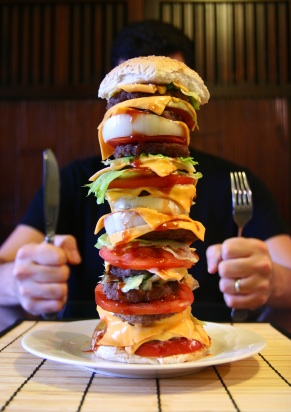
Mediocrity.
Recently, I spent a lunch hour strolling around the property where I work, and I visited the enormous, former vegetable gardens that were an employee benefit until this season. The grounds were bare, littered with the forgotten remains of last year’s tomato blight. Growing wild out of the middle of a patch of grass was a thick, gorgeous bunch of garlic chives. I pulled a handful, and thought about dinner: pasta with whatever I had around that was fresh—mint, thyme, and some local ricotta that I’d found over the weekend, that’s made from milk and salt and starter and that’s it. It was simple, fresh, delicious, seriously close to the ground, decidedly un-tarted up, and cheap. It was basic, but it wasn’t mediocre.
It’s hard to avoid mediocrity out there in our day-to-day; it always seems to show up somewhere, and pity the poor bastard who honestly believes that life and work should be all smoke and mirrors and fabricated complexity. Like food, it’s best when it’s kept simple, straightforward, and real.
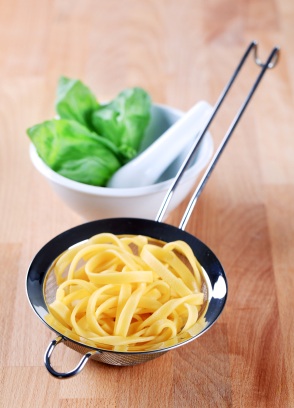
Lemon Fettucine with Garlic Chives, Ricotta, and Herbs
This dish, cooked slowly, was simple, frugal, fresh, and delicious. The oil—a combination of extra virgin olive oil and walnut oils—is infused with the essence of the chives , herbs, and lemon, keeping the dish light and fresh-tasting.
Serves 3-4
1 tablespoon extra virgin olive oil
1 tablespoon walnut oil
1 bunch garlic chives (about half a pound), cleaned and sliced into thirds
3 sprigs fresh thyme
3 mint leaves, minced
1 tablespoon capers, drained and lightly rinsed
1/2 cup chicken stock
1 tablespoon unsalted butter
juice of two lemons
zest of one lemon
1/2 pound fettucine
3/4 cup reserved pasta cooking water
fresh ricotta
fresh black pepper, to taste
1. Bring a large pot of salted water to boil.
2. In a medium-sized, straight-sided saute pan set over medium-low heat, warm the oils together, until they shimmer. Add the garlic chives, toss, and cook slowly, until they begin to wilt and soften, about five minutes. Add the thyme and mint to the pan, and continue to cook for another seven minutes, and add the capers, chicken stock, butter, lemon juice, and zest.
3. Bring to a slow simmer, remove from heat, and set the pan aside.
4. Cook the pasta for approximately eight minutes, until al dente, and reserve the cooking water before draining. Add the pasta to the pan with the chives, toss well, and continue to cook for two to three minutes, tossing well to combine. If the pasta seems dry, add some of the cooking water, in slow drizzles.
5. Serve in warm, shallow bowls, dolloped with ricotta and drizzled with good olive oil and black pepper.




Anyone who really cares about producing quality work is a Mozart in a Salieri world. Unfortunately it’s been that way for at least a decade…if not longer. Mediocrity reigns…
Delicious sounding recipe – can’t wait to try it ! (Here in the mid Hudson Valley we’re rolling in assorted good ricottas and don’t talk to me about garlic chives, the weed of the Western World once they get going).
As for the mediocrity, agree with absolutely everything except the idea that producing and/or accepting it is a new phenomenon. To me, what’s new are all the ways we’ve figured out to make mediocre versions of things that were formerly either good or non-existent.
In the Salieri-world . . . mediocrity becomes the new excellence. So chicken that tastes like sauteed compressed paper is held up as the norm; dull or incompetent art gets prizes. And as a result, those who say, “This is not good: I remember what’s good!” appear to be snobbish or elitist. There’s even another distasteful result (and I choose that word on purpose): food products concocted by “artisans” that trumpet their unusual / rare ingredients and offer mediocre taste at high prices. Alas and woe. But one can still find excellence: it just takes a good deal of sniffing-around. And a plateful of well-made simple food can be just the solace one needs.
The other night, I was talking with an acquaintance who said that she and her family are huge label readers and they don’t buy anything with high fructose corn syrup, msg, antibiotics, etc. I mentioned that it will be a really great day when people stop reading labels…because they are eating fresh instead of processed food. How about boycotting labeled food. “What a good idea,” she said. “I never thought of that.”