It’s been kind of a crazy busy time here, but the good-crazy kind (mostly): last Saturday, Susan and I spent the day at our goddaughter, Rachel’s, baby-naming in Virginia. Jumped in the car the next morning at the crack of dawn, raced to Manhattan to meet up with fellow food writers Brigit Binns, Jacqueline Church, and Jane Sigal, to compete with them on the first-ever, non-chef/restaurant team in D’Artaganan’s wild and wooly Duckathlon, where we spent the day doing things like correctly reassembling a cryovacked pig; identifying plumed birds; accurately guessing the weight of a piglet; identifying spices blindfolded; and having a team member (Jane) launch a crepe through the air off a swim fin,with the goal of catching it in the top of my toque (I did).
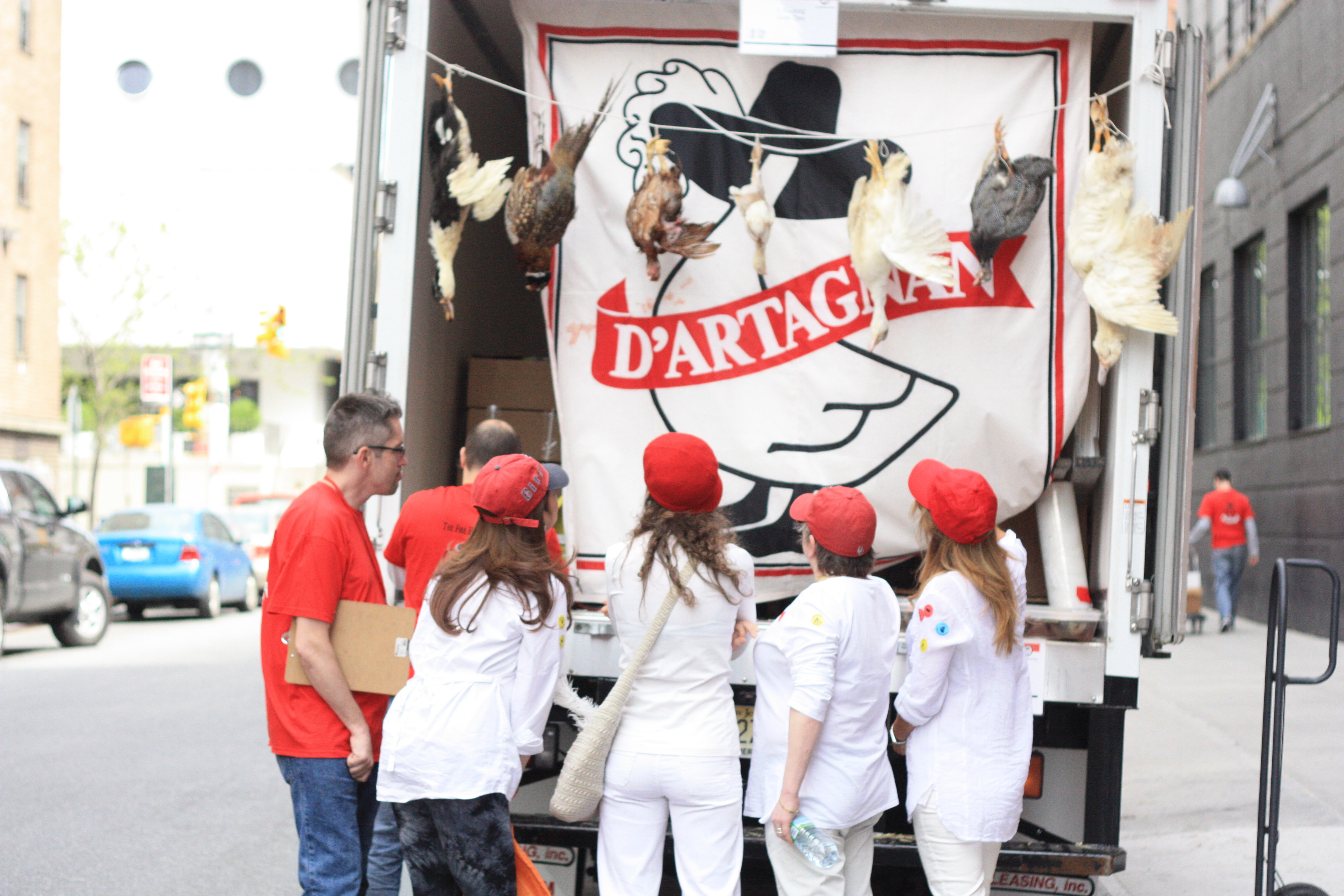
The Bird Brains identify all the plumed beasts correctly.
We drove back home that night, prize duck (with foie gras intact) in tow, and for the next few days, I alternately worked my fingers down to nubs to get two articles and one cookbook off to their respective editors on time, all while readying myself for The James Beard Awards on Friday night. Ultimately, I lost in my category to Barry Estabrook (congratulations Barry!) but spent the remarkable night chatting with people who are my own personal heroes — people like Dorothy Kalins, and David Tanis and his partner, Randal Breski; Tracey Ryder and Carole Topalian and the Edible Communities home team; Amanda Hesser, and Grace Young (the latter of whom is solely responsible for my having a brace of giant, Chinese woks hanging off my kitchen wall, none of which I am pleased to say are stick proof).
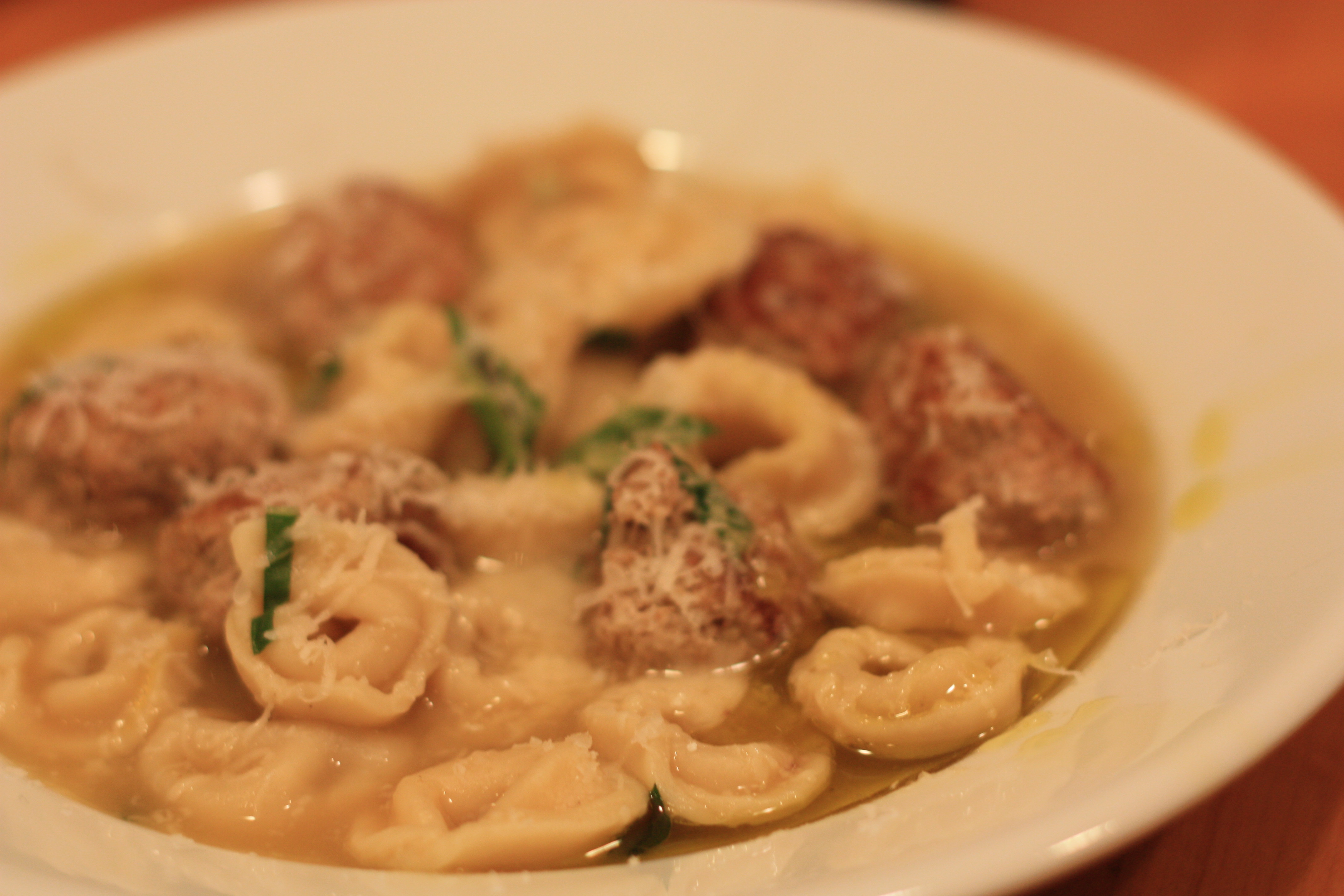
Tortellini en Brodo
We came home on Saturday bleary-eyed and bone-tired, hungover from the combination of excitement and alcohol, and starving; the only thing to make were small bowls of tortellini en brodo with tiny meatballs — comfort food at its purest, because we knew that a few hours later, on Sunday morning, we’d have to get up again and go our separate ways — me, back to Manhattan, and Susan, up to Farmington, Connecticut — to celebrate Mother’s Day. And you can add together all that we did in the previous two weeks —- the travel to Virginia; the drive home; the Duckathlon; the deadline writing; the Beard Awards — and nothing quite punctuates them so perfectly as the gastronomical psychodrama that is our Mother’s Days, both collective and individual.
Our mothers couldn’t be more different: Susan’s mother, who is 93, likes to sit on her screened-in porch on Mother’s Day, sucking down a succesion of vodka tonics and ordering a spongey, mediocre pizza from the local, suburban, Italianesque restaurant, which pretty much makes it like every other weekend day. My mother, who is not 93, used to like to go to La Goulue — a recently-defunct restaurant on the Upper East Side of Manhattan, where New Yorkers went to pretend they were French. Susan’s mother used to like to get lavender or pink flowers for Mother’s Day, and last year, Susan planted a gigantic planter filled with lettuce seeds at the bottom step of her back stairs, so she could always have fresh greens with her dinner; my mother used to like to get things in Tiffany blue boxes, and last year, I gave her a tiny, white gold horseshoe to wear around her neck. Susan’s mother likes to dress in a cornea-burning combination of clothes, many of which come from church sales and Lord & Taylor of Litchfield (aka Goodwill). My mother likes to dress in Max Mara and Moschino and off-the-rack Jason Wu, although she is also fond of vintage Kenzo. Susan’s mother doesn’t much like to go out. My mother wants to be seen.
So, every Mother’s Day — busy or not — I spend days wringing my hands and banging my head against the wall, trying to get the perfect reservation at the perfect restaurant that’s not too quiet and not hugely expensive, but terribly fabulous. And now that La Goulue is closed, other suggestions started rolling in fast and furious: Barbuto? (Ha. Try and get a table there after the New York Times feature came out about Jonathan Waxman.) Maialino? (Danny Meyer’s new Roman restaurant? Not so much.) Locanda Verde? (“You could just call Andrew and see if he can get you in, because I can’t,” said the host. Click.) Union Square Cafe? (See Danny Meyer, above.) The Spice Market? (My mother thinks that her container of 1980 Durkee garlic powder is a spice. God forbid anything should make her mouth feel any way but asleep.) I looked and searched and decided, finally, on Beaumarchais down in the Meatpacking District, and for Mother’s Day, it was perfect: I ordered salmon tartare, which she actually ate (she generally refuses anything raw), and two salads laden with chicken, bacon, and hard-boiled eggs, because whenever I go out with my mother, I had better order a salad if I don’t want to spend the rest of the day fielding comments like “I remember back when you were a size 6….It seems so long ago!”
So, like a bunny, I dutifully nibbled on this big pile of protein-laced butter lettuces, while my mother picked the bacon out of it and declared it wonderful. By the time I paid the bill, I was ravenously hungry.
Ultimately, it was a good day: the fact that we were surrounded on all sides by French speakers staring at my mother’s spectacular, vintage Lugenes/Iris Apfel glasses thrilled her no end, and she struck up conversations with everyone. We strolled all over the Meat Packing district, arm in arm, until we wound up at Allsaints Spitalfields where my mother stunned the staff by trying on a skin-tight, pleat-waisted jacket and looking like the showroom director she once was, not very long ago.
“You know,” one of the sales people said to me quietly, “she could be a model–”
“She was,” I replied, “and always will be.”
By the time we walked out, I was ready to eat my own arm.
Driving up the West Side Highway on my way home after dropping my mother off at her apartment, I stopped at Fairway in Harlem and picked up a bag of spaghetti, some good olive oil, and a wedge each of Pecorino Romano and Cacio di Roma. It was all subconscious, and I strolled the aisles almost robotically; I hadn’t planned on making the simple, ubiquitous heat-bursting Roman pasta dish that seems to unaccountably be all the rage lately, like when Red Wing work boots started to show up at Barney’s for $500. I didn’t call Susan up at her mother’s and ask her what she wanted for dinner: I just wanted pasta, salt, cheese, fat, and heat. A lot of heat.
So, after an insanely busy fortnight capped off by a fraught afternoon with my mother, Cacio e Pepe it was. And while Susan and I devoured this bowl of perfection, my fuzzy, exhausted brain took off on a murky, dreamlike tangent, and imagined the day a few years after the war was over, when some fabulous older lady from Lazio — maybe still dressed in her sensible Ferragamo pumps and black cardigan after morning Mass and feeling a bit flush — said oh, what the hell, and cracked a raw egg into the saute pan with some cooked bacon and the spaghetti and the oil and the mountains of black pepper, and changed the world yet again.
I’m home for two days before I head out again on Wednesday — this time to Seattle, to do some work with a writer friend; at the end of next week, I fly to Naples, Capri, and Ischia to learn about Caprese cooking, and the Neapolitan art of pizza making. Over lunch, my concerned mother asked me how much pasta I’ll have to eat while on this trip.
“Not a lot,” I told her. “Maybe just a bowl or two of something simple.”
Cacio e Pepe
(Adapted from Saveur, and Alyssa Ettinger)
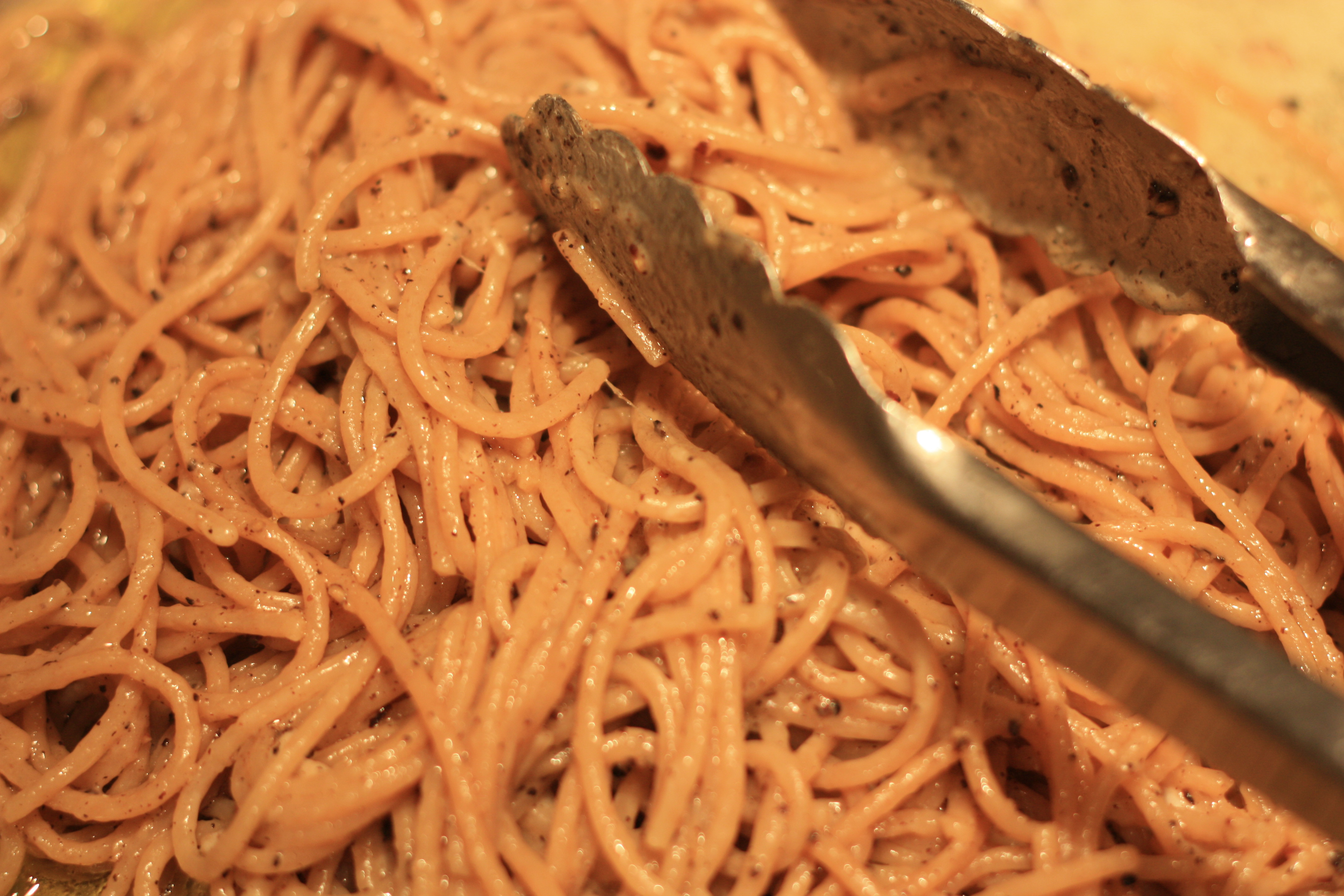
It was my old/new friend, acclaimed ceramicist Alyssa Ettinger (we went to sleepaway camp together in the early 1970s, and never saw each other again until last year) who actually turned me on to the fact of Cacio e Pepe recently, by telling me that not only did she love the dish, she loved it made with whole wheat pasta, which I couldn’t fathom. Ultimately, I made this traditional tangle of peppery goodness with a lighter whole wheat spaghetti, which worked beautifully; pity that there was nothing left from which to make a frittata.
Serves 3ish
1/2 pound spaghetti, whole wheat or not
1/4 cup extra virgin olive oil
1 tablespoon coarsely ground black pepper, plus more for finishing
1/2 cup grated Pecorino Roman, plus more for finishing
1/2 cup grated Cacio di Roma, plus more for finishing
Bring a large stockpot filled with salted water to a boil, add the spaghetti, and cook for approximately 7-8 minutes, or according to the instructions on the package. After 5 minutes, carefully ladle out a cup of the pasta water into a small bowl, and set aside.
While the pasta is cooking, heat the olive oil in a deep skillet over medium heat until it begins to shimmer. Add the black pepper, spreading it out in the pan with a wooden spoon and allowing it to toast uniformly. Drain the pasta in a colander, add it to the skillet and toss vigorously with tongs so that the peppery oil coats every strand. Sprinkle in the cheeses, tossing well, and add the pasta water to the pan, a tablespoon at a time, until the mixture is creamy but not wet (you may not need the whole cup).
Serve in warm, shallow bowls with more pepper and cheese.