On Waiting

September 27, 2011 · 9 comments

What I waited for.

Sometime in the mid-seventies, when I was a young teenager, my parents and I stood for hours outside a movie theater on Third Avenue, across the street from the back entrance to Bloomingdales. The line stretched out the door and around the block, and snaked east towards the Queensborough Bridge, which, every time a truck drove over it, rattled and shook the very ground we were standing on, like a small earthquake.

“When can we go in?” I whined at my father, shifting my pouty, angst-ridden teenage self from Dr. Scholl’s Exercise Sandal to Dr. Scholl’s Exercise Sandal, folding my arms across my chest. I stared at the sky, annoyed. I might have stamped my foot.

“When they say we can,” he said glumly, lighting two cigarettes. He handed one of them to my mother who took a long, sweet, lipsticked drag off it as she gazed into the distance, propped in her ever-present model’s pose, her right knee bent in slightly towards her left, her hips slung down and under, like she was about to sit down on a bench.

We were on line that day to see Annie Hall, and there was a scene in the movie where Alvie and Annie are standing on line outside a theater across town, on Broadway, waiting to get in to see a documentary about Nazis. They wait there together, both of them cranky and aggravated, and when a professor standing behind him starts to pontificate loudly about modern media and culture, Alvie begs us, right through the fourth wall, for a large sock filled with horse manure.

It has far less to do with the fact that there’s this supercilious academic jackass standing on line behind him — going on about Fellini and cohesive structure and La Strada and negative imagery — and far more to do with the the fact that no one ever likes to wait. Waiting is a bore. It’s a waste of our time. But more than that, it leaves the twitchy and nervous among us feeling vulnerable and prone, like a naked, cold newborn; it leaves us helpless, and in that state, we risk absorbing all the mishegas that swirls around us, like a psychic sponge. I was once in Nice with a few friends; we had just flown in from New York and were sitting in a tiny, poolside restaurant attached to the hotel we were staying in. Our waiter brought our menus, and took his time coming back to us to take our order; when it was clear that he was operating on French time — everything took a while, by American standards — one of my friends jumped up and shouted, red-faced,

WHAT IS WRONG WITH YOU?? WE HAVE BEEN WAITING FOREVER!

I WANT MY FOOD NOW!

NOW NOW NOW!

“Have you just marched through the Sahara, madame?” the waiter asked, nonplussed, before walking away.

The thing is, when we wait — on line at the DMV, or for a delivery, or for the first course to come, or for the cable guy to show up, or for a machine at the gym, or for a test result — the metaphysical car keys are snatched right out of our hands, and replaced with the fact that we’re no longer at the steering wheel: we’re out of control. This particular friend of mine who shouted at the waiter in Nice doesn’t like being out of control, even though the universe had other plans for her.

You thought the world was moving on your watch?  the Universe snickers. Well guess again, Chuckles.

I’ve heard every argument under the sun for why Americans are stuck on fast/instant/processed food, and issues like economics, food deserts, sheer ignorance, addiction, and bad habit obviously come into play. But nobody ever talks about the fact that we’re also a country that thrives, regardless of socioeconomic status, on time-saving, and speed: our oil changes are done in a Jiffy; our film is developed in an hour; movies are downloaded in an instant; we don’t have to get out of the car to use the ATM or to make a deposit; airline check-ins are done by computer; entire Thanksgiving dinners are nuked in a microwave or bought in a can. That European construct — the coffee house — where you could go and sit down with a newspaper or a friend and just have a small cup of coffee and a slice of pie in the middle of the day, has gone the way of the drive-thru: almost every suburban Starbucks now has one. It’s all rush-rush-rush, Hello may I help you, can I take your order please, thank you and please haul your Yukon up to the next window.

Americans wait for nothing; we’re people of convenience, of demand and entitlement, and the myth that it keeps us and everything around us in control. We loathe idleness, both practical and psychic. If we’re not doing ten other things—or thinking about doing them— while we’re drinking our latte or getting cash from the ATM, or heating dinner in the microwave and eating it standing up while watching The Biggest Loser, we’re convinced that we’re not good enough, or that the world is getting away from us, or that someone, god forbid, might be getting ahead faster than we are.

Recently, I was talking to a neighbor — someone I don’t know well —about our garden; he wanted to know what we we grew over the summer, so I told him.

“Some long Italian flat beans, some tomatoes, some zucchini–”

He cocked his head a bit, and pointed to one of our front yard boxes, still packed with lush, emerald green foliage.

“What’s that?”

“Potatoes–” I said, walking him over to the box.

“Why don’t you pick them?” he asked.

“Because,” I said, “we have to wait.”

“But could you pick them now? Would they be ready?”

“No,” I said again, “we have to wait.”

“But what do you do while you wait? Can you eat the leaves? Or the blossoms, maybe?” he asked, hopeful.

“Nope,” I said, jamming my hands in my pockets. “We just have to wait.”

He looked at me like I had three heads and then asked, “How about those vines, over there?”

“Winter squash,” I said. “They’re not ready yet, either.”

“How long do they take?” he asked.

“It can be months–” I said, “Broccoli, too. We planted it in early August so if we’re lucky, we’ll have it in mid-November.”

“Why don’t you just buy it?” he asked me, like I was an imbecile.

“Because it’s worth the wait,” I said.

“But who the hell has the time—” he mumbled, and walked away, late for an appointment.

That’s the thing about waiting, when it comes to food; most times, it’s a very good thing. Because the act of waiting forces something else on us which most of us don’t have a whole lot of: patience, and time. It takes patience and time for winter squash to grow; for bread to rise; for the flavors in the braise to develop; for potatoes to get to the point where you can actually use them.  Right now, I don’t have a whole lot of time, between writing my book and this blog and a slew of other articles, editing cookbooks, taking care of our house, making sure that Susan gets a good dinner when she returns home from her commute into New York every day, making sure that the dogs are walked and that they’re fed and vetted, making sure to call my mother and my cousins and my aunt and my mother-in-law, trying to get to the gym so that I don’t blow up into something that looks like the Hindenburg … it’s all a giant time suck. And I don’t have children, so I can’t even add soccer mom to that list. (Imagine if I could.)

But I find myself inadvertently drawn to things that force me to wait: I make bread that requires I be stuck in the house for the second punch-down; I make long braises that require I hang around; I grow things that have to hang out in or on the ground for a really long time — garlic, carrots, winter squash, broccoli — because I assume they’ll be a lot more delicious than the stuff that’s chemically induced  to grow quickly and assertively and in sync with some corporate supermarket’s supply chain needs. That’s not really growing vegetables any more than a CAFO is hog farming.

I know it sounds counterintuitive, but in this go-go world — where everything is instant, or mechanized — being forced to wait, to slow down, to have patience, to take time, makes me feel a little less like a chicken with its head cut off. If I take the time to seriously cook down that soffrito — slowly, carefully so that it doesn’t burn but instead builds a thick base layer of flavor — I’m not going to be able to walk away from it, or get distracted. I can head into my office down the hall from the kitchen and finish a chapter, or write a recipe, but I can’t just turn my back wholesale.

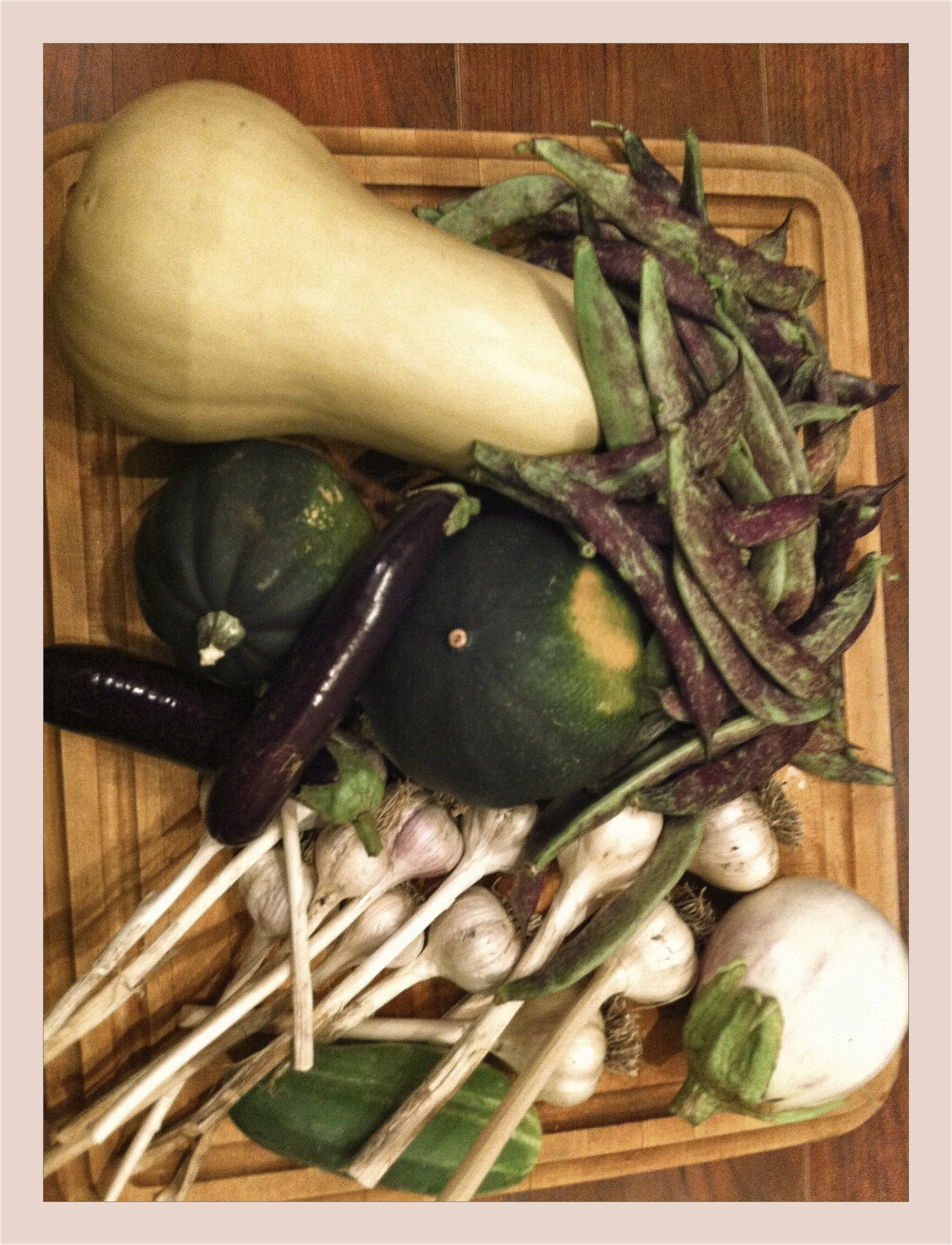
This year, with a major deadline looming, and without planning to, we planted nothing that didn’t need a lot of time, and it forced us to slow down a little, and to wait. We did have one butternut squash that ripened quickly, though, and I made a simple butternut squash soup with it, and it paid us back with four very elemental lunches. Beyond that, we’re still waiting on the potatoes, and the rest of the acorn squash, and the garlic for next year’s harvest.

They’ll be worth the time it takes.


The kids finally went back to school a little while ago, after Hurricane Irene, and my mother, blew through town. Even though we have no children of our own, it’s still been a very exciting time around here, heady with delight, anticipation, and worry; there are several first-timers who live on our street, and when I asked them if they were excited, they all emphatically shook their heads yes, but their eyes said Not so much. 

As if on cue, the temperature dropped that first day of school from a hot and steamy 88 over the weekend to a chilly, damp 60; we raked for the first time  after some of our neighbors came by to (mercifully) cut down the rest of our storm-fallen trees, and haul away the wood. Late in the afternoon, we harvested about three cups of Italian flat beans, a gorgeous butternut squash, a few tiny acorn squashes, and cleaned off our dried garlic. We had the presence of mind the other day to buy fifteen pounds of tomato seconds for $6 — the kind that have small dings in them and thus turn people off with their lack of empirical perfection; then, our neighbor, Melissa, who has recently started keeping chickens, brought us around fifteen pounds of peach seconds. So we had an evening’s worth of slicing and storing to do, before we made dinner.

And all I could think of, the entire time, was Did I remember to feed Paula Wolfert‘s mother?

It was a fast, quiet summer; I’ve been working, head-down, finishing my book, so we didn’t spend much time traveling the way we always do. And even though it was a warm summer filled with great, fresh meals,  I’ve been focusing more on cooler-weather recipes and “storing” ingredients — things that you have to care for, that will give back to you over the long haul: did I remember to mound the potatoes? Did I remember to feed the sourdough? Can I use the preserved lemons yet? Should I plan to can the peaches and tomatoes, or can I just freeze them? And then, of course, there was the issue of Paula’s mother. Because where the long haul is concerned, Paula’s mother is just going to keep on giving and giving, as mothers are usually wont to do.

Back in July, Susan and I were invited to take part in the unthinkable; to be clear, this was unthinkable good, as opposed to unthinkable bad. This was the unthinkable that, in murky light, might be construed as the direct result of lunatic sycophancy, or what happens when you trip over yourself, deaf, blind, and stupid, because you love someone’s work so much that you read it over, and over, and over again. It speaks to you, calls out your name, and, like an imbecilic child in desperate, platonic love with her teacher, nothing else exists for you on the same plane. That is what certain authors and books do to me— Wallace Stegner and Maira Kalman, Alice Waters and Mary Karr, Elizabeth David and Leo Tolstoy, M.F.K. Fisher and Jeanette Walls, Wendell Berry and Mary Oliver: like if I were in a room with them, I would turn into a blithering idiot. (I have been, in a few cases, and I did. Tolstoy was not among them.)

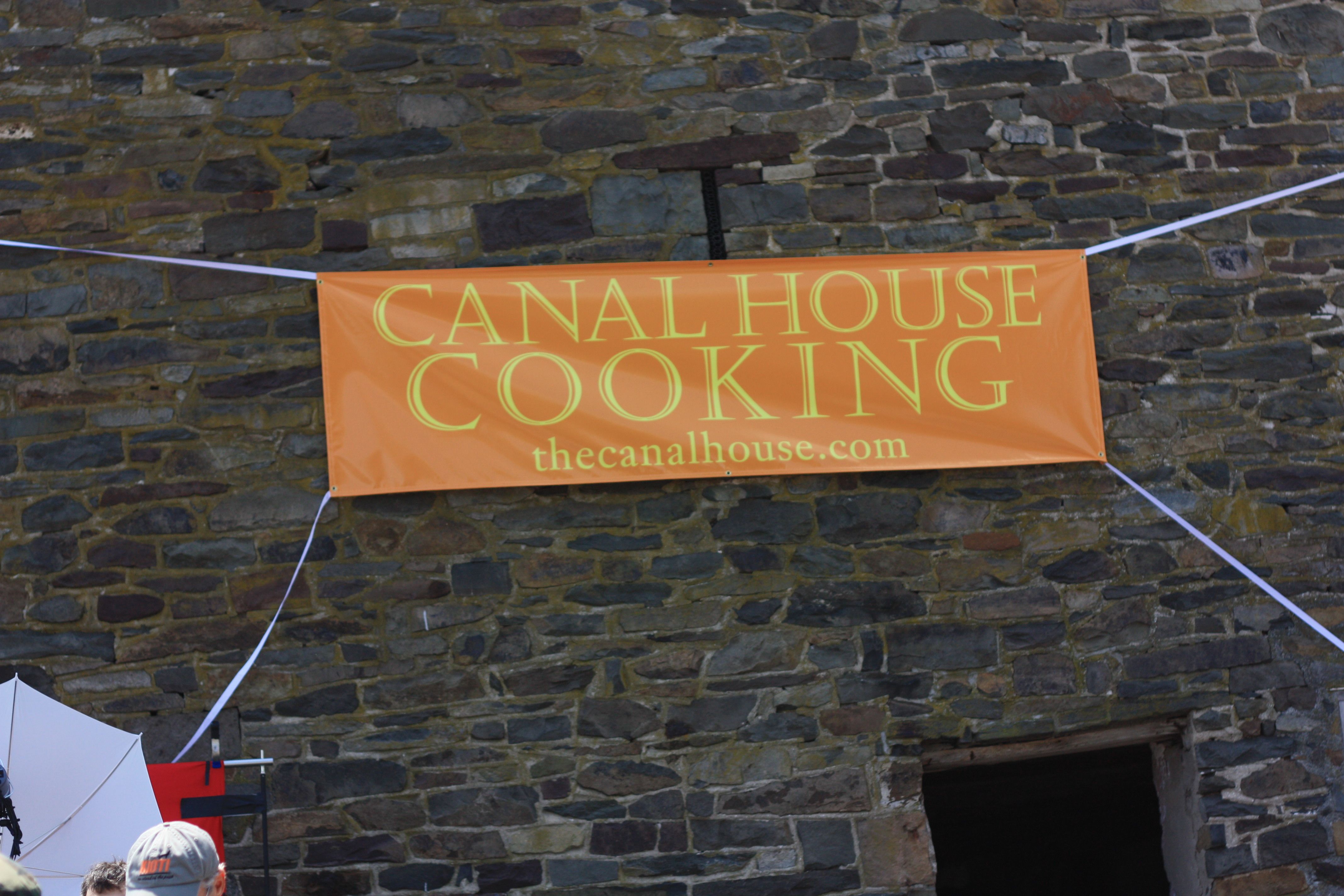
I feel this way about Canal House Cooking; most of you who read Poor Man’s Feast know that. I can’t help it. In a vast sea of gastro-literary mediocrity, here is this extraordinary book series, published a few times a year, written and produced by Christopher Hirsheimer and Melissa Hamilton out of their fairly elemental working loft along the D & R Canal, and it’s so remarkable and seductive in its furtive simplicity that, when I think a new edition might be on its way, I spend my days racing out to the mailbox, like Steve Martin waiting for the phonebooks to arrive in The Jerk.  When it shows up, I close the door and squirrel myself away for days, reading it from cover to cover, over and over again. Every once in a while, Susan tosses me a piece of raw meat, like a zookeeper.

Even before I knew them, Christopher and Melissa had become friends just by way of their voices, their kitchen, and their food, which is authentic and not at all fussy, even though it sometimes can be celebratory (which is vastly different from fussy). It’s cold lobster with mayonnaise, and chicken thighs with bacon and olives, and cassoulet, and creamed onions, and berry cobbler. It’s five o’clock, and time-for-a-small-cocktail, wherever you are. And it’s the kind of homey food that actually makes you feel better, existentially, when all around you is fancy food designed to give you an inferiority complex. Just yesterday, I spent hours going through a stack of very important cheffy restaurant cookbooks written by very important cheffy people; the books were all very nice and pretty and heavy and enormously impressive but —call me crazy — I don’t so much need to know how to make a leaping dolphin out of spun sugar, in the same way that I don’t need to know how to make trout foam. If you do need to make trout foam or a spun sugar dolphin, you won’t find recipes for it in Canal House, so move on.

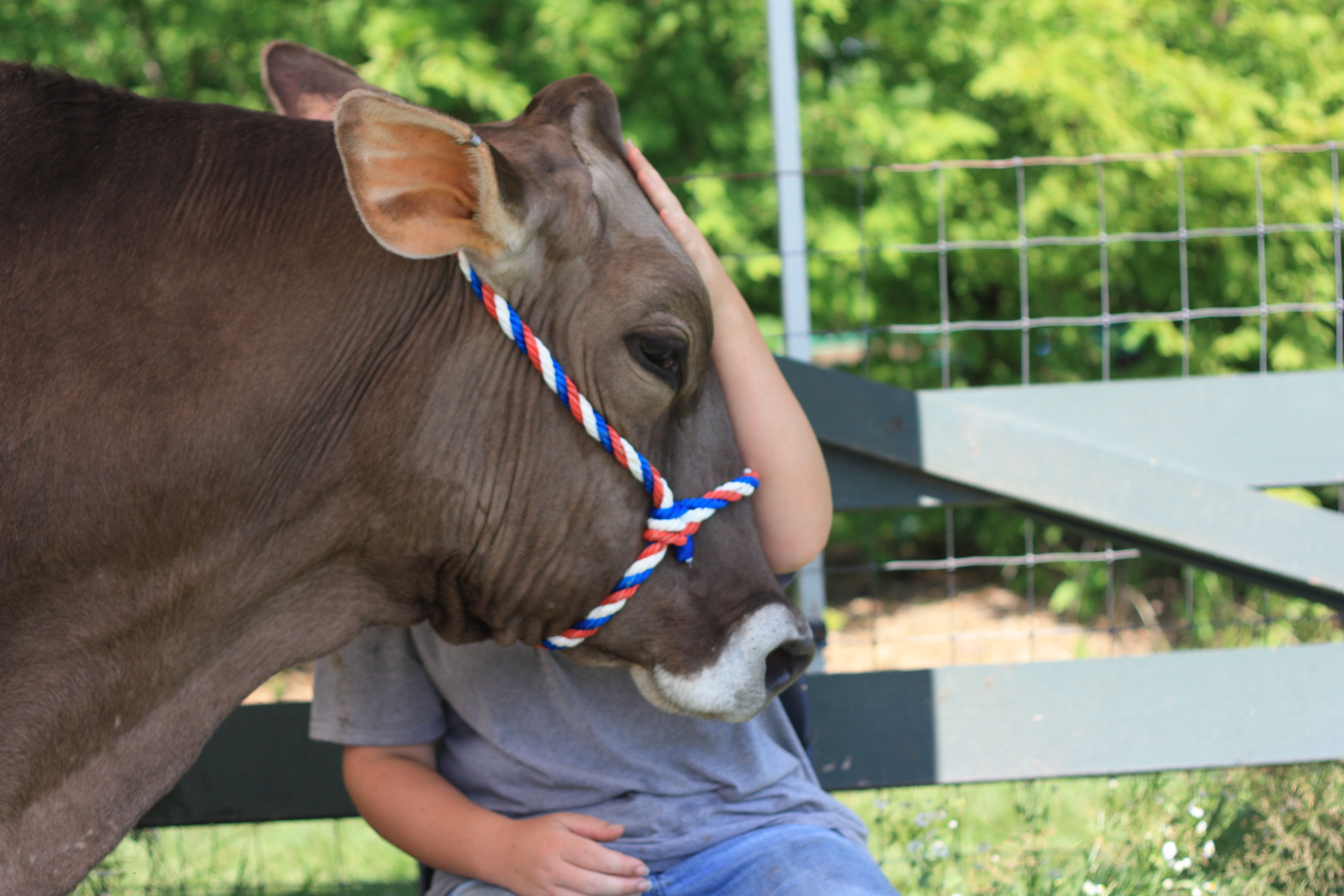
Anyway, back in July, Melissa and Christopher hosted a Small Holding Festival at the bucolic Linden Hill Gardens in Ottsville, Pennsylvania; off we went to see the animals, to watch the Bobolink Dairy folks make ricotta, to watch hunky Ian Knauer carve an immense piece of pork the size of a Volkswagon. There were all the expected goings on: the Old Timey string band playing on a platform hovering above the festival; there were the animals, including a gorgeous Swiss Brown cow so calm and sweet that every time she blinked, her luxurious black lashes fluttered and fanned like one of those ancient peacock feather  sunshades cooling Anne Baxter in The Ten Commandments. There were the attendees — the general public, and then, the not-so-general-public: Colman Andrews and his wife; Dorothy Kalins and her husband, filmmaker Roger Sherman; Aaron Wehner, the publisher of Ten Speed Press. There was Sunset food editor extraordinare, Margo True, and a few members of her staff, signing copies of their remarkable book, The One Block Feast, which, if you read it cover to cover, will walk you through the vagaries of doing everything from raising your own chickens to making your own wine and beer, harvesting your own salt, raising your own bees, making your own cheese, growing your own vegetables, canning your own vegetables, and so forth. But what separates the book from the very few others like it is that the folks who put this book together broke themselves down into teams: Team Chicken and Team Vinegar, to name just two. (You can see the remarkable results of their efforts by going here.) And in honor of the book, Margo and her staff brought along Paula Wolfert’s mother— dragged her, I believe, all the way from California, and then divvied her up into tiny canning jars — so that those of us who were invited to stay for a late lunch could actually take a little bit of Paula’s mother home with us. We did, and she’s here sitting in my kitchen, in a special crock, as I write this.

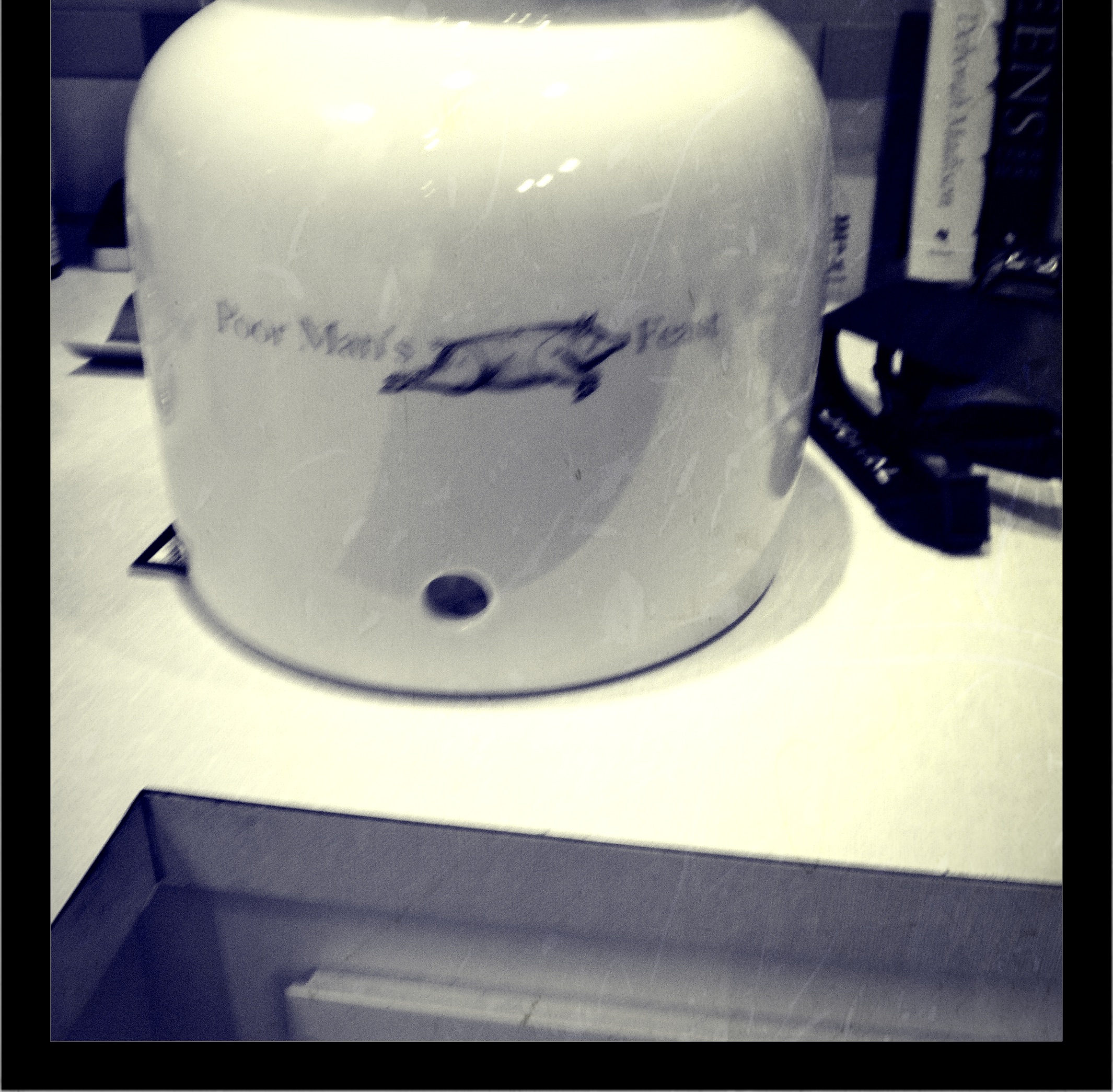
The vinegar crock.

We snogger her up with a little bit of red wine every now and then, and expect that she’ll reward us for the attention we pay her. She’s a red wine vinegar mother — not unlike a sourdough starter — and has been in Paula Wolfert’s kitchen for some time. We refer to her as:

Mama Wolfert

Mother Wolfert (formal)

BIG MAMA Wolfert

Spicy Mama Wolfert

Sweet Mama Wolfert

Pungent Mama Wolfert

Lip-Smackin’ Mama Wolfert,

(as in “did you remember to feed Lip-Smackin’ Mama Wolfert today, honey?”)

Sitting down to lunch.

Lunch was one of those gorgeously relaxed summertime affairs that you only read about in the pages of magazines: a big, stone barn; three forty-foot long tables set with wild flowers in Mason jars; enormous platters of cold fried chicken; quart jars filled with water melon pickle. I had never had water melon pickle before, and I could have embarrassed myself by plunging one of the serving spoons into it and dumping the entire contents of the jar out onto my plate. Luckily, Susan took the spoon away from me before I had the chance. It was a great day, and I didn’t make a glutton of myself, so that was nice.

Last week, while I was taking a break from writing, I spent a few hours sitting on my couch surrounded by all of the Canal House books published to this point, and I read them cover to cover again; I remembered back to that gorgeous July day in the country with the cow and the homemade ricotta and all that fried chicken, and I smiled. The weather is getting cooler now — I could see my breath this morning when I took the dogs out — and in order to keep the house at a temperature that is friendly to long-term, very-much-alive endeavors like sourdough starters and vinegar mothers, I’ve had to close the windows.

But that’s okay: I want Paula’s mother to be comfortable. We like to think she is.

Poussin Marinated in Red Wine Vinegar, Herbs, and Garlic

In the 1986 North Point Press edition of Marcel Pagnol’s My Father’s Glory and My Mother’s Castle: Memories of Childhood, Alice Waters contributed a foreword and a recipe for grilled quail with wild herbs and olive toasts requiring the marinating of the tiny birds in “a little sweet wine from Provence.” The recipe always struck me as an icon of glorious simplicity, but when I first came upon it in 1988, I was living in a fifth floor walkup on East 93rd Street in Manhattan on a stupidly small income, and couldn’t afford, much less find, a little sweet wine from Provence. There was also no way for me to grill anything over hot wood embers without being evicted, so I took to broiling a lot, and beating the smoke detector into submission with a wooden spoon while standing on an upturned stockpot.

Over the years, I’ve been lucky enough to have both a charcoal grill (my father-in-law’s patent pending Weber kettle) and a gas grill, hooked up to my propane line, which means that I can grill all year ’round. And while I can now happily afford sweet little wines from Provence on the odd occasion, I prefer marinating small birds — quail or poussin; I like the latter for their meatiness and because they bear less of a likeness to Ortolans — in red wine vinegar and herbs before blasting them over high heat. The residual sugar in the red wine vinegar concentrates and sweetens the skin, which then caramelizes and crisps to a gorgeous, dark honey brown; the sour edge softens a little bit, but still provides a high note to the meat. Now that we’re making our own red wine vinegar with help from Paula Wolfert’s mother, I expect to make this dish a lot more often.

Serves 2-3

2 poussin, butterflied and flattened

1/4 cup good quality red wine vinegar

1 teaspoon fresh chopped rosemary leaves

1 teaspoon fresh thyme leaves, smashed once with the side of a knife, to release their oil

2 cloves garlic, peeled and smashed

a pinch of salt

black pepper, to taste

Place the butterflied poussin in a glass or ceramic baking dish — a lasagna pan is perfect — and massage all over with the vinegar, herbs, garlic,  salt, and black pepper. Cover loosely with foil and refrigerate for up to four hours. Remove from the pan, place on a small platter, and let come to room temperature.

Meanwhile, heat a clean, oil-brushed grill to medium-hot (about 425 degrees F). Place the birds, skin-side down, directly over the heat source, and cook for about 10 minutes; if there are flare-ups, remove the birds to indirect heat with long tongs, and then replace them over the heat source. Turn them over, move them to indirect heat, and cook, covered, for another 10 – 15 minutes, until cooked through. Remove them to a clean platter and loosely tent with foil; let rest for 10 minutes. Halve the birds and serve them with garlic toast and a tossed salad.

indiebound


©2009, ©2010, Poor Man's Feast. All rights reserved. To reprint any content herein, including recipes and photography, please contact rights@poormansfeast.com