I’ve been spending a lot of time lately trying to be good, and this hasn’t been easy.
Life recently has been metaphysically challenging, sometimes inept, often unfair, and frequently M*A*S*H-like, in that Baghdad Bob-no-bombs-are-falling-on-my-city kind of way, even as the Iraqi night sky was lit up with explosions and the ground shook beneath The Information Minister’s feet.
Anyway, at times like these, I tend—like most of us do—to favor comfort foods, which isn’t exactly a great idea. Because when you’re as stressed out as I’ve been lately, your body starts to react in weird ways; you get sick, you get tired, you get sick and tired, or worse. And eating badly when you’re sick is just not a good idea, for too many reasons to get into here. That said, I don’t at all advocate going down the health-food, tastes-like-plywood, lentil-nut-loaf route either. There has to be a happy medium that doesn’t involve steamed millet or braised pork belly, and I think I might have found it.
Back in December, when my doctor announced that I really needed to eat more grains, I just laughed. Beyond quinoa–which I’ve always loved—the idea of eating grains conjured up images of the contents of my backyard bird feeder. I don’t care how nutty and toasty and wonderful I try to convince myself they are, it’s always been hard for me to warm up to grains unless I add a lot of other ingredients to them. Like pancetta. Or softened chevre.
Or varnishkes.
Even the recent healthy eating convert, Mark Bittman, in his book Food Matters, talks about getting more grains into his diet. In nearly the same breath, he also talks about the possibility of adding bits of meat to them, which sort of says a lot for a guy who’s a vegan until dinner.
But nevertheless, there is something that calls to me from the world of grains, and I’m not entirely sure what it is. For one thing, I confess to finding a bowl of properly prepared barley with maybe a bit of parsley and a touch of butter seriously comforting. Am I also drawn to them because they’re ancient—and because hungry comfort food seekers have been eating grains for eons? Is it the fact that eating them makes me feel holier than thou? Or is it because, in the broad scheme of things, they can be pretty cheap, they can be frozen if necessary, and they can add texture to virtually any vegetable dish? Yes. Definitely. All of the above. So why are many people so resistant to them? Because, unless you take great care with them during the cooking process, they can end up having the consistency of small pebbles. And not as in the Flintstones pebbles. They can also be bland and pasty if overcooked (see necessity of pork, above). Generally speaking, grains are also not universally easy to cook; they all differ in need, and require some form of presence, meaning that you shouldn’t really stray too far when you’ve put them on the stove.
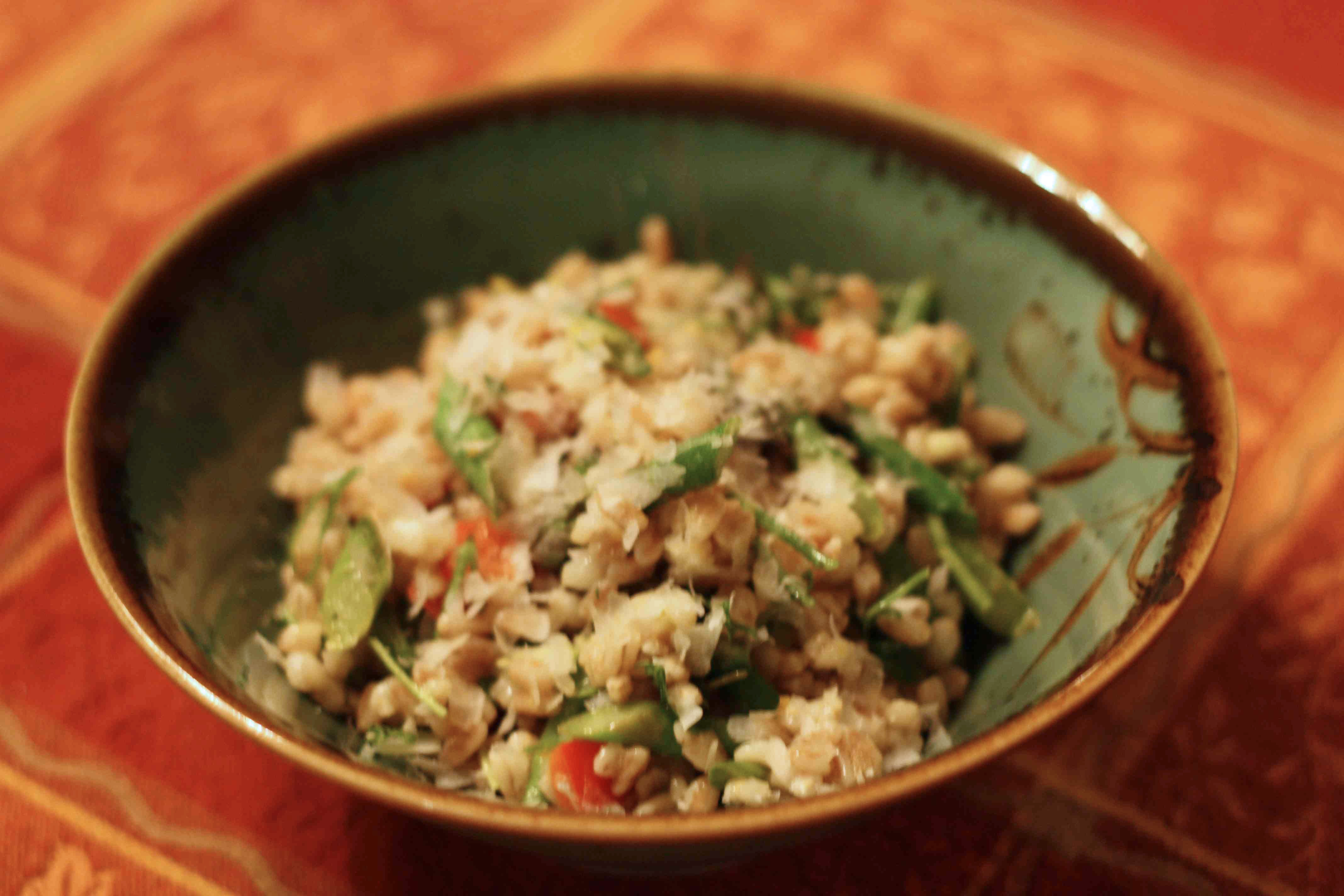
I had an odd grain craving the other night (who ever actually craves grains beyond their grandmother’s kasha varnishkes?) but I didn’t want just any grain dish, or grain salad; I wanted a combination of grains, and I actually gave some consideration to the fact of flavor, texture, and color. Barley would be the base, and to it, I decided I’d add some farro, mainly because I only had about half a cup of it left in my grain cabinet. They cook differently, so I prepared them in two separate pots, simultaneously: the farro, which is a chief staple in La Cucina Povera, was cooked slowly, in a small skillet, with a little bit of oil and the steady addition of water, the way I’d make risotto. The barley was prepared according to Deborah Madison‘s instructions in Vegetarian Cooking for Everyone: 3 cups of water to 1 cup of barley, and boiled, more or less like rice. The result was the most unbarley-like barley that I’ve ever had: the grains swelled up to the size of small pillows, were light, fluffy, and the perfect foil for the farro, which remained toothsome, tender, and nutty. Once the grains cooled to room temperature, I mixed them together and tossed them with lightly sauteed vegetables, parsley, and peels of a delicious sheep’s milk cheese . We could have had them as is, but Susan made a simple vinaigrette, with a few dribbles of fresh Meyer lemon juice.
Almost anything goes where grains are concerned; you easily can add some pork, or some cubed, firm tofu; you can steam or saute spinach and toss them together with the grains, for a mess of a delicious dish. You can add dried fruit and nuts to them, or you can turn them into a gratin by adding some cheese, folding it all into a baking dish, and putting it in the oven. But whatever you do to them, grains may never take the place of mac and cheese, or a bowl of my bubbie’s chicken soup: that said, they’re still some of the cheapest comfort around.
Farro and Barley with Asparagus, Sweet Pepper, and Manchego
Toss it with a vinaigrette, and this kaleidoscope of color, texture, and flavor becomes a salad; add a bit of meat–leftover ham or pork–and it becomes a substantial meal; omit the Manchego, and it becomes vegan. Whatever you do to this colorful bowl of reasonably healthy comfort, it’s satisfying, and a great light dinner or lunch that travels well. This recipe leaves an overage of un-dressed, residual grains; save that in the fridge in an airtight container, to toss with leftover vegetables during the week.
Serves 4
2 tablespoons extra virgin olive oil, divided
1/2 cup farro
4 cups water, separated (3 for the barley)
1 cup pearl barley
salt and pepper, to taste
1/2 pound asparagus, trimmed and sliced into 1 inch lengths
1 shallot, peeled and minced
1 small red bell pepper, cored and chopped
1 small green bell pepper, cored and chopped
1 small yellow bell pepper, cored and chopped
1/4 cup chopped Italian parsley
Manchego, or other sheep’s milk cheese, for grating
1. In a small saute pan set over medium heat, warm one tablespoon of olive oil until it shimmers. Add the farro, and gently toss it, coating all the grains with the oil. Add one cup water one quarter cup at a time, stirring the farro constantly, until the farro is tender but still slightly toothsome.
2. Place the barley in a medium sauce pan set over medium high heat, add the remaining three cups of water, bring to a boil, add salt and pepper to taste, cover, and simmer for approximately 35 minutes, until the barley is tender. Drain the grains in a colander, shaking off any residual water, fluff with fork, and let cool.
3. Meanwhile in a large saute pan set over medium heat, warm the remaining tablespoon of oil until it shimmers. Add the asparagus, and saute until it begins to turn bright green, and then add the shallot. Cook for approximately six minutes, until the asparagus begin to grow tender. Add the peppers, toss well, and saute for another six minutes, until soft.
4. Fold two cups of the grain mixture together in the same pan with the vegetables, and toss to combine well. Add the parsley, fluff the grains with a fork, and spoon into warm bowls. Top each with a shaving of fresh Manchego.