 Some years ago, I was having dinner at a now sadly-closed Alsatian restaurant called L’Acajou, in Manhattan’s Chelsea. It was decidedly un-fancy, and that was part of its charm. The other part was that on a witheringly cold winter’s night, you could go there and order a smoked pig’s knuckle. It was that kind of place.
Anyway, around ten years ago, a few friends from the publishing industry and I decided to go downtown for dinner, and we wound up there. It was damp and cold out, and one of my colleagues, who had spent a long time studying in Belgium, wasted no time in ordering the smoked knuckle. I ordered some sort of very garlicky saucisson, which was served on a bed of sweet and sour red cabbage. Our third friend had a big bowl of moules marinieres. The lady who took our order—she was the owner, and rather stout and stern—seemed very pleased in that way that only French servers can be when you’ve ordered something they heartily approve of. We felt very happy and warm, and a little bit smug.
And then our fourth friend loudly announced
I WANT THE PASTA PRIMAVERA.
The lady shook her head and didn’t even look up from her pad.
Non. You will order something else.
My friend was aghast.
BUT I WANT THE PASTA PRIMAVERA.
The lady glared over her reading glasses, without moving a muscle.
Non. You will not order the pasta primavera, madame.
My friend’s lower lip started quivering, and I could see where this was going.
Then why do you have it on the menu?
The owner put the pad in her pocket and puffed herself up like a Fugu.
It is a leftover from when we first opened, in the 80s. Nobody eats pasta primavera anymore. So please, madame, order something else.
It was like a call to battle.
I will have the pasta primavera. With extra cheese.
The owner looked at the rest of us and winced. We shrugged. Twenty or so minutes later, our dinner arrived: first the moules, then the saucisson, then the knuckle. And then, a shallow bowl of exceedingly flaccid pasta, strewn with exceedingly flaccid vegetables was plunked down in front of my companion, along with a bowl of hastily-grated, unidentifiable cheese.
I assume you will want bread too, madame?
The bread basket followed.
Ever since that night, I haven’t given a moment’s thought to eating, much less making, pasta primavera. An American construct apocryphally invented in the 1970s at Le Cirque by Sirio Maccioni, and served as an “off the menu” dish to diners in the know, pasta primavera is one of the last culinary gasps of a peculiar decade that also gave us the Pet Rock, Plato’s Retreat, the Hustle, triple-weave polyester, and Squeaky Fromme. If you look it up in any traditional Italian cookbook—Marcella Hazan, Giuliano Bugialli, Ada Boni—you won’t find it. It does, however, show up in the Silver Palate Cookbook, which was a virtual bible of 1980s cookery; several remarkable versions of it (including spring pasta with artichokes, mushrooms, and peas, and a lovely pappardelle with spring vegetable ragout) appear in Deborah Madison‘s landmark The Greens Cookbook, which was published in 1987; a version, featuring asparagus and artichokes, also appears in Chez Panisse Pasta, Pizza, and Calzone, which was actually published in 1995, long after the fact of pasta primavera as it had come to be known in America—flavorless and always a little bit dry—disappeared from our gastro-cultural restaurant lexicon. And that makes sense; both The Greens Cookbook (and all of Deborah’s books, in general), and the Chez Panisse books are all about deceptively simple combinations of fresh ingredients yielding remarkable results, and I’m pretty sure that no one culture can claim the miracle of culinary simplicity as their own (although several try).
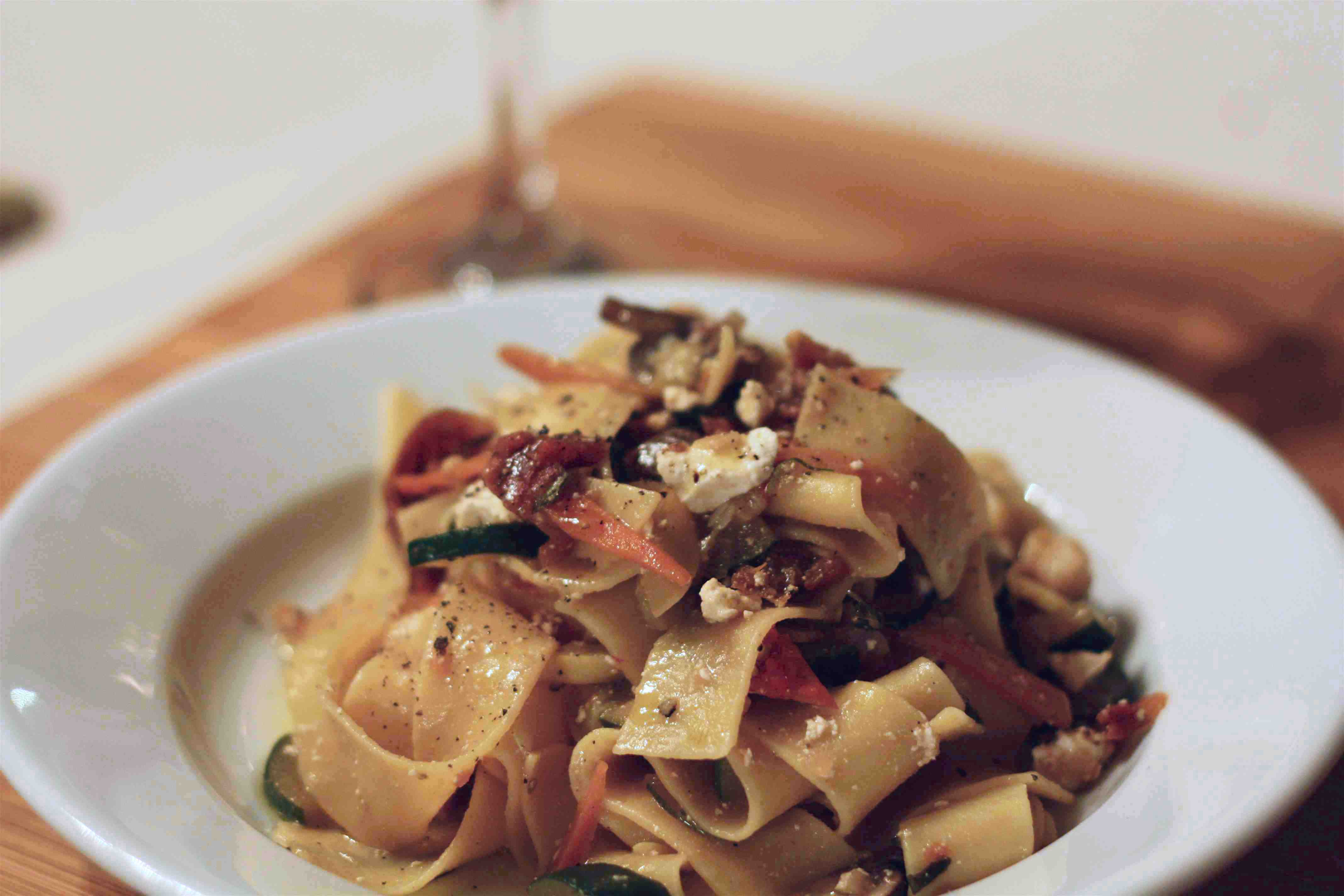
After a long, sad, and drawn out absence of pasta from my life, I suddenly had a wild craving the other night for what could be defined as pasta primavera, and I was actually a little bit embarrassed. It wound up being an enormously parsimonious dish, because I used just what I had on hand: cremini mushrooms, carrots, shallots, zucchini, yellow squash, fresh thyme and basil, some stock, and a small wedge of ricotta salata, which would add an edge of brine to it. I also added a few minced sun-dried tomatoes that I had reconstituted in white wine, which, combined with the stock, was what I cooked the vegetables in. I had a box of angel hair pasta (which was the most often-used in the fabrication of 1970s restaurant pasta primavera), but I loathed it then in this dish, so I assumed I’d loathe it now. Instead, I went with pappardelle.
The result was glorious, light, flavorful, texturally lovely and ribbony (as opposed to gloppy), and cheap as beans. If I was lucky enough to live in a town that had a four season farmer’s market, I would have gotten my vegetables (whatever they might have been) there, and it probably would have been even more delicious. The leftovers went into a frittata, the next day.
I learned a few valuable lessons: first, if you’re craving something, spray cheese not withstanding, you should probably have it, even if it embarrasses you or renders your server peevish (unless they know something you don’t, which they might). Second, the culinary laughingstock of any particular decade can be rendered delicious with a balanced combination of care in assembly, and quality of ingredients.
Pasta Primavera, henceforth known as Pasta with Vegetable Ragout, is back on my menu, and there is not a Bee-Gee in sight.
Pasta with Vegetable Ragout
The key to getting a good result when making this dish is variety of vegetables (which will give you a combination of textures and flavors), freshness, plenty of herbs, the gentle and deliberate cooking of the ragout, and knowing what to add to the saute pan, and when (example: add zucchini early on, and it goes limp). The result is a lovely tangle of texture and taste.
Serves 2
6 ounces pappardelle
1 tablespoon extra virgin olive oil plus more for drizzling
1 large carrot, scraped and thickly julienned
1 shallot, peeled and minced
2 cloves garlic, peeled and minced
1/2 cup sliced cremini mushrooms
1/2 cup chicken or vegetable stock
1/2 tablespoon fresh thyme leaves
1/2 cup sun-dried tomatoes
3/4 cup dry white wine
1 small zucchini, sliced into 1/4″ half-circles
1 small summer squash, sliced into 1/4″ half circles
salt, to taste
4 fresh basil leaves, rolled like a cigar, and minced
ricotta salata
1. Bring a large pot of salted water to a boil, and add the pappardelle. Cook for approximately 8 minutes (it should be al dente), drain, shock with cold water, giving the colander a few good shakes. Set aside.
2. In a large saute pan set over medium heat, warm the olive oil until it shimmers. Add the carrots, and cook for about 3 minutes, until lightly tender. Add the shallot and garlic, reduce the heat to medium low, and continue to cook until they’re almost soft (but don’t take on color).
3. Add the sliced mushrooms and continue to cook, tossing frequently, until the mushrooms begin to release their liquid, about 6 minutes. Drizzle in half the stock, add the thyme leaves, combine well, cook for another 3 minutes, cover, and remove from heat.
4. Bring the wine to a simmer in a small saucepan, add the sun-dried tomatoes, remove from the heat, and let steep for 5 minutes. Strain through a fine mesh sieve set over a small bowl, and reserve the wine. Chop the tomatoes coarsely.
5. Return the saute pan to a low flame, add the zucchini, squash, tomatoes, wine, and the balance of the stock, and toss well. Bring to a low simmer, and add the basil. Cook uncovered until the zucchini is tender, tossing it frequently.
6. Add the pappardelle to the saute pan with the vegetables, to heat through. Transfer to warm, shallow bowls, ladle in some of the broth, top with crumbled ricotta salata, and drizzle with olive oil.



Hi Elissa. Wonderful story as usual. It reminds me though of one of my great menu pet peeves – and you can see it almost anywhere – “Shrimp Scampi.” Drives me insane.
Thanks Kurt. Most diners wouldn’t know what real scampi was or looked like if it bit them in the behind.
I’ve always thought of Pasta Primavera as the vegetarian dish of the 80s
(eggplant parmigiana went to the 70s, the portobello mushroom to the 90s), and it is one of my pet peeves, too. Especially when shows up in January laced with red peppers and tomatoes – hardly primavera. Your pasta with vegetable ragout sounds, well, I wish someone would bring me a bowl!
C’mon over Deborah!
Elissa–love that you used pappardelle. You are right; angel hair pasta is the WRONG noodle for this dish.
p.s. did you know there are only two Bee Gees left? : (
I’ve heard that about the Bee Gees, but it’s 3 if you count Barry Gibb’s hair.
Marvelous post, lovely dish. And if that’s your idea of parsimony, I’d like to know what you consider excess!
Nice recipe, Elissa!
Just wanted to point out one little mistake, though. The book Chez Panisse Pasta, Pizza and Calzone was actually first published in hardcover in 1984. I have a very well-tattered and used first edition of this wonderful book. I think that probably the paperback was first printed in 1995. Keep ’em comin’
I make a Canadian Winter version with diced roasted root vegetables, reconstituted dried porcini mushrooms, the mushroom stock, white wine and fresh sage-pumpkin seed pesto.
Thanks so much for the correction—Appreciated Lyle!