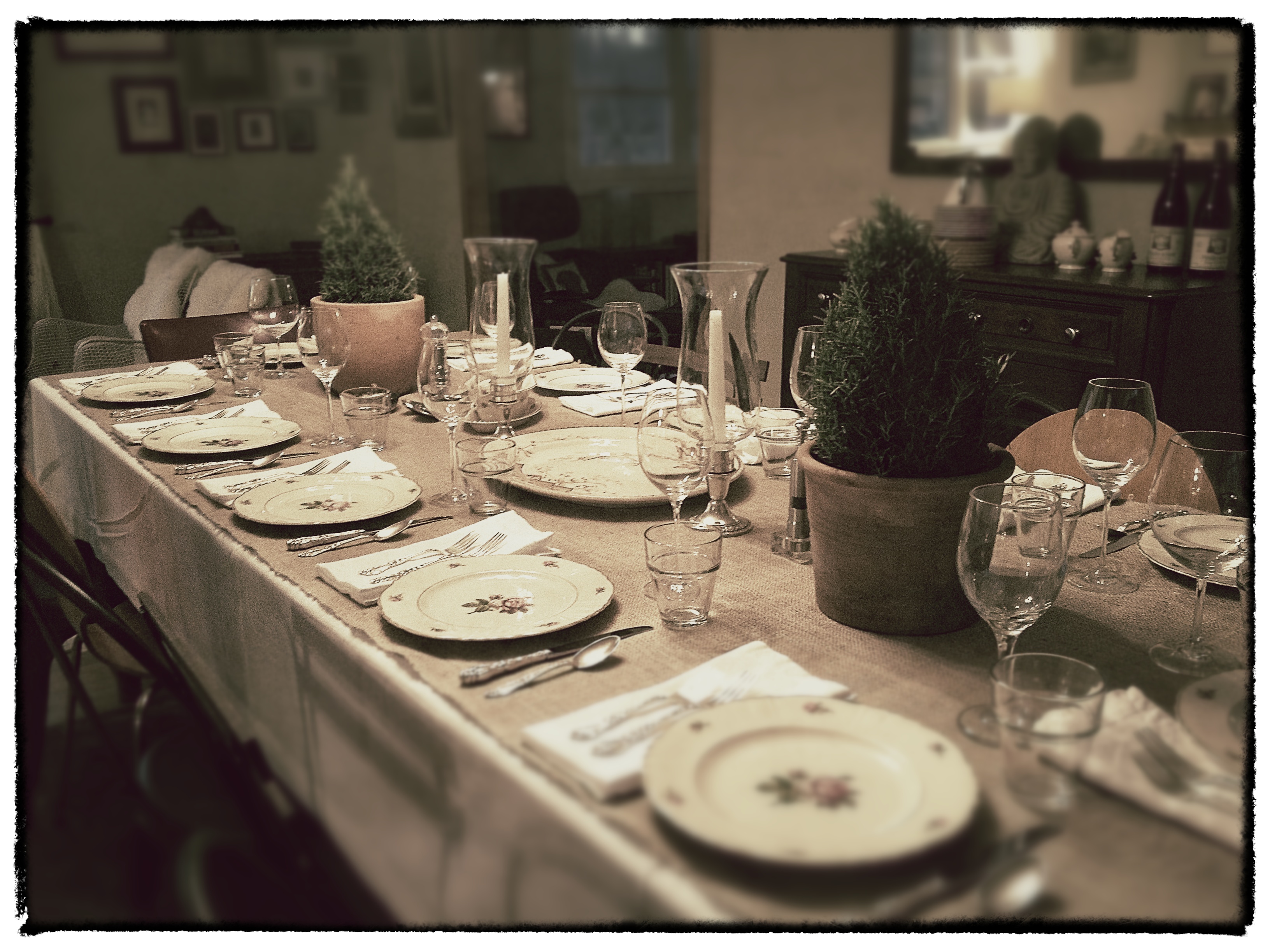
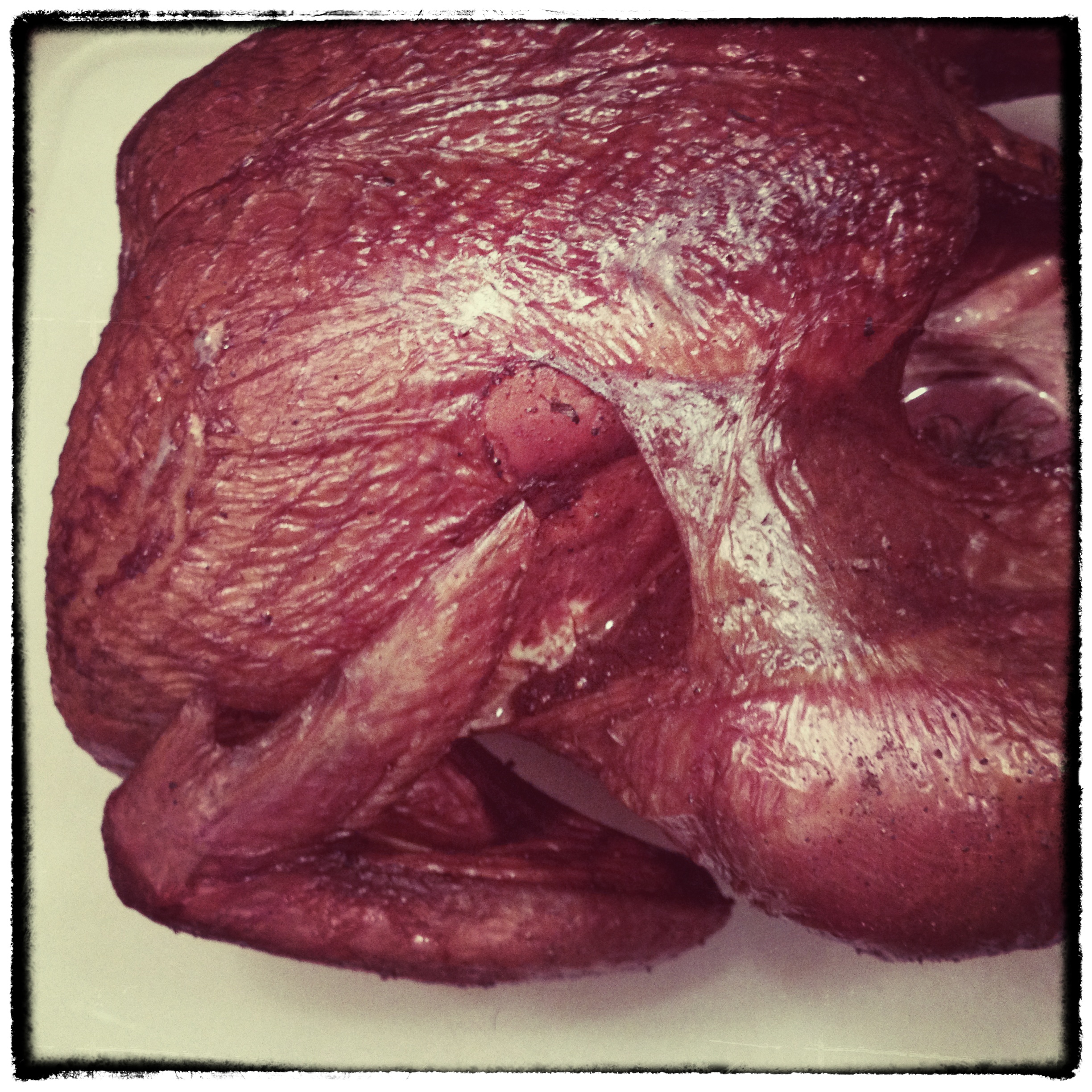
Ten years ago, a few months after my dad died, Susan and I cooked our first holiday dinner for my family, at my cousin’s house in Virginia. It involved a twenty-two pound artisanal turkey that we drove south from Connecticut in the back of my Subaru; it rode in a massive, two-ply food-grade storage bag stretched to its limits like a water balloon, nestled in an ice-packed Coleman cooler the size of a small casket.
The turkey traveled in its brine, which was composed of a misguided melange of water, salt, Grade B maple syrup, short-run Bourbon, and late-harvest Tuscan rosemary clipped from our herb garden. Susan and I made stuffing from slow-rise homemade bread — one kind with fennel pork sausage, one kind with turkey; one with chestnuts, one without (for the nut-intolerants) — and stoneground cornbread dressing for anyone who didn’t approve of the stuffed-inside-the-bird variety. We made two kinds of crackers from scratch — black pepper Parmigiana Reggiano, and garlic thyme — and three kinds of pies. We roasted and pureed poblano peppers for Smoky Butternut Squash Soup and garnished it with fried purple heirloom sage leaves; we decided it would be a lovely and surprising way to start the meal.
My family was surprised all right, especially my hot pepper-loathing aunt, who prefers her food simple and her flavors bland.
Susan and I sniped and snarked at each other that holiday; she was in my way, I was in hers, we were in a kitchen that wasn’t ours, nobody much liked anything we made, and if they did, they didn’t say so. The next day, as if to punctuate the weirdness of the occasion, twelve of us went out for dinner to a small Italian trattoria and arrived five minutes after the chef cut his hand off with a meat saw.
The holiday, start to finish, was an unmitigated disaster.
Susan and I had done everything we could to make a dinner we were sure everyone would love, and that would go down in the annals of family holiday history as one of the best, ever. We demanded, yearned, ached for everyone’s approval. But in truth, we weren’t cooking for them. We were cooking for us, and that was something that we just never took into account.
For one thing, nobody much wanted roasted poblanos in their butternut squash soup; they didn’t want butternut squash soup at all. They wanted my aunt’s traditional mushroom and barley soup, preferably made by my aunt, who had been serving it at Thanksgiving for half a century. Nobody wanted homemade crackers — who the hell makes homemade crackers? — and no one particularly cared whether or not the bird was of fine pedigree and had schlepped south from New England in the back of my Forester or had come with its own plastic pop-up thermometer, straight from the local Safeway. No one commented on the fancy French chestnuts in the heritage cornbread dressing, and the only words muttered during the flamingly-spicy soup course came from my father’s sister, who said, as she coughed and dolefully dabbed at her running mascara, I can’t eat this.
Thank God––everyone gasped, taking their cue from the family matriarch and dropping their spoons. There was the simultaneous clatter of soup-silver-against-family-china: Susan and I got up and carried a stack of overflowing, gold-rimmed Lenox bowls dripping with thin, incendiary mush into the kitchen, where they were deposited in the sink, washed, and dried before the salad was tossed and the turkey carved.
This was the first year that things were different — my father was gone, his longtime girlfriend decided to celebrate with her own children, my aunt was no longer making the holiday meal on Long Island and ringing her tiny kitchen cowbell to call her passel of buckaroos to the table — and so Susan and I went over the top to prepare a meal that I was certain would jettison us into position as the new keepers of the family culinary flame. This meal, we believed, would just be a lure, to let everyone know what they could all expect in the future: we were certain that it would be our table everyone would come to for the next forty years. We would make our own traditions, like my aunt and her cowbells had. And so that first holiday after my father died, we were determined to feed everyone a family dinner that was unforgettable and extraordinary.
And it was. Just not in a good way.
In my family, women make the leap over the transom from child to adult with the creation and serving of their first big holiday dinner. Likewise, the first time we get up to help the other adult women in the family clear the dishes — I was fifteen and no one asked me or gave me a signal; it was just my time and I knew it — is a little bit like hitting puberty: you’re on your way to becoming a full-fledged member of the tribe, and everyone around you knows it. So cooking for my father’s family for the first time just two months after his death was fraught with need and hunger and expectation: I wanted him back, to hear his laughter at the table, to feel his delight at seeing me finally as the adult woman that cooking for twenty heralds. I wanted him to look down from the heavens, and to be bursting with pride at the fact that I, the youngest of my generation, was providing sustenance for the people he loved. He would have thrilled at the fact that I’d made his family’s most important meal and the one that always brought us together around the table every holiday season.
Cooking this meal was my way of keeping him alive. The only problem was, he wasn’t.
When the shape of a family begins to shift and tilt — when there are fewer older people left and the younger ones begin to jockey into position to make their culinary mark on things — it’s very easy to get caught in a scrum of desire, assumption, and emotional desperation; the presumption is that you will pick up the historical cooking mantle like a baton passed from one generation to the next. You’ll get mired in making plans to wow and thrill, and you’ll never quite realize that these people you’re so set on wowing and thrilling may actually have other plans. They may not want change at all; odds are, they probably don’t. They likely just want what they know and what they love. Oh, and that baton? It may never actually have been handed off to you after all. You and your raging kitchen ego just assumed it was.
Years ago, in an attempt to get her very young son to eat fish for the first time, one of my beloved cousins tried to pass it off as chicken, which she knew he liked. As he folded his arms, pursed his lips, stamped his feet and shook his head NO, his mother turned to the powers of logic.
This, she said, is a sort of chicken that we call fish.
Her child was unmoved; he knew better. He wanted what he wanted, not what she wanted to give him, regardless of how many times she told him it was the same thing. A chicken is not a fish; the only thing that’s the same about them is that they both can be dinner. Smoky poblano butternut squash soup is not your family’s favorite mushroom and barley soup; the only thing that’s the same about them is that they’re both eaten with a spoon.
Things may appear to be the same, but really, they’re not.
Ten years ago, with my father’s place at the table empty, I made my first holiday dinner for my family, certain that it would render me an adult in their eyes, and certain that it would bring my father back. Susan and I cooked a meal laden with overwrought dishes that had no place on their holiday table; desperate for my family’s approval and acknowledgement as head chef, I received neither. It wasn’t my time or my place.
When the holiday was over, Susan and I drove the seven hours home, took our coats off, and cooked what would soothe our souls: custardy scrambled eggs made in a double boiler, toast, and well-done bacon, just the way my father liked it.
We ate breakfast-as-dinner in the quiet of our home, and began to plan for Christmas.




Oh, I love this post, on so many levels. It takes a mature cook (and writer) to admit to the foibles of wanting to please, impress, do it “your way” instead of a employing empathy. Although empathy can have its culinary downside too.
Thanks Christine-
Lovely post, and resonating for me from both sides. I’ve done it and been done in by it.
Beautiful as always. You have such a knack for plucking my heart strings, writing the emotions that I feel, and still put a smile on my face. Thank you for your gift.
Thank you Katie-
How this resonates – the unconscious drive to make it all more special, grander, more memorable – to offset a level of sorrow that is immeasurable. The transition to adulthood that is defined by who helps clear the table and brings out the soup. The need to provide comfort first and foremost where the need is greatest – to one’s own heart.
I loved this post. Every year I struggle with wanting to impress the in-laws and I always fail. I get the standard remarks not matter if it’s heritage and homemade, or grocery store fare. Some years I give in and buy the cheapest bird and use boxed stuffing. Then, I rise back up and try something new the next year, because I can’t help myself. This year, I offered up what they like, and tried to make it the best result possible. Next year, who knows? Thanks for the great post!
I wish I could have eaten that lovely meal…can you give out the recipe for the crackers?
Now you’ve gone and made me cry. In a good way.
Sorry Brenda….
Such lovely words and so true…thank you
Hey… as I recall it, that “chicken” ploy worked.
While my sister and I have yet to take on the responsibility of Thanksgiving dinner solely on our shoulders, the day is coming.
“When the shape of a family begins to shift and tilt — when there are fewer older people left and the younger ones begin to jockey into position to make their culinary mark on things — it’s very easy to get caught in a scrum of desire, assumption, and emotional desperation; the presumption is that you will pick up the historical cooking mantle like a baton passed from one generation to the next. ”
I relate to this post in so many ways, it’s not even funny. Thanksgiving this year represented a wind change in our family and I felt a little chill in the weeks leading up to dinner, though dinner itself was very nice…different, but nice.
~Nancy
PS My sister used to tell my nephew everything was french fries, in order to get him to eat something that wasn’t french fries. It worked until it didn’t. 🙂
LOVE it, Nina!
Echoing what several others said – just a lovely, nostalgic, melancholy ode to marking passage via holiday meals. Makes me think of my mom, who’s long gone, no longer around to ask culinary questions of…
This resonated so strongly with me! I’ve done similar things in the past and my latest ‘learning curve’ has been to hand over the reins to the next generation. That is very hard.
This past Thanksgiving it struck me that I was trying too hard — to keep family together when they really have other plans; to serve food that I thought would wow – it did but only to me; to pretend that time has not changed a thing and the holidays would always be like when Grandma was alive. I’m still blue and your words managed to say what I could not. Thank you.
This is beautifully written and resonates so strongly for me, taking me back to my younger self when I too stepped up to be the family holiday cook for varying reasons on each side. One of those bittersweet life passages that doesn’t always go as we envision no matter the intent and the effort. I love the way you write about how food and family are intertwined, not always in simple and joy-filled ways but always in powerful ones.
Dear Elissa,
Thank you for your wonderful post. It was so insightful – comforting and amusing.I love your posts. Thank you.
Yes, a super read, and oh I can picture the emotions on both your side and the family you so intently fed. Wonderful post!
AGAIN, I love your writing, this story and did it ever hit home. You do that for me almost every time. Thanks.
{ 1 trackback }